October 17, 2026

Instruction

left arm straight 1

Let’s discuss a big golf myth: Keep your left arm straight (or right arm for lefties).

It’s one of Five Old Wives Tales in Golf.

  1. Keep your head down
  2. Keep your left arm straight (front arm)
  3. Shift your weight/turn your shoulders
  4. Hit the ball
  5. Follow through

I don’t believe you should try to bend your elbow, but I do not want you to try to lock it either.

left arm straight 1

The mission of golf is to start the face square, sitting behind the ball (Photo 1), swing the club to the top of the backswing, and return the club back to the bottom of the arc as close as possible to where it started. If you do that, the ball will go straight.

When you swing the club to the top of the backswing, the club head will always travel farther than your hands due to its length. If your front arm is straight and you try to get the club back to the bottom of the arc, the face will be way behind your front arm. As you can see from Photo 2, the hands will get back to the ball first because your arm is pulling. If you do this, the face will be WAY behind the grip. The face is pointing WAY right. That is where the ball will go. 

left arm straight 2

I suggest you allow your front arm to hang straight. Relaxed. Like a piece of cooked spaghetti.  If you do this, you will allow your arms to swing the clubhead, and will feel the weight of the club head in your hands. The head of the club is like a pendant on the end of a chain. You need to allow it to swing. If you do, and keep your body still, the face will always come back to the bottom of the arc and square up. If the face is square, the ball will go straight.

Cindy Miller, LPGA, teaches at several clubs and golf centers in western New York. Visit her at www.cindymillerinc.com


shaft rotation 1

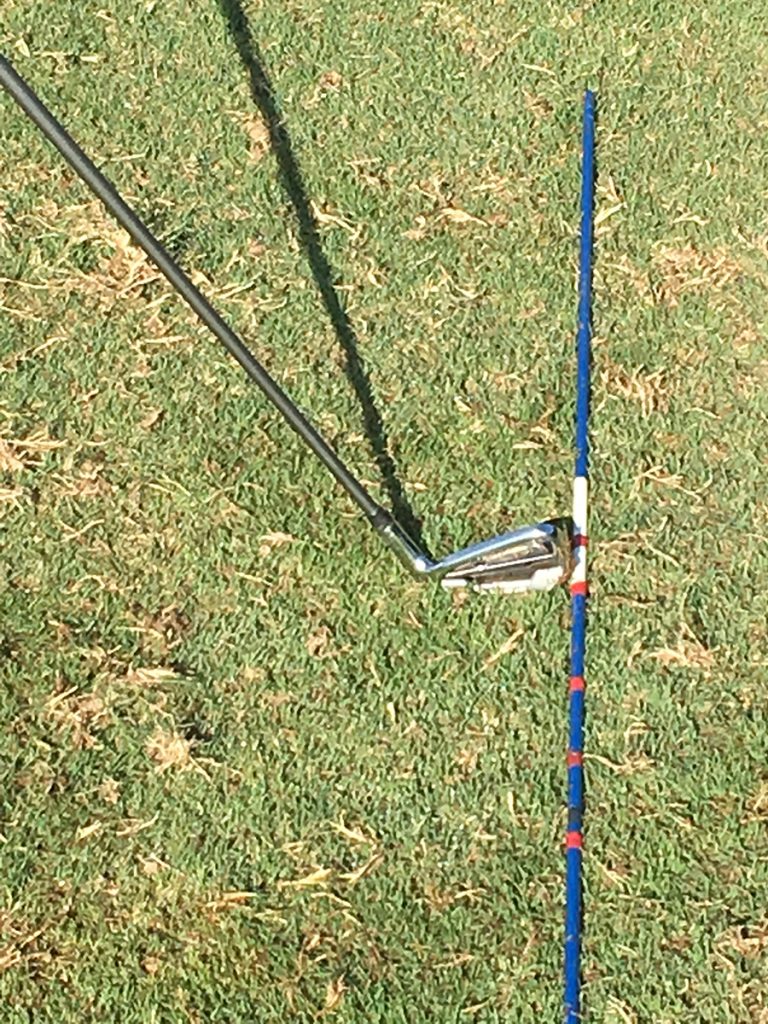
shaft rotation 1The legendary Mike Austin, whose 515-yard drive was the longest in competitive golf history, had a unique but very effective way to describe a square clubface, which he demonstrated to me in his front lawn many years ago. It had to do with shaft rotation.

We went to the edge of his driveway which he used as the target line (I instead us an alignment stick in the photos here). Then he set the club so that the toe of the club was at the edge of the target line, as I’m doing in Photo 1 at right. Then he said “the clubhead is closer to the target line than the shaft, right?” I agreed.

The key, he said, is that it should remain closer to the target line than the shaft throughout the swing. When this happens there is an absolute minimum of shaft rotation on the way back and on the way through, as I’m demonstrating in Photos 2-4 below. And when shaft rotation is reduced, accuracy increases in a big way.

Remember this simple drill the next time you hit the practice tee.

shaft rotation 2-4

Georgia-based John Marshall, PGA, is just one of just five Golf Channel Swing Fix instructors selected to teach at the Tour Championship. He is a two-time American Long Drivers Association super senior national champion and five-time RE/MAX World Long Drive finalist.

golf swing power oosty backswing

Most golfers are aware that swinging the club on the proper plane is important. When the plane is correct, especially on the downswing, the club head approaches the ball from slightly inside the target line, which leads to more golf swing power and potentially more accuracy as well.

Here is an effective way to control your plane: control the position of your left elbow (for right handers). Most everyone knows that Jim Furyk’s shaft is virtually vertical in the backswing. That’s because his left elbow is pointed at his toe line. During his downswing the shaft plane flattens because his left elbow is now pointed at the ball target line.

To simplify your swing (don’t we all want to do that?) get the left elbow pointing at the target line during your takeaway until your left arm is parallel to the ground halfway back, like Louis Oosthuizen is doing in the photo above. On the through swing have the right elbow aimed at the target line until the right arm is parallel to the ground, like he’s doing in the photo below.

golf swing power oosty downswing

Before you know it, you’ll be striping it down the middle well past your buddies.

Georgia-based John Marshall, PGA, is just one of just five Golf Channel Swing Fix instructors selected to teach at the Tour Championship. He is a two-time American Long Drivers Association super senior national champion and five-time RE/MAX World Long Drive finalist.

Photos: perfectgolfswingreview.net
keep your head down vangellow
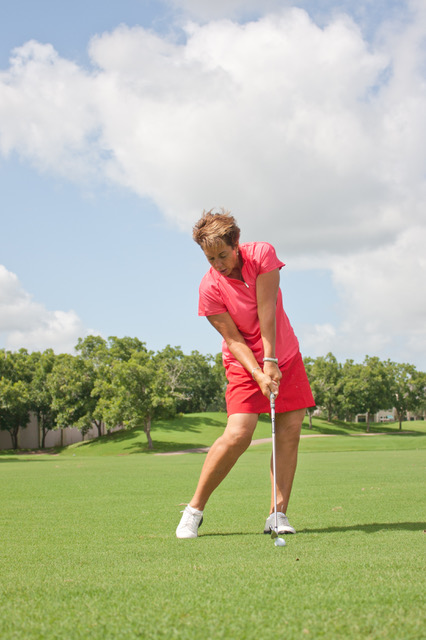
Deb Vangellow at impact.

Fall is right around the corner. The kids are heading back to school and the weather here in the state of Texas will be perfect…for golf! So many folks can now commit to learn to play golf — the wonderful game we all love.

If you are new to golf and are starting with golf instruction, do consider the “Success Progression.”

What is the Success Progression? Simply, this is acquisition of skill for transfer to play, working from the putting green back to the tee.

This is simply the best, most logical way to begin to learn the skills from the smallest swing (putter) working towards the biggest swing (driver). This progression ensures a clear understanding of the skill areas in a chronological fashion, where the order of movement slowly gets introduced and each new skill area builds on the one before.

I like to call this growing the size of the swing or working from grace to power—short game and then long game. This seems to work for most new golfers and the success you will feel from the start will give you a boost of confidence for sure. You will be playing on the golf course in no time.

Consider these key points for your learning sessions in the Success Progression.

short game landing spots

I love short game situations. There are so many choices and not a lot of “rights versus wrongs” — it can be the best display of creativity.

But sometimes we all “mix the fundamentals” of one shot with another, and the short game shot we were hoping to gracefully see head toward the cup ends up either zinging across the green or landing well short because we “chunked” it.

Here’s some help.

Let’s chat about three common shots: The Pitch/Lob, the Pitch and Run, and the Chip.

To help separate how you might set up for each shot, we’ll start with your likely intention.

Once you know what you want to do to approach the cup from around the green, depending on where you are and what you might have to go up, over, or through, we’ll make sure you have a checklist of sorts to help you create the shot. Half the battle is committing to the type of shot (how much height/how much run out).

This alone leads to a higher chance of success when your goal is to get up and down from off or near the green.

I like to envision aircraft approaching the green.

If you can imagine a helicopter landing on a helipad, on a crowded city building rooftop, you will think of this coming in from high and settling calmly on top of the building. This is a great “picture” for a pitch/lob shot, as in Photo 1…it is like an underhand pitch in softball, too. Think maximum time in the air, minimum time on the ground.

Next, almost the polar opposite of the pitch/lob shot is the chip shot. For this shot, see if you can imagine (from the fringe around the green) a large 747 airplane touching down on the runway and taxiing out after landing, to eventually slow at the end of the runway before turning around to park at the terminal gate. This large plane comes in low and still has speed upon touchdown before slowing (Photo 2) … the end of the runway is the cup! Think minimum time in the air, maximum time on the ground.

In essence, you can also see it as two targets of sorts: the touchdown point and the eventual stopping point, which is the cup.

Depending how much green you have to work with, you can potentially use the same simple stroke and just change the golf club based on some carry and roll info. Every club has a carry and roll ratio in a chipping situation; knowing in general what these are can help you commit to the club you believe in before you create the shot. Again, half the battle.

Finally, if you are off the green with more than wide fringe in front of you, you might imagine a corporate plane coming into a private airport (Photo 3). That plane won’t need as much runway upon landing…it can touch down and taxi to slow, then to stop, in a shorter distance. The touchdown point of this plane is the pitch (kind of a medium height shot) and the smooth-to-slowing taxi part is the run for the pitch and run shot.

Lob, sand, pitch, and gap wedges are generally good club selections for this shot. The pitch and run can be an excellent percentage shot (versus the high pitch) because you can take less swing and less can happen that might be unfavorable. I like to refer to this as the “in-betweener” shot: not quite as high as a pitch/lob and not quite as low as a chip shot.

Here are some considerations for these three short game situations:

Pitch/Lob

  • Ball in middle or forward of center, depending on height and distance desired
  • Hinge elbow and wrist to form a letter “L” on both sides of the body. The shape of the swing may appear to be a steeper vertical “V”
  • Shift and turn to finish facing left the target
  • Smooth rhythm/timing/tempo/balance for finesse using a gravity drop feeling

Pitch and Run

  • Ball in middle or back of center, depend-ing on touchdown point on green and amount of green you have to work with
  • Move your hands down the grip end of the club halfway to shorten the club for control
  • Slight hinge of elbow and wrist to have the shape of the letter “U.” Waist-high to waist-high matching swing sides.
  • Quieter shift and turn to finish with body facing slightly left of target and club at target
  • Smooth rhythm/timing/tempo/balance for tension free touch and small swing-ing motion

Chip

  • This is a putt with a flying start…kids love to call this a “PuttChip.”
  • Steady body with a confident arms/hands swing with minimal wrist hinge to prevent too much backspin
  • Ball slightly right of center/handle end of the club has slight lean forward to help keep trajectory low
  • Move your hands down the grip end of the club to shorten the club like a putter
  • Clubhead does not get higher than your knees on both sides of the swing/stroke.
  • Don’t be afraid of a small assertive
  • “Pop” at the ball/bottom of swing to help the ball touch down before it starts to taxi to the hole

Some ratios to consider for chipping in a carry-to-roll picture: 9 iron is 1:3 (ball touches down at your carry of “1” and rolls out 3 more), 8 iron is 1:4, 7 iron is 1:5, and so forth. If a pitching wedge were still numbered in the set, it would be marked as a 10 iron and the sand wedge would be an 11 iron: 1:2 and 1:1 carry and roll ratios, respectively. The ratios can give you a good starting point before looking at other things (slope, the wind, green speed, etc.).

I hope these images help you create these three shots with ease. Your score will be significantly improved if you can pull these shots off with grace and touch. Think of each of these shots as your first putt — if you get good with these, you will two-putt more often.

LPGA Master Professional Deb Vangellow teaches at Riverbend Country Club in Houston, Texas. She is the 2012 LPGA National Teacher Of The Year, an LPGA and Golf Digest Woman “Top 50” Teacher, a Golf Digest and GOLF Magazine “Top Regional Teacher,” a US KIDS GOLF “Top 50 Master Kids Teacher” and a GRAA “Top 50 Growth Of The Game Professional.”

Photo 1: HeliHead/Shutterstock. Photo 2: Rebius/Shutterstock. Photo 3: Alexey Repka/Shutterstock
driver distance 1

driver distance 1Creating driver distance is all about a wide, even arc, and generating as much clubhead speed as you can.

It doesn’t matter if you’re at sea level, or at high altitude, as I am here on the first tee of Tom Weiskopf’s beautiful Spanish Peaks Mountain Club in Big Sky, Montana. You’ll hit longer drives if you get these key fundamentals right.

What I like to do is start my swing from my core. While keeping my arms long and wide, I generate clubbed speed by rotating my core and shoulders back and through, as I’m doing in the photo at right.

Timing is everything. If you can’t come back to contact straight and with a square club face, you better start over.

As I’m doing in the photos below, Stay Wide, Watch Impact, and Keep Your Balance.

Kali Quick, PGA, is Director of Golf at Spanish Peaks Mountain Club in Big Sky, Montana

driver distance sequence


play better golf opener

play better golf openerAre you one of those golfers who absolutely pures it on the practice range with every club in the bag, but eventually goes into the tank during the course of play? It’s an unfortunate scenario experienced by a vast majority of golfers, most often caused by too little time dedicated to practice or too long a time period between rounds, so I hope the following 44 ways to play better golf truly help.

For most golfers, the onset of trouble starts on the very first tee, where high anxiety invariably sends the tee shot deep into the woods.

For others, the tanking occurs gradually as the round unfolds–a loose swing here, a twitched putt there and poor shot selection in between–until, around the 14th hole, you say to yourself, I guess it’s not my day. The worst of it is, you’re right–it isn’t your day.

However, there are methods to protect your game from suffering a complete collapse on the course. To play your best golf, you need an arsenal of skills and strategies to insulate your game when the heat is on.

This feature presents a catalogue of specific golf advice, ranging from mental thoughts and images to easy-to-accomplish swing changes that guarantee better performance during your round.

Among the top 50 are quick and easy tips to harness more speed from your swing (Power section), reduce grossly off-line shots (Accuracy), create better scoring opportunities (Strategy), get up and down every time (Short Game), keep round-wrecking scores to a minimum (Safe vs. Sane) and, most important, prevent the wheels from coming completely off during the course of play (Damage Control).

I call this collection of advice the Top 44–you’ll call them lifesavers. Use them wisely and enjoy great results even when your A game turns into a C or worse.

pga jr. league high five

Twelve facilities have been named host sites of the 2019 PGA Jr. League Regionals presented by National Car Rental, which will take place throughout September. 

At each of these competitions, four co-ed All-Star teams of junior golfers ages 13 and under (48 in total) will compete to earn one of 12 spots in the 2019 PGA Jr. League Championship presented by National Car Rental, held Oct. 11-14, at Grayhawk Golf Club in Scottsdale, Arizona.

“From first-hand experience as a PGA Jr. League Coach, the fun and competitive team atmosphere of the PGA Jr. League Postseason presented by National Car Rental is so exciting to watch,” said PGA President Suzy Whaley, PGA/LPGA. “To host the Regional competitions at 12 PGA facilities only adds to the unique experience. PGA Jr. League is an outlet for girls and boys to learn and enjoy a lifetime sport, and we’re proud of the PGA and LPGA Professionals who are leading the charge.”

2019 Regional Competition Host Sites

Region 1: Cranberry Valley Golf Course – Harwich, Massachusetts (Sept. 14-15, 2019)
Host PGA Professional: Roman Greer, PGA Director of Golf

Region 2: Seaview Golf Club – Galloway, New Jersey (Sept. 14-15, 2019)
Host PGA Professional: Alex McGann, PGA Director of Golf

Region 3: Springfield Golf & Country Club – Springfield, Virginia (Sept. 21-22, 2019)
Host PGA Professional: Josh Tremblay, PGA Director of Golf

Region 4: PGA National Golf Club – Palm Beach Gardens, Florida (Sept. 7-8)
Host PGA Professional: Jane Broderick, PGA Director of Golf

Region 5: Nemacolin Woodlands Resort – Farmington, Pennsylvania (Sept. 14-15)
Host PGA Professional: Eric Johnson, PGA Director of Instruction

Region 6: Olive Branch Country Club – Olive Branch, Mississippi (Sept. 21-22)
Host PGA Professional: Daniel Yeargin, Head PGA Professional

Region 7: White Hawk Country Club – Crown Point, Indiana (Sept. 14-15)
Host PGA Professional: Duane Borcherding, Head PGA Professional

Region 8: Glen Oaks Country Club – West Des Moines, Iowa (Sept. 14-15)
Host PGA Professional: Steve Watt, PGA Director of Golf

Region 9: Lodge of Four Seasons – Lake Ozark, Missouri (Sept. 14-15)
Host PGA Professional: Dan Hilker, PGA Director of Golf

Region 10: The Club at Las Campanas – Santa Fe, New Mexico (Sept. 7-8)
Host PGA Professional: Brad Lardon, PGA Director of Golf

Region 11: Gold Mountain Golf Club – Bremerton, Washington (Sept. 14-15)
Host PGA Professional: Daryl Matheny, PGA General Manager

Region 12: Boulder Creek Golf Club – Boulder City, Nevada (Sept. 14-15)
Host PGA Professional: Andrew Schaper, PGA Director of Golf Operations

Click here for a Regional map color-coded by participating Sections in each event.

PGA Jr. League brings boys and girls together to learn and play golf on co-ed teams with expert coaching from PGA and LPGA Professionals. Kids wear numbered jerseys and play on teams with friends, competing in a two-person scramble format that builds confidence and encourages sportsmanship. 

Following the Spring/Summer Season, 10-player All-Star teams are formed from a combination of players in each league. These teams move through Section Championships in August to earn a spot at one of 12 Regionals held across the country in September. Twelve Regional champions advance to the PGA Jr. League Championship presented by National Car Rental, which has been held at Grayhawk Golf Club since 2016, and will stay through 2022.

While the focus of PGA Jr. League is primarily on the developmental nature of its Spring/Summer and Fall Recreational Seasons, the PGA Jr. League Postseason presented by National Car Rental presents competitive golfers a fun and aspirational finish to Spring/Summer Season play.

PGA Jr. League is the flagship youth pillar program of the PGA of America’s 501 (c)(3) foundation, PGA REACH, with the goal of making the program accessible to all interested kids in the United States and around the world.

PGAJrLeague.com

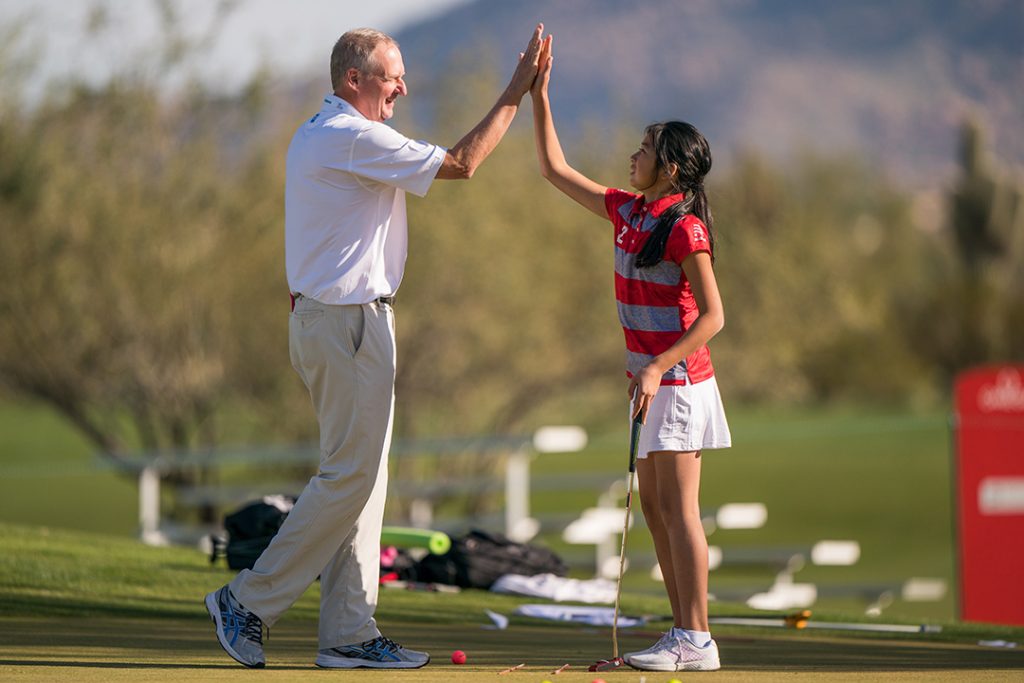
Photo above: Captain Kevin Weeks (l) and Allyson Duan (r) of Team illinois during a Practice Round for the 2018 PGA Jr. League Championship presented by National Car Rental held at Greyhawk Golf Club in Scottsdale, Arizona on November 16, 2018. (Photo by Darren Carroll/PGA of America)
golf-injury-infographics-small.jpg

golf warm-up routine infographicIt’s a fact: Golfers play better when they put in the time to not only train, but also use a compete warm-up routine.

For instance, a typical professional golfer may stretch for 10 to 15 minutes (the top-tier players, even longer) and then practice their putting stance for an additional 15 minutes. They may then spend an additional half-hour working on their ball striking and end their warm-up with 20 minutes of pitching, chipping, and hitting sand shots.
Some may even extend their warm-up with an extra five minutes or so of putting exercises before finally making their way to the tee.

The aforementioned warm-up routine may be very different from an amateur golfer’s warm-up routine, which may involve simply parking their car, walking to the course, swinging their club a few times for “practice” and then heading to the tee.

Let’s look at daily warm-up routines for amateur golfers that can make them feel like a pro when it’s time to tee off.

Dynamic Stretching

You do not need to necessarily practice on the links like professional golfers often do. However, if you are only able to get on the golf course once a month then it is highly recommended that you maximize your playing time by following the proper warm-up routine.

For instance, a quick and easy way to get warmed up is to practice dynamic stretching exercises on a continuous basis.

Dynamic stretching actually triggers your neuromuscular skeletal system so that it becomes more alert for your swing: This is in stark contrast to simple static stretching, which is far less effective.

Below you’ll find some dynamic moves that you can perform as part of your warm-up routine before you actually tee-off. You should hold each stretch for about four to eight seconds, which equates to roughly two to four pronounced breaths.

Pelvic Tilts While Standing

To perform standing pelvic tilts, cross your arms over your chest. Take your address stance and tuck your pelvis below so that a posterior tilt is formed. Arch your back to form an anterior tilt, then revert to a neutral spinal stance. Repeat this warm-up exercise five times (in each direction) to achieve optimal results.

Rotational Speed Trunks

Take your address stance as you would with the standard pelvic tilt exercise and bring the palms of your hands together. Inhale as you rotate from the core and bring your right arm back. Exhale as you bring your hands back together as if you were clapping.

Repeat this routine at least 10 times in each direction.

After a brief break, return back to your starting stance and extend both your arms directly in front of you, then rotate both arms from your core. Also repeat at least 10 times.

Standing Hip Stretch

For this warm-up routine, set both your hands on either a golf club or a sturdy chair to help keep you in balance. You can try to perform the warm-up without a golf club or chair, but it is best to play it safe. 

Place your right ankle on the exterior of your left knee. Inhale as you bend your left knee, so it looks as if you are actually sitting on a chair. Then, proceed to bring your chest towards your shin so that your shoulder blades are rolled in unison. Hold the stance for 3 full breaths and repeat at least five times. Switch sides and repeat the process.

Club Behind Back Shoulder Stretch

For this warm-up, you will need either a towel or a club. To begin, your right palm should face toward the ceiling; place either a towel or a club in your right hand. Then bring your arm overhead while keeping your palm behind you. Bring your left arm behind you to grab the towel or your golf club. 

Inhale gently as you slowly pull on your club or towel before exhaling and legging go of the item. Repeat five times before switching to the other side for five reps.

Neck Stretch

Tilt your head so your right ear moves toward your right shoulder. Inhale as your left arm is pressed towards the ground, followed by an exhale and relaxing of your arm. Repeat part 1 of the warm-up at least five times, but do so very slowly to reduce the risk of neck strain or sprain. In other words, you should slowly return your neck and head to a neutral stance and then switch sides to finish off the warm-up.

Oakville Chiropractic

If you need some help in creating the perfect warm-up routine in order to enhance your golfing performance as well as significantly reduce the risk of serious injuries, then we can help. At Oakville Chiropractic we specialize in health and wellness programs and treatments that are custom-tailored in order to help our patients maximize their strength, flexibility, and range of motion, while also reducing the risk of injuries. 

We specialize in chiropractic as well as massage therapy modalities, and you can learn more about our full range of safe, effective, and homeopathic treatments by either visiting our website or by giving us a call at (289) 724-0917.

Source:
https://www.menshealth.com/fitness/a19541112/golf-warm-up/
https://www.oakvillechiropractic.com/how-to-avoid-getting-injured-while-golfing/
Editor’s Note: This is Sponsored Content
practice to play golf forever opener

practice to play golf forever openerOne of the biggest things that all of us feel as we get older (I’m 48!) are the random aches and pains after spending too much time on the practice tee or working on short game. We need to learn to practice to play golf as long as we can. Hopefully forever.



Let’s face it, swinging hard and/or bending over for too long can play havoc on your whole system. Take Tiger, for example: in his comeback leading up to his Masters win he repeatedly told us he could no longer stand on the tee or on the practice green practicing like he used to, due to the issues with his back. Thus he had to practice SMARTER, not HARDER, as he had in the past. At his age and with his physical condition he cannot outwork his peers like he once did, so Tiger, like us all, has now been relegated to practicing in a more efficient way to get better.

If you are standing on the lesson tee without a plan you are wasting the shots you have in your system for that day. Sometimes you have 500 shots in your body, while other times you might only have 200 — use them wisely or feel the effects later. This is a fact!

0
0
Your Cart
Your cart is emptyReturn to Shop