October 17, 2026

Instruction

play golf forever top 25

Let’s talk about every serious player’s goal: To play golf forever.

No matter what age you are at this moment or where you are on the golf accomplishment spectrum — rank beginner to grizzled multi-decade vet — you can avoid the “autumn golf” phase of life for as long as you’d like. You can put off any thoughts of giving up the game because of limitations, physical or mental or social, real or perceived.

Golf is indeed a Game of Forever if you follow a few simple, tried and true tips from our Top 25 Instructors. They know a thing or two about how the stages of life affect everything from distance off the tee to putting prowess, and even more about how to roll with the aging punches. They can get you from here to there, or just keep you where you are: Loving every moment of the game, shot to shot and round to round and friend to friend.

Read on for your roadmap to golf longevity, then check out Tom Stickney’s plan for lasting and pain-free practice.

golf milestones 3 break 100

We’re getting into fall and cooler temps are the norm. It’s time you start ramping up your efforts to reach or surpass your Golf Milestones before the season catches up with you.

golf milestones 3 break 100

BREAKING 100

Chip Shots are Your Savior

If you haven’t learned by now, it’s time you do. Chances are no matter how bad the lie or condition you’re in during a round, you’ve probably used a chip shot or a variation of a chip shot to escape the trouble and limit the damage you’re in. If you’ve been effective, a couple big numbers may have fallen off your score card.

Chip shots are just not for around the green. They can be used anywhere, with any club, to minimize the trouble you’re in and significantly reduce the chances of making a bigger number trying to create a “hero” shot you’re not capable of producing yet. Whether in a leafy area of trees, to just off the green, to being in a bunker too far away from the green, understanding how to choose a club and set up as if you are going to chip or “bump and run” the shot to escape your trouble is a great way to eliminate the bitterness of the medicine you must take to reduce your scores.

MARK YOUR GOLF MILESTONES PART 1

MARK YOUR GOLF MILESTONES PART 2

right foot drill 1

I’m a big believer in having drills that will give my students the best opportunity to feel what he or she needs to — to swing straight, for instance. Once you feel it you have a much better chance of repeating it.

I’ve used the right foot back drill in my teaching with every level of golfer from scratch players to beginners.

In fact, I’ve use this drill often for my own game.

I was introduced to this drill in the mid 1980s by PGA professional Craig Harmon. I was working on my game with Craig and was struggling with hitting pulls and blocks.

He suggested this drill and after a few swings I started hitting the ball great! To this day whenever I feel I’m a little off I fall back to this drill to get the “feels” that I want with my own game.

Here’s how it works.

  1. Start with a seven or eight iron and put it on a small tee. Assume your normal stance. Make sure your ball position is close to the middle of your stance (this position will help produce that little draw.)
  2. right foot drill 1Now pull your right foot back off the target line until your right toe is even with your left heel (Figure a). Be careful not to get too far from the ball. This stance will give you the feeling that you can easily approach the ball from the inside.
  3. right foot back 2Starting with small, easy swings, shift your weight on the line of your feet. On your backswing (Figure b), shift your weight to your right foot, and on the beginning of your downswing (Figure c) feel your weight shift toward your left toe. This weight shift will help keep the club on the inside as it approaches the ball.
  4. right foot back 3Don’t be afraid to exaggerate the feeling of the club coming from the inside and your weight shifting from your back foot to your front foot on the line of your feet.

right foot back 4Ben Hogan once said the weight shift in the golf swing goes from the right heel on the backswing to the left toe on the start of the downswing, and then to the left heel at the finish (Figure d).

In addition to helping your path, this drill will also help you with your backswing pivot. With your right foot pulled back you should be able to make a bigger shoulder turn and hip turn. That should help increase clubhead speed.

Try this drill —I’m confident it will help.

Jim Roy, PGA, is Director of Instruction at Bellevue Country Club in Syracuse, New York. Visit him on Facebook at Jim Roy Professional Golf Instruction

Tom Patri Golf Tips Instruction 2019

As I begin this critically important instructional piece that I call Target Line USA (more on that in a moment), I’d be highly remiss if I didn’t give full credit to the late great Coach Bill Strausbaugh. Bill was a PGA of America National Teacher of the Year, my primary mentor, a father figure to literally thousands of PGA Professionals, and a dear friend I miss every day.

Bill instilled in me a strong belief in Target Line awareness and its importance if you want to play this game at a higher level. Thank you, Bill.

As a golf coach (coach first, teacher second), I feel it is critical during every practice session with my students to establish a strong target line awareness. Bill used to call this “Target Line USA.” It’s important to establish as many visual references as possible to cue the students’ eyes, therefore then their brains (The Control Center) to our final destination, the target. After all, this is a TARGET GAME.

To many of the golfers I work with who have made golf a ball game: Baseball is a ball game. In baseball you get three chances called strikes and three fields to hit toward — left, right, and center. In golf you only get one strike and only one field, center, which is optimal! It’s best our focus stays there. 

golf practice 1-3

So many times, when I am talking to new students, they tell me their golf practice goes well, but they can’t seem to transfer their golf skills into scoring.

I immediately ask them how they are practicing. Most people just do the mechanical aspect of golf. For example, while working on their swing, they focus their practice on their take-away. Mechanics are important to the game, but you need to add feel and scoring practice to lower your scores.

Divide your practice into three parts: mechanics, feel, and scoring. You should do this with ball striking and short game.

golf practice 1-3

If I applied these three things to my putting practice, my practice routine could look something like this (refer to the corresponding photos):

  1. Mechanical practice: Do a drill with a chalk line, Putting Arc, or alignment sticks. This works on path and alignment.
  2. Feel practice: Move back from the hole every two feet, working on lag putting and tempo of stroke
  3. Scoring practice: Do a ladder drill, working on achieving a goal before you can move on. This is creating an on-course feeling.

Vicki Goetze-Ackerman is Director of Instruction at Buckhorn Springs Golf & Country Club, Valrico, Florida. Reach her at getzack@gmail.com

golf ball position 1-3

As a Long Drive specialist, I feel really comfortable with a driver in my hands and I am confident when I tee it up, I can hit a decent drive. What I struggle with is consistency and solid ball striking with my irons.  My coach Paul Horton, 2017 PGA of Canada Coach of the Year, taught me a routine with my golf ball position that has been a game changer for hitting longer, straighter and better irons. 

Like many golfers, I used to start my ball position for pitching wedge in the middle of my stance and move it slightly forward for each club (9, 8, 7,etc.), creating a different ball position for every club in my bag. 

Paul explained to me that our club bottoms out at the low part of our swing. The lowest point in our swing is at the shoulder joint of our lead shoulder (left shoulder for right-handed golfers).

Paul went on to emphasize that to properly strike a golf ball, you want to contact the ball first, compress it and then have your swing bottom out at the golf ball and moving forward. To know if you are doing this properly, your divot should always be in front of your golf ball, not behind it.

Since your club always bottoms out at the same point, your ball set up should always be in the same positon, except for driver.

golf ball position 1-3

Here is the routine:

  1. Start with your feet together with the ball lined up in the middle of your feet.
  2. Move your lead foot (left foot for right handed golfers) about 3 inches or the width of an iron, towards your target. (Photo 1)
  3. Then move your back foot to comfort. It will naturally be closer for shorter irons and farther back for longer irons. (Photo 2)
  4. Finally, take your regular stance and swing. (Photo 3)

The one change in ball positon is in driver.  For all the other clubs in your bag you want to hit down on the golf ball.  On your driver swing, you want to hit up on it. 

golf ball position 4-5

Here is the routine for driver:

  1. Similar to the ball position for all your other clubs, start with your feet together with the ball in the middle of your feet (Photo 4)
  2. For driver, since you want to hit up on the ball, you leave your front foot stationary and you simply move the back foot. With driver, you always want to tee the ball up off the instep of your lead/front foot (Photo 5). This is non-negotiable.  A lot of golfers let their ball position drift towards the middle of their stance for driver, robbing them of key yards and consistency.

Try these tips and I guarantee you will be hitting more solid and consistent strokes.

Lisa “Longball” Vlooswyk is an 8-time Canadian Long Drive Champion for Women.  She is a Keynote Speaker, Golf Entertainer, has her own Instructional Video and runs a Golf School for Women. Lisa can be reached through her website www.lisalongball.com or through Twitter @LisaLongball

VIDEO EXTRA: CHECK OUT LISA’S ‘SECRET GOLF’ EPISODE

Steve Elkington visits Calgary, rides jump horses at Spruce Meadows, and plays a round of golf with long drive champ Lisa Longball.


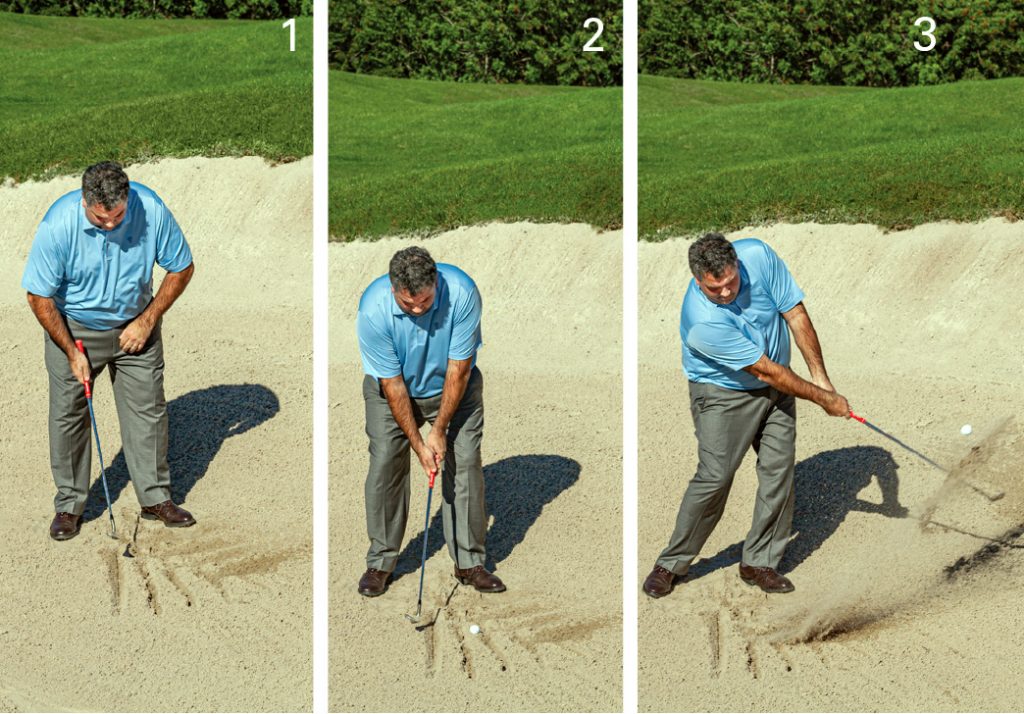
green-side bunker umbrella drill

A green-side bunker shot is supposed to be one of the easiest shots in the game. After all, it’s the only shot in golf where we can hit up to three or four inches behind the ball and still get an acceptable result.

Most golfers struggle with a green-side bunker because they have a difficult time controlling exactly where the club hits the ground. If you hit the sand too far behind the ball it stays in the bunker…hit too close to the ball and it goes sailing over the green. Learning how to control where the club strikes the ground is paramount to getting out of the bunker on the first try.

That’s where the “Umbrella Drill” comes in.

In Photo 1 you can see I’ve drawn several lines in the sand that look like the ribs of an upside down umbrella, beginning in the middle of my stance and progressively angling out toward the toe of my front foot. The idea is to keep your feet in the same place and make practice swings progressively erasing each “rib.” It teaches you how to move the bottom of the swing arc forward or backward in stance as needed.

Finally, place a ball on the rib opposite the inside heel of your front foot (Photo 2) and practice trying to make the club hit the sand between the two ribs on the umbrella (Photo 3) … allowing you to take just the right amount of sand.

Brandon Stooksbury, PGA, is Director of Instruction at Idle Hour Country Club in Macon, Georgia. Visit him at www.stooksburygolf.com

golf learner 1

golf learner 1One of the best things you can do for yourself is find out what learning style you are. While the validity of learning styles has long been debated by neuroscientists, many great educators feel they are not only valid, but are invaluable for teaching and learning. Knowing your learning style — what kind of golf student you are — can increase your awareness during practice, lessons, and on course play.

Let’s say you need to go somewhere you have never been. You don’t know how to get and are not allowed to use a map or your GPS. Would you want me to:

  1. Tell you how to get there?
  2. Read written directions?
  3. Look at a map?

golf learner 2This is a simple way to discern which style you might be. I have created a longer version which you can complete online (see below), but for now, this will do.

If you said, “Tell me how to get there,” that would mean are an auditory learner. If you said, “I want to read written directions,” you would be more of a kinesthetic learner. If you want to see a map, you are a visual learner.

How can you use this knowledge to play better golf? For me, creating swing keys that I use while playing help me stay focused on the task at hand.

Let’s say you have a habit of being quick from the top.

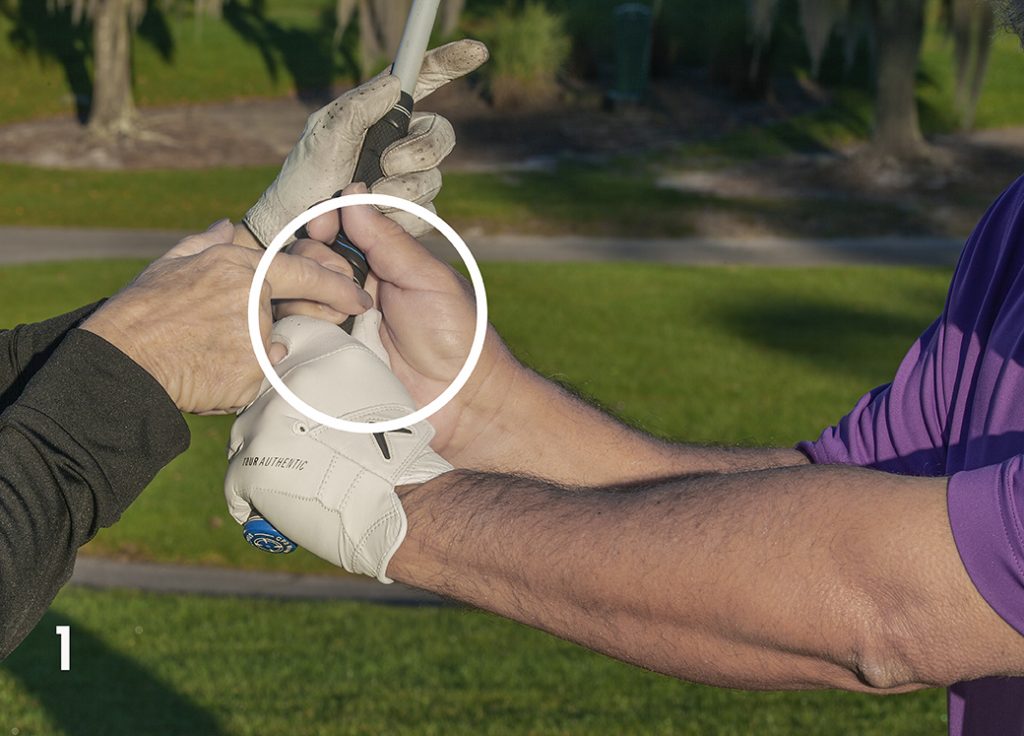
If you are someone who needs to feel their swing, I suggest you try to feel the club resting on your thumb at the top of your backswing (Photos 1 and 2). For a right-handed player, you would feel the club resting on your left thumb at the top of the backswing. (Left handed players would feel it on their right thumb).

If you a visual player, you can use the logo on your glove to be sure your hands are correct at the top of your swing (Photo 3). Typically, you can see this out of the corner of your eye as you take the club back, I am not asking you to lift your head, just move your eyes as the club starts back. This will ensure the face to square.

golf learner 3If you need to hear it, I suggest you create a mantra while you swing. I use the rhythm,

One – And – Two – And  

or

One – Two – Three – Four

In a golf lesson, you will learn and retain more if you know what your personal style is. If you are a visual learner, ask your teacher to show you what they want you to do. When they visually demonstrate you will learn easier. You can also as them to video tape you.

If you are an auditory learner, ask them to tell you exactly what they want you to do.

If you are kinesthetic, ask them if they have notes you can read to be sure you understand what they are telling you.

I guarantee if you learn to better understand yourself, your game will improve. Visit here if you’re interested in the online version.

tga premier

TGA Premier Sports (TGA), a leading youth sports organization specializing in introductory and recreational programs, announces the launch of a new TGA Premier Golf franchise in the Long Island, New York area.Tiffany Pippins, a veteran educator, journalist and TGA golf coach recently launched the TGA Premier Golf of South Nassau County franchise, parlaying her love of the game to reach local youth with the “sport of a lifetime.”

Pippins, who holds a degree in Secondary Education/Journalism from Queens College, has taught English and youth development for more than 10 years throughout New York City and the tri-state region for various non-profit organizations. Through coaching TGA Premier Golf programs in and around Nassau County, she’s seen the impact and successful engagement TGA has igniting an enthusiasm for golf in youths and decided she could grow her reach by becoming the owner of her own TGA Premier Golf business.

“While covering the 2019 PGA Championship at Bethpage Black, I had a vision of how I could use my knowledge and admiration for the game to inspire and facilitate golf in various districts within Nassau County through TGA’s exceptional golf enrichment program. We’re already starting to build strategic partnerships within the Nassau County community,” Pippins said. “I spent part of my formative years in Nassau County. It’s the perfect place for me to connect and share my passion for golf with the next generation of avid golfers.”

Pippins’ territory includes Long Beach, Merrick, Bellmore, Rockville Centre, Baldwin, and Valley Steam. “TGA of South Nassau will run its innovative after-school golf programs on school campuses, as well as look to run its popular youth golf camps at a few local courses like Lido Beach, Merrick Golf Course and Bethpage State Park,” she adds.

TGA has become a leading introductory and recreational program in golf, tennis and team sports by activating nearly one million participants since 2003. With Pippins’ new franchise, thousands of youngsters will be impacted in and around Long Island. “I am humbled and excited to have a career in golf and youth sports that will impact youth and grow the sport of golf in communities that matter to me,” said Pippins, an avid golfer, traveler and contributing writer for African American Golf Digest.

TGA impacts communities by bringing introductory golf, tennis and team sports programs directly into schools and community centers through before- or after-school enrichment programs. By putting golf on a level playing field with other mainstream sports and youth activities, TGA creates a huge opportunity to grow golf participation in a way that starts “grassroots” but has national implications.

“It’s always inspiring when we see one of our coaches empower themselves to become an owner of a TGA Premier Sports franchise,” says TGA CEO Joshua Jacobs. “Tiffany’s belief in our curriculum and programming means a great deal and she’s going to have success in a market that has a rich heritage in golf.”

TGA creates a player pathway for students and their families to advance further in the sport. From introductory programs to camps, clinics and family programs at recreational golf, engagement in these programs can lead to juniors playing on high school and college teams.

TGA provides all of the equipment for kids at no cost in the program, including its own line of custom golf equipment to provide all players an affordable option to get into the sport. The program can also be utilized anywhere on school campuses regardless of weather, including gymnasiums, hallways, cafeterias, fields and blacktops.

Families and schools nationwide have embraced the TGA model and its programs because it creates a healthier and safer environment for students at schools and community centers. The school-based curriculum includes golf skill progression, education subjects and STEM/STEAM Labs, in addition to physical fitness and health components.

For more information and to register for the TGA Premier Golf programs in the South Nassau County area, visit www.playtga.com/SouthNassauCounty.

TGA franchises can be found in more than 74 markets across 27 states, as well as internationally in Canada and Spain. Its continued growth has impacted over 825,000 youth and made these sports available to 1.75 million families through its education-based programs. In addition, the TGA Sports Foundation provides access for all children and promotes the physical, educational, social, and character-building elements of these sports.

 www.playtga.com

better tee shots photo 1

Better tee shots mean hitting the ball straight.

There’s nothing worse than standing up on the tee setting up for your “normal” shot shape, then hitting the deadly double-cross! So now you are left picking up the pieces of a shot that went left to left or right to right…not fun!

Here at Punta Mita we have a hole where this can happen quite often: No. 18 at Pacifico. The hole design bends gently left to right with out of bounds left and the ocean to the right. There’s plenty of room to move the ball left to right or right to left, depending on your “normal” shot pattern, but if you double-cross it, you’re back on the tee hitting three, or dropping the ball out of the hazard and hitting three as well. Neither situation is a great option.

Now that we understand what a double-cross is (playing for a fade and hooking it or playing for a draw and slicing it), it’s now time to figure out how and why it happens!

So, let’s set up for each shot shape.

better tee shots photo 1

In Photo 1 I am set up for a left to right shot where I am on the right side of the tee box and aiming down the left side of the fairway.

For the right to left shot pattern I am setting up on the left side of the tee box and aiming down the right side of the fairway (Photo 2).

better tee shots photo 2

These two alignments will give us the best opportunity to use the entire width of the fairway so we can hit it in the short grass. Now let’s investigate what each shot shape player tends to do when they hit a double-cross.

better tee shots photos 3-4

FOR THE LEFT TO RIGHT PLAYER

The main reason you will double-cross your fade is when you fail to get off of your back foot on the way down. When you hang back as shown in Photo 3, the body stops and the arms and hands fling by closing the club face through impact (Photo 4). As we all know, when the face angle is left of the path, the ball will start left and hook with a centered hit.

To make sure you do not allow this to happen again, you must make sure you move through the ball, allowing your weight to move into your forward foot earlier. For this I have a simple drill.

Place another tee (the same height) about three to four inches in front of your current golf ball on the same target line (Photo 5). Your goal is to hit the ball and the top of the second tee with the clubhead on the way through.  This will help you to move the weight into your lead foot earlier, thus keeping the face right of the path, and you will see the ball move left to right.

better tee shots photos 5-7

FOR THE RIGHT TO LEFT PLAYER

The main reason why you will double-cross your draw is when you lose your posture through impact, standing the club shaft upwards and opening the face.  When you stand up as shown in Photo 6, the hands also raise; when this occurs the face of the club will stay right of the path (Photo 7). As we all know, when the face angle is right of the path, the ball will start right and then move further right with a centered hit.

better tee shots photo 8

Now that we understand what is happening, how do we make sure it won’t happen again? Find an alignment stick and place it in the ground as shown in Photo 8 (which is just a touch in front of the ball.)  If you stand up and raise your hands, you will be the first to know! By keeping the club shaft closer to its address angle you will find that the club has an easier time closing, which will help the face to be slightly left of the path during impact, causing the ball to gently move right to left.

Understanding the double cross is the first key to stopping it for good. The second step is to use the appropriate drill to stop you from either hanging back or standing up. Alleviating these issues will go a long way to helping you have more confidence that the ball will indeed move in the direction you want — and stop you from hitting the ball left to left or right to right, causing you headaches.

Tom Stickney is Director of Instruction at Punta Mita Resort, Riviera Nayarit, Mexico.

0
0
Your Cart
Your cart is emptyReturn to Shop