October 17, 2026

Instruction

yH5BAEAAAAALAAAAAABAAEAAAIBRAA7


Bushnell Golf Reveals Latest Innovation with the Upgraded Launch Pro – Newly Configured Ball-Enabled Launch Pro Provides Professional Grade Technology to Golfers at Every Skill Level.

Overland Park, KS, October 11, 2023 – Bushnell Golf, makers of the #1 laser rangefinder in golf, today introduced their latest product advancement with the Ball Enabled Launch Pro personal launch monitor. Developed in partnership with Foresight Sports, the revamped Launch Pro is built on the industry’s best and most widely accepted technology and aims to bring professional grade ball-tracking to the everyday golfer.

“Innovation and technology advancements are at the cornerstone of our mission at Bushnell Golf, and we are proud to announce this latest addition to our product line,” said Jason Seeman, Global Director of Sales at Bushnell Golf. “The Ball Enabled Launch Pro will offer our customers access to the best technology in personal launch monitors at a more accessible price point .”

“Launch monitors have become a vital part of the game of golf, and this update to the Launch Pro will help us satisfy the demands of consumers,” Co-President at Foresight Sports Jon Watters added. “Now more than ever, golfers are looking for ways to improve their game when they cannot make it out to the course, and we are proud to deliver a personal launch monitor that provides golfers with an exceptional playing experience—both indoors and outdoors.”

The base model, which carries an MSRP of $1,999, provides ball only data to golfers. The data points provided include ball speed, carry distance, spin rate, spin axis, and launch angle (horizontal & vertical). The Launch Pro can be upgraded to also include club data for an additional $1,500 at the time of registration.

In addition to club data, optional software packages – powered by Foresight Sports – are also available. The Gold software subscription, which costs $499 per year, provides users with access to FSX Play, FSX Pro, FSX Subscription, and 25 different virtual golf courses. A 14-day free trial will be provided with every purchase.

The Launch Pro is available now for purchase at BushnellGolf.com and select golf retail outlets nationwide. For more information on the new Bushnell Golf Launch Pro, please visit: www.bushnellgolf.com

 About Bushnell Golf

Bushnell Golf is the industry leader in Golf Measuring Devices, including laser rangefinders and GPS devices.  Our brand has been the #1 rangefinder in professional golf for more than a decade with 99.3% of PGA Tour Pros choosing to use our product. Our guiding principle is to continuously advance the game by bringing breakthrough game improvement technologies to heighten both enjoyment and player skill.

About Foresight Sports

Headquartered in San Diego, California, Foresight Sports develops the most advanced and most trusted performance analysis solutions in the golf industry. Outdoors or indoors, from cutting-edge launch monitors and software to the ultimate virtual golf experience, Foresight Sports is your total technology solution.

Contact: Derek Schuman – Bushnell Golf  (913) 752-3426/dschuman@bushnell.com


McLemore_18C_6-22_WebReady
 
Golf Tips Magazine – 3 Day Golf School
 
Visit McLemore Resort this fall atop Lookout Mountain, Georgia. Take your game to the next level with world class golf instruction by 3 of Golf Tips Magazine’s, Top 25 Instructors.
 
Join Golf Tips Magazine’s 3 Day Golf School – October 27th – 29th, 2023.
 
For details email: editor.golftipsmag@gmail.com
HURRY! Limited Spaces. “BOOK NOW!” https://form.jotform.com/232096447523155
 
Play Among The Clouds
 
Experience one of the southeast’s golf treasures. Located atop Lookout Mountain in northwest Georgia, the McLemore Highlands Course, is an award-winning, cliff-edge par 71 course re-imagined by Bill Bergin and Rees Jones that plays 7,055 yards from the tips. McLemore’s second course, The Outpost, will boast five cliff-edge holes and is scheduled to open in early 2024.If you are new to McLemore and want to experience golf above the clouds, simply join our Friends of McLemore opportunity or reserve a cottage or home in our Stay & Play program.
 
 
The Creag “Clubhouse”
Overhead view of the 6 hole short course

Olde Cypress

The Club at Olde Cypress, one of the most vibrant, active and welcoming private clubs along the Sunshine State’s stunning Paradise Coast, has named Gary Shea its new head professional.

Before arriving at Olde Cypress this month, Shea was the first assistant at Foxfire Country Club, a 27-hole Arthur Hills-designed course just 20 minutes away. He’s lived in Naples since 2009, when he started at Foxfire, and has been a Class A PGA Member since 2021. An avid and highly-skilled player, Shea plays in numerous South Florida PGA Sectional tournaments throughout the summer offseason. He first played Olde Cypress in 2011 and last year finished second at the challenging P.B. Dye-designed course during the Southwest Chapter Pro/Pro.

“Gary has such a passion for this wonderful game and is already developing a powerful connection to our members who appreciate his commitment to the product and experience,” says Olde Cypress Director of Golf Joe Conforti, PGA. “We’re excited to welcome him to Olde Cypress and to have him as part of our valued team.”

Shea arrives at Olde Cypress during an unprecedentedly exciting time, as the club has undergone numerous enhancements over the past two years. In 2021, the course reopened following a multi-million-dollar investment by owner STOCK Development. The expansive project entailed resurfacing all 18 greens, practice green and chipping area with TifEagle Bermuda. Tee boxes were enlarged, leveled and re-grassed with Bimini Bermuda, and a new subsurface drainage system was installed for rapid expulsion of excess water. The course’s 98 bunkers were also refreshed with new edging, contouring and visually-stunning sand.

“The unwavering commitment to Olde Cypress by ownership, management and these wonderful members made this an easy decision and incredible opportunity,” says Shea. “That, and I’m a true believer that this is one of the state’s best golf courses and operations. I’m proud to be a part of the team and look forward to creating an amazing experience for our members and guests.”

The experience is now punctuated by a recently renovated 34,000-square-foot clubhouse that reopened in September last year following a full-scale interior renovation by Winter Park-based Soco Interiors. The golf shop, welcome area and offices were recast in a contemporary palette of crisp whites, sophisticated grays and layered neutrals with accents of deep blue.

The woodwork was painted a cool gray, blending seamlessly with new silver and wood-accented pendant lighting and a modern sphere-shaped chandelier. Countertops were finished with Calacatta stone tops, and revamped display areas for clothing and shoes create a neutral backdrop for displaying the latest fashion trends.

The Club at Olde Cypress is operated by STOCK Hospitality, which provides innovative solutions uniquely tailored to club communities. Creating exceptional member experiences is the cornerstone of all Stock Hospitality services, which range from club operations and golf course maintenance to membership marketing and programming. New members can choose from three categories of membership carefully crafted to offer something for everyone.

Widely considered one of the most vibrant, active and welcoming clubs in Southwest Florida, Olde Cypress is home to the first P.B. Dye golf course in Collier County. Other amenities include tennis and pickleball courts, fitness center and pool and a 34,000-square-foot clubhouse featuring both casual and fine dining. The club and surrounding 540-acre gated community are just minutes from Naples’ famous beaches, world-class shopping on 5th Avenue, and the Southwest Florida International Airport.

For more information about Olde Cypress and all it offers along Naples’ Paradise Coast, visit www.oldecypress.com.

open-close-mind


Having the best equipment, playing on a top course, or having endless knowledge about the golf swing will never yield success in the game if the golfer doesn’t know how to use his mind on the course.

Things like anxiety, emotional reactions, and distractions can all cripple a golfer’s ability and keep him from success. Overcoming these obstacles is the key to lower scores and the only way to do that is “To Clear Your Mind.”

To improve, you have to keep your mind ‘Open’ to new techniques and instruction. It has been often said that a beginning golfer tends to be more open minded to instruction than an expert golfer who tends to view instruction with a skeptical and closed mind.

A great many golfers come to a lesson with so many preconceived ideas about their swing that they are unable to digest anything the instructor introduces. When receiving instruction you must be willing to try different techniques and put practice time in to perfect it. Withhold any judgment about the new technique until you have put it into practice for awhile.

Ben Hogan comes to mind as a perfect example of keeping your mind open. He was one of the greatest ball strikers of all time, practiced relentlessly, and never seemed to tire of trying new techniques, in fact, he delighted in it because he believed there was always more he could learn. He kept his beginners mind, meaning he was always open and receptive to new things and ideas.

On the course you have to open your mind to letting go of stress, anxieties, distractions and reactions. These are negative components in a game. Deep breathing before each tee can release tension and promote relaxation, which will help you achieve a more relaxed swing.

While on the sidelines visualizing successful shots can eliminate emotional reactions instead of beating yourself up for a previous blunder. Also, keeping your mind on the game is critical for success. Instead of getting distracted by conversation, golfing tips from fellow players, text messages vibrating in your pocket…use your time to focus your mind on how techniques are working for you.

Keep your mind clear, open, and free from distractions.

shutterstock_309088538 - Copy


The Scenario 

You hit a pretty good drive, but as you step off the yardage to the green you discover that you’re 5 yards farther than you comfortably hit your 8 iron, and 5 yards shorter than you would hit your 7 iron. So what do you do? 

Here’s the Solution 

Learning to take yards on or off the distance you hit each club is an important skill. If you don’t have it, then the only time you will get close is when you are at exact distances from the pin with each of your clubs. The odds of that happening are not very likely, so you need to be able to make adjustments in order to give yourself options. Below are clues to help you decide between hitting a hard shot with a shorter iron or a soft shot with a longer one.

Hit The Longer Club If… 

  • The hole plays uphill
  • The wind is in your face
  • There’s trouble short. 

Plus, make sure the distance you’re sitting at is to the pin, not the center of the green. If you only know the distance to the center, play the longer club if the pin is in the middle or back of the green.

Hit The Shorter Club If… 

  • The hole plays downhill
  • The wind is at your back
  • There’s trouble long
  • If you only know the distance to the center, play the shorter club if the pin is in the front of the green. 

To add or subtract 5 yards off that club you need to incorporate the following techniques. 

How To Add 5 Yards To An Iron 

Step 1 – Play the ball just back of center and lean the shaft forward. This will de-loft the clubface, turning your 7 iron into a 6 ½ iron. 

Step 2 – Make a full backswing. From the top, feel like you’re about to pinch the ball between the clubface and the grass, as opposed to picking it off the turf. 

Step 3 – Be sure to accelerate to a full finish.

How To Subtract 5 Yards From An Iron 

Step 1 – Play the ball forward, more towards your left heel, and set your hands directly above the ball. 

Step 2 – Make a ¾ backswing, so your hands reach about shoulder height. 

Step 3 – Swing to a ¾ finish on the follow through, but make sure to fully turn toward the target. Because you are not making a full turn, be sure to keep an even tempo in your swing. It’s easy to rush in the backswing or downswing on less than full shots. So think “Smooth” when you execute the ¾ shot. 

Another “Key Point” to remember. When hitting your longer club, choke down an inch or two on the handle when taking your grip, it shortens the club making it easier to control. If you keep this in mind next time you’re faced with shots that are in-between your normal distances, you will find that you will be able to better handle the situation. This is a great tip to practice next time you visit the practice range, having the skill to execute these shots will give you a world of confidence on the course.

Ball Below Feet Pic 4

After hitting your tee shot on a short par-3, you discover that your ball has not only landed in the greenside bunker but is well below your feet. There’s no mistaking it; this is a difficult shot even for the pros. 

With a few adjustments to your setup, even a high handicapper can execute this shot with ease.

  • Lower your center of gravity to help reach down to the ball. 
  • Open the clubface just slightly, unlike for a normal bunker shot. This will help to dig down in order to get the ball out. 
  • Play the ball just forward of center. Too far forward, and you will likely blade the shot. 
  • Pick the club up quickly in the backswing, and abbreviate the follow-through to maintain your balance.

Incorporate these into your bunker play next practice session, and you will hit this shot with confidence. 

trackman foley-rose

Most golfers these days have heard of TrackMan. We’ve seen and heard it mentioned on TV countless times.

What is TrackMan? It’s is a Doppler radar device that tracks both the golf ball, the club and the clubhead. TrackMan provides 26 data parameters on club delivery and ball flight along with numerous analytic tools.

With the ball, it accurately measures the distance, the direction, the spin rate, the spin axis, the launch angle and the ball speed (among other things).

It also tracks what the clubhead is doing to the ball to create these performance measures — things such as swing path, calculations of the face angle at impact or the relationship of the clubface to the swing path (square, open or closed in measured degrees), the angle of attack (neutral, up, or down in degrees), calculations of the loft at impact, the clubhead speed etc., are all tracked. Why guess when you can track?

PURE AND ACCURATE DATA

Building Trust, One Shot At A Time

Ball flight laws are unquestionable. So is the quality of TrackMan’s data. TrackMan is considered to have set the industry standards for accuracy in ball impact and ball flight measurements. That’s why the leaders of the game trust TrackMan.

Quality data leads to quality analysis which again fosters sound decision-making and, ultimately, superior performance. Critical data is captured at the impact moment between the club and the ball, meaning in 1/2000 of a second. This essential data is instantly translated into an easy-to-understand language on a portable device for analysis and increased understanding of the swing. That’s why reliable data is indispensable for Tour Players striving to lower their scores and to maximize their performance. Jordan Spieth, Jason Day & Dustin Johnson trust TrackMan.

Tiger Woods is also a strong convert. “A lot of times what we’re feeling that we are doing is not exactly what we’re doing,” says Woods. “I just think you’re trying to match up feel and real, and as you make swing changes, you make slight alterations, and you start realizing what the club is doing at impact and what that can translate into in the performance of a golf ball.”

Many Tour players use TrackMan to make practice more fun and precise while confirming what they are feeling.

Dustin Johnson, for example, uses TrackMan daily to dial in his wedges. Dustin went to No. 1 in the world by improving his wedge play by working on different trajectories and distance control—low-spinners, high-stoppers, one- to two-bounce stop and check. Rory McIlroy is doing the same thing. Players can structure their own tests or use the already-scripted tests built into the software and get instant feedback. TrackMan shortens the hours, days, and months to improvement.

Some say it’s too technical. I would argue just the opposite and it’s only too technical if you don’t understand TrackMan. If you understand TrackMan, it simplifies things. It is a vital tool in my teaching arsenal and those of other instructors worldwide. It’s portable, it’s accurate and TrackMan is constantly refining its software parameters to give players and instructors a better understanding of what to do with the information provided.

PUT IT INTO ACTION

How A Trackman Lesson Can Improve Your Game Fast

The average golfer would benefit greatly from a TrackMan session with a Certified TrackMan Professional. With TrackMan you will quickly understand the why and the how.

We coaches use TrackMan to best determine the course of action to make you a better player. You will improve immensely the first day. With TrackMan you’ll quickly become an insider of the most revolutionary training tool in the industry.

Sean Foley, Justin Rose and Cameron Champ’s instructor, says, “It’s a moderator somewhere between science and Harvey Penick.”

Bob Grissett teaches in Boca Raton and Palm Beach, Florida. Reach him at www.bobgrissettgolf.com

pocket pitch shots 1

Are you struggling with those pitch shots around the green, whether to hit it high or low, make it stop quickly or skid and roll? Here’s my prescription for making the shot selection and execution process as simple as possible.

In fact, what I love about this shot is that you can basically use the same technique, then just change ball position and clubs to create all the shots you need from 30 yards and in. No more confusion on set-up or execution.

Here we go. Set up…keep it clean!

pocket pitch shots 1FOR THE STANDARD SHOT

  • Stance narrow, just inside hip width (Photo 1)
  • Front foot dropped back and flared slightly, this will help your body rotate through the shot
  • Ball position for standard shot, just slightly back of center
  • Center of sternum over ball
  • Place more pressure onto your lead foot
  • Handle of club pointing just slightly forward of belly button.

pocket pitch shots 2The Motion

From a nice, compact but balanced set up position, swing your arms back and allow your trail arm to fold until your hands are just off your rear pocket, as I’m doing in Photo 2.

big miss tee shot 1-3

One of the biggest disappointments in golf is to look up and see your tee shot heading not just off-line, but way off-line! It can ruin your round, not to mention your day.

In fact, hitting the driver off the planet on every hole far exceeds the aggravation caused by missing a short putt, or shanking the ball around the green. This, in my opinion, is the worst thing that can happen while you are playing.

So, what causes the big miss with the driver, and how can one go about curing it once and for all?

There are a few aspects that work against you when it comes to hitting drivers:

  • Length of the driver
  • Loft of the driver
  • Clubhead speed of the driver
  • Gear effect with woods
  • Correlation between the face and the path

The Length of the Driver

The biggest reason players struggle with drivers is the fact that the longest club in the bag is the hardest to control, basically due to its length. This extra length exacerbates the swing flaws you have within your swing and, coupled with the other items above, can drive you out of the game.

Golf companies started to make drivers longer and lighter in efforts to raise the swing speeds of the average player, and while this works for most players, no one thought about the negative impact this would have on accuracy. To make it simpler, the longer the club, the bigger the miss, with all things being equal. Couple this with a club that is too long for you to handle, and you have a recipe for a big miss.

big miss tee shot 1-3

I have always been an advocate of playing a driver that is long enough to for you to produce speed, but not so long that you can’t find the face. So, here is a simple test:

Hit 10 drives and chart your clubhead speed, as well as your impact point (you can use Dr. Scholl’s on your home range, spraying it on the driver face as I’m doing in Photo 1, then hitting the ball (Photo 2) and audit the results (Photo 3).

Next, choke up half an inch and repeat, etc. After you do this a time or two, you will find the length that works best for you and produces both speed and a consistent impact point—this is what you want to  find out.

The Loft of the Driver

As we know, ego plays a big part in the lofts most people use, as everyone wants to use a loft that is lower than all your buddies.

However, what we’ve found out is that your launch conditions are vital to making sure you have the right loft. If you tend to hit the ball high on the face, you can use lower loft, but if you hit the ball lower on the face, you will need more loft. Many drivers are adjustable, so be sure to experiment with this technology.

Why? This is due to the vertical gear effect on the driver— high face impacts add dynamic loft to the driver and the low face impacts reduce dynamic loft.

Once again, go to the practice tee and make sure you find the loft setting (Photo 4) that fits in with your typical impact location, and also fits in with the conditions you play at home.

If your course tends to play wet, you need more loft to ensure more carry; if you play a more firm golf course, then you can get away with a touch less loft.

The Clubhead Speed of the Driver

As we stated, more length (to a point) creates time for more speed, and we know that the more clubhead speed you have, the more off-line your missed tee shot will be versus a player with much less speed.

Think of the misses of Mr. Havercamp, your oldest lady member, versus Troy Mullins (the long drive champion). Mrs. Havercamp does not possess enough speed to hit the ball that far off-line, thus she hasn’t missed a fairway since 1972.

Sadly, the big miss is greatly affected by speed. Because of this, you must find a speed that is around 70% to 80% of your total speed. So, find out your max speed on the range and scale it back a few MPH, and you will have a speed that you can play with – but if you smash it, you will have to go find it!

The key is to go to the range and find the speed that you can control. You can audit this by charting the landing dispersion.

big miss tee shot 4-5Gear Effect with Woods

We have talked about vertical gear effect, which can change your launch conditions, but what about horizontal gear effect, which can make your misses much worse if you hit the wrong part of the face?

Let me explain: most manufacturers have built gear effect into the toe and the heel of the club, which means that a heeled tee shot will tend to slice and a toed tee shot will tend to hook. Couple this with a funky path and face combination, and you have the recipe for the big miss.

If your path is left of the target, you hit the ball on the heel (like I’ve done in the Trackman image, Photo 5), and your face at impact is pointing right of the target, then you have a ball that is going right to right with the blinker on! Why? Because you have both the face and path, plus the gear effect, working against you.

You must focus on hitting the ball in the center of the face, as I’ve done in Photo 6, no matter what the path. This is a fundamental that must be focused on as much as anything else.

big miss tee shot 6-8

The Correlation Between the Face and the Path

TrackMan has shown us that the ball mostly begins where the face is pointing at impact and curves away from the face. Thus, when you have the face and the path pointing in radically different directions, you will have huge misses.

The key is to make sure your face and path are only separated by a few degrees in order to eliminate the big miss. The face-to-path comparison in Photo 7 illustrates this optimum situation on the left, while the right image shows a big problem.

So, if it’s this easy, how can we make this happen?

In my opinion, the biggest reason for big face-to-path variances is lack of attention to where the target is, and where you are trying to swing the club. Ninety percent of all golfers come over the top, which is the root of the average player’s big miss.

So, to shift the path back into the correct position, I would suggest setting up a practice station like I have done in Photo 8. By placing an alignment stick a foot or two outside the ball’s targetline and just a touch on the left side of the ball, you are forcing yourself to make a swing that is more from the inside. This, coupled with some relaxation, and you have the chance for the club to release naturally. The ball should drift slightly more right to left.

Once you can hit nice, tight draws, the final step is to spray the face and ensure you’re hitting the ball on the face where you should be in order to find the optimal impact location for your swing.

Remember, eliminating the big miss takes some time, but it’s as simple as that. Now go and work on it!

Tom Stickney, PGA, is Director of Golf at Punta Mita Resort in Riviera Nayarit, Mexico. Reach him at tom@tomstickneygolf.com


milestones 2020 break 100

The 2020 Golf Season is right around the corner. With courses in many parts of the country opening soon, you need to be on top of your game now. Reaching your milestones early in the season is possible and requires just a little effort as your course opens for play.

milestones 2020 break 100BREAKING 100

Do You Know How to Read a Green?

Your ability to make more putts relies on your ability to determine how far a putt must travel, as well as in what direction the ball will curve to as it approaches the hole. At your current skill level, the subtleties of greens are harder to see. As your experience level grows, so will your ability to see the smaller details of green reading.

Until then, here is an easy way to determine in which direction, and how much a ball will curve when you putt:

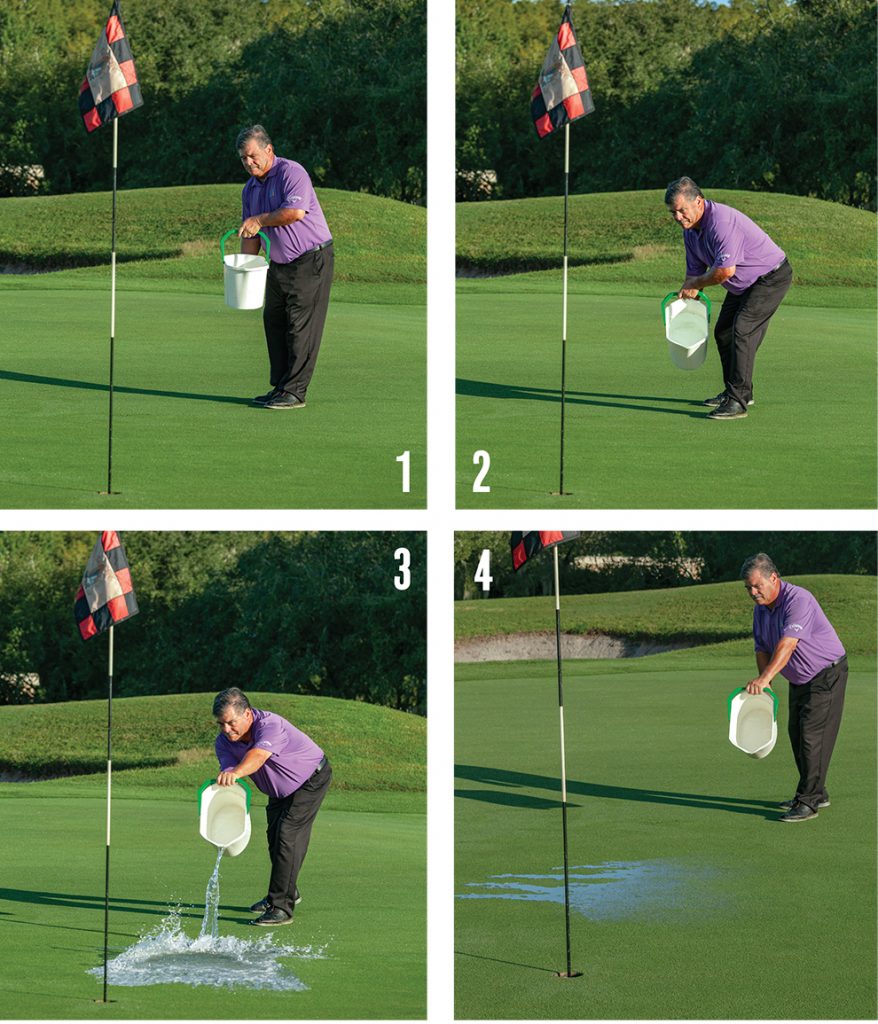
  • Stand behind the ball in a direct line with the hole.
  • Now imagine you have a bucket of water in your hand. Pretend you will toss the water out of the bucket on the straight line to the hole.
  • Which way did the water go, left or right? That’s the direction your putt will break.
  • Now determine where the water started turning. Take that place and move that point in the opposite direction (e.g., if the water moved to the left, you’re going to look to the right) until you can see the water pouring into the hole;
  • It’s at that point where you want to hit a straight putt. Allow the hill to curve the ball to the hole, just like it did with the water from your bucket.

0
0
Your Cart
Your cart is emptyReturn to Shop