October 17, 2026

Strategy/Troubleshooting

milestones 2020 break 100

The 2020 Golf Season is right around the corner. With courses in many parts of the country opening soon, you need to be on top of your game now. Reaching your milestones early in the season is possible and requires just a little effort as your course opens for play.

milestones 2020 break 100BREAKING 100

Do You Know How to Read a Green?

Your ability to make more putts relies on your ability to determine how far a putt must travel, as well as in what direction the ball will curve to as it approaches the hole. At your current skill level, the subtleties of greens are harder to see. As your experience level grows, so will your ability to see the smaller details of green reading.

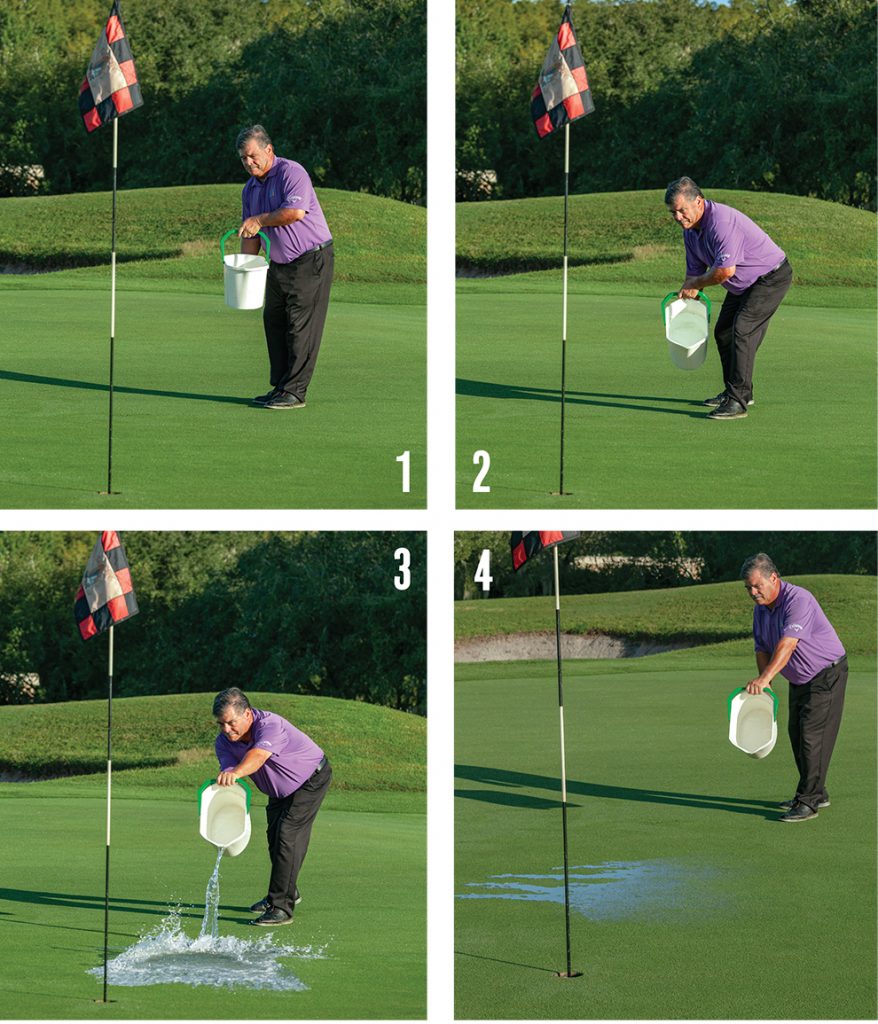
Until then, here is an easy way to determine in which direction, and how much a ball will curve when you putt:

  • Stand behind the ball in a direct line with the hole.
  • Now imagine you have a bucket of water in your hand. Pretend you will toss the water out of the bucket on the straight line to the hole.
  • Which way did the water go, left or right? That’s the direction your putt will break.
  • Now determine where the water started turning. Take that place and move that point in the opposite direction (e.g., if the water moved to the left, you’re going to look to the right) until you can see the water pouring into the hole;
  • It’s at that point where you want to hit a straight putt. Allow the hill to curve the ball to the hole, just like it did with the water from your bucket.

golf hazard opener

golf hazard 1-3Here we are facing one of the hardest shots facing any player: A 60-yard shot to the green, with a dreaded golf hazard in front and a bunker behind that. It’s a shot that takes a lot of commitment.

Some players will go by the front of the green yardage — how far to just get over the hazard — when what I recommend is taking all of that out of play. Play the number to the back of the green. If you play it long, oh well — you’re not in the hazard or bunker and give yourself a chance to save bogey or perhaps par if you make a good putt.

Again, play the yardage to the back of the green with a good, aggressive swing. If you quit on it, you most certainly will get in the hazard or bunker. So go after it and play the longer distance!

Caleb Martin is Head Professional at Grizzly Ranch Golf Club in Portola, California

golf milestones 4 break 100

The holidays. Less daylight and colder weather are now upon us, creating fewer opportunities to break through your golf milestones before the end of the year.

Don’t panic! You can still make this happen. Being patient and allowing your current skills to take you there will work.

But if you’ve determined that next year is the year to break through your Milestone, you can start working on that plan now.

golf milestones 4 break 100BREAKING 100

Set-Up—The First Cornerstone to Achieving your First Milestone

Without a great set-up, you’ll only advance as far as your current athletic abilities will take you. At some point, a proper set-up will be required for you to achieve any milestone.

Some of the greatest players in the game have used winter to their advantage to obtain improved and superior set-up positions that provide them the best possible start to the new season ahead. They see the golf set-up in the same way as setting up any machine you’re using before turning it on. If the machine is not properly set up and you turn it on, there’s a high likelihood the machine produces an unwanted result. Same goes for setting up to each shot you hit.

The basics of set up are:

  • Alignment — Be sure to aim to the target you intend to hit.
  • Balance — If you can’t balance, you can’t swing. Be sure to keep your weight evenly distributed between toe and heel, and from the belt down equally balanced between left and right.
  • Posture — Too much bend in the knees or bending forward will make you out of balance. Bounce in your knees and natural bend from the hip joint forward is all you need to get started.
  • Grip — Observe how your hands hang naturally from your shoulders to each side of your body and attempt to replicate the angle at which they hang as you grip the golf club. Use your fingers to hold the club, not the palm.
play better golf opener

play better golf openerAre you one of those golfers who absolutely pures it on the practice range with every club in the bag, but eventually goes into the tank during the course of play? It’s an unfortunate scenario experienced by a vast majority of golfers, most often caused by too little time dedicated to practice or too long a time period between rounds, so I hope the following 44 ways to play better golf truly help.

For most golfers, the onset of trouble starts on the very first tee, where high anxiety invariably sends the tee shot deep into the woods.

For others, the tanking occurs gradually as the round unfolds–a loose swing here, a twitched putt there and poor shot selection in between–until, around the 14th hole, you say to yourself, I guess it’s not my day. The worst of it is, you’re right–it isn’t your day.

However, there are methods to protect your game from suffering a complete collapse on the course. To play your best golf, you need an arsenal of skills and strategies to insulate your game when the heat is on.

This feature presents a catalogue of specific golf advice, ranging from mental thoughts and images to easy-to-accomplish swing changes that guarantee better performance during your round.

Among the top 50 are quick and easy tips to harness more speed from your swing (Power section), reduce grossly off-line shots (Accuracy), create better scoring opportunities (Strategy), get up and down every time (Short Game), keep round-wrecking scores to a minimum (Safe vs. Sane) and, most important, prevent the wheels from coming completely off during the course of play (Damage Control).

I call this collection of advice the Top 44–you’ll call them lifesavers. Use them wisely and enjoy great results even when your A game turns into a C or worse.

golf milestones 3 break 100

We’re getting into fall and cooler temps are the norm. It’s time you start ramping up your efforts to reach or surpass your Golf Milestones before the season catches up with you.

golf milestones 3 break 100

BREAKING 100

Chip Shots are Your Savior

If you haven’t learned by now, it’s time you do. Chances are no matter how bad the lie or condition you’re in during a round, you’ve probably used a chip shot or a variation of a chip shot to escape the trouble and limit the damage you’re in. If you’ve been effective, a couple big numbers may have fallen off your score card.

Chip shots are just not for around the green. They can be used anywhere, with any club, to minimize the trouble you’re in and significantly reduce the chances of making a bigger number trying to create a “hero” shot you’re not capable of producing yet. Whether in a leafy area of trees, to just off the green, to being in a bunker too far away from the green, understanding how to choose a club and set up as if you are going to chip or “bump and run” the shot to escape your trouble is a great way to eliminate the bitterness of the medicine you must take to reduce your scores.

MARK YOUR GOLF MILESTONES PART 1

MARK YOUR GOLF MILESTONES PART 2

range to golf course

As coaches, all too often we engage in the following conversation when a player’s skills seem to get lost from range to golf course:

Coach: “How did you play?”

Player: “Rubbish, but I don’t get it, I hit it so well on the range.”

The question: “Why didn’t my range game transfer over to the course?” Fortunately, the Game Like Training team gets it. In fact, we thought out this series of tips to provide you with practice tasks that will help you transfer that spectacular range game to the golf course so that you never ask that question again.

Before we do this, it is important that you understand why the above is the most asked question in golf.

The key to having your best ball striking show up when you need it the most (i.e. in a Sunday match or the club championship) is to add context to your practice.

By practicing on the golf course, you are exposed to interference. Bunkers, water, trees, and varying lies provide environmental interference. Through making your practice “game like,” you are exposed to psychological interference as you are competing for a score or to complete a level. This means that your practice will look real, feel real, and provide a higher chance of your best swing showing up on the course as you learn to deal with the contextual interferences that golf provides.

Let’s put it like this: If you decided you wanted to become an Olympic swimmer and were presented with the following options, which would you choose?

Swim daily in your bath tub and perfect your stroke.

Go to the pool and learn to race against other swimmers.

I am sure that most of you reading this article would obviously select option 2. However, when it comes to golf, most players select the equivalent of learning to swim in the bath tub, aka, the golf range.

It’s not that the golf range doesn’t serve a purpose. Understanding that it is just one part of the process to improving is vital — and, in fact, it is often something that golfers fail to understand as they become content re-peatedly hitting their favorite club down the range. While this may feel nice and produce a sense of confidence, at some point a player must step out of this comfortable environ-ment and test their swing in context.

So here it is.

sexy golf shots soft pitch

Whenever average players watch a good player play golf, they are amazed at the number of “sexy golf shots” the low handicapper, and especially the Tour pro, has the ability to play versus their own game. In fact, the better the player, the more such shots they know how to play. So why not you?

The following practice will help you to learn how to play nine of the Tour’s Sexiest Shots.

sexy golf shots soft pitch
1. Open face, open stance. 2. Set the wrists. 3. Hold face open. 4. Move rear shoulder through.

The Soft Pitch Over A Bunker

A good short game is the key to achieving lower scores and more game enjoyment in general. Here’s how to turn a missed green into a better up-and-down opportunity when you have a bunker to clear and some room to work with between you and the hole.

  • Set up with an open stance and open face
  • Put the ball in the front of your stance
  • Set your wrists fully on the backswing
  • Hold the face open through impact (picture balancing a glass on it)
  • Keep your rear shoulder moving through

tricky par 5 drive target

In my years as a head pro in the beautiful Sierra Nevada of Northern California, I’ve come to love mountain golf and the unique challenges it brings, including the occasional tricky par 5 that hugs the hills. Not only is the golfer dealing with sometimes extreme elevation changes, high-altitude air and distracting vistas, but there’s something about being up there among the tall peaks that makes a player want to go for it. Why not? You didn’t come all this way to lay up.

tricky par 5 drive targetThen again, sometimes leaving the Big Dog in the bag and taking on a wily, winding mountain hole is exactly what you need to do to chart a proven course to par, or even birdie.

So, here we are on the 12th hole at Grizzly Ranch, my home course tucked among forested peaks about an hour northwest of Reno, Nevada. It’s a long par 5 but, as I said, you don’t necessarily want to break out the big stick here. Most golfers go straight to their driver instead of looking at their yardage guide, where you can learn a lot about what an architect had in mind for each hole

No. 12, for instance, is a nicely designed hole by Bob Cupp, a player’s designer who wants you to use every club in the bag. Ideally it’s a conservative play off the tee, and you can be a little more aggressive after that. You run out of real estate in two spots after your first shot, and on your second shot you have to hit over a ravine.

tricky par 5 drive

THE TEE SHOT: EASY DOES IT

The first shot, you want to be conservative — center of the fairway, 270 yards is the most you want to hit it from the back tees. I go back further than that, about 230 yards. Left and right are trouble and too far is serious trouble. You want to get into a nice landing area, a flat spot. This is mountain golf and the ball can easily end up below or above your feet. A good target is the cart path on the left.

If you play from one of the “up” tees, you have a different decision to make. Our white or copper tees are the most commonly played. If you’re a first-time player you might not have an idea that you have about 235 yards before you run out of fairway. To the left it’s even less. Play the number that’s on your placard. Some guys think they can fly the ditch, but everything slopes right and kicks you into the hazard. So again you want to play it safe, about a 200 yard club from these tees, center of the fairway. You want to avoid left and right, where you’ll get severe lies.

tricky par 5 second shot

SECOND SHOT: STRETCH IT OUT

For my second shot I can actually hit a longer club and be more aggressive. I have a 5-wood and want to play it left-center of the fairway, since it moves left to right. I want to play the golf course and let it do the work for me. Then I’ll have a reasonable shot into the green. I’m aiming at the green box on the left, a very specific spot, which helps me focus.

tricky par 5 third shot

THIRD SHOT: EASY WAY HOME

Now we are laying two on this long par 5, and we’re on a nice, ideal flat spot. I have about 130 yards to the pin, a good distance to put it close with a chance for birdie.

Caleb Olsen is Head Professional at Grizzly Ranch Golf Club in Portola, California. Visit him at www.grizzlyranchgolfclub.com


rough golf lies photo 1

The first objective off the tee is hitting the fairway, but even the pros miss their share of short grass. It’s then that their expertise at “reading” the resulting rough golf lies kicks in, and they find a way to a better spot … or, hopefully, the green. You can be an expert, too. Properly reading how a golf ball has come to rest in the rough, whether in the full swing or short game, is critical to scoring well. The critical points to consider are:

rough golf lies photos 2-5

Will the lie allow me to take my normal set-up and swing, or do I need to make adjustments to one or both? Also, you will need to consider how will these adjustments affect the ball flight.

  • Will the ball come out faster or slower than normal?
  • Will it fly higher or lower?
  • Will it spin more or less?
  • Will it affect the direction or curvature of the shot? Considering these four keys will help you select the correct club, type of shot and target — all musts for success on the course.

Consider the two balls in Photo 1. The ball on the right is sitting up in the grass, allowing you to play a normal shot. The ball on the left is sitting down enough that a normal set-up and swing will most likely result in a topped shot. Most amateurs will send themselves into a downward spiral thinking their swings have fallen apart after a topped shot when it was due to failing to read the lie properly and making the proper adjustments.

Check out the differences in the set-up for the two lies: In Photo 2, you can see that I’ve taken a normal set up.

The ball is approximately one club head width inside my left heel, my weight is 50/50, my hands are even with the ball, my right shoulder is lower than my left and my spine is angled away from the target. These set up keys promote a shallow angle of attack.

Notice how different my set up is in Photo 3. To steepen my angle of attack, minimize any grass between the club face and ball and ensure the most solid contact, I’ve made several set-up adjustments. The ball is further back in my stance, I have more weight on my lead leg, the shaft is leaning more toward the target, I have minimal spine tilt away from the target and minimal shoulder tilt. These adjustments promote a more vertical swing with more of a downward path of the club into the ball.

Notice the difference in the positions halfway back in my swing. In Photo 4, my normal set up results in a swing where my left arm is across my chest and the club is on plane. In Photo 5,the adjustments to my set-up for the bad lie have resulted in a much more vertical arm and club plane. They will also cause the ball to come out slower than normal, thus flying shorter, lower with less spin and more to the right.

Knowing how the ball comes out will allow me to choose the proper club and target, giving me the best chance to hit a good shot.

Dale Abraham is Director of Instruction at Bighorn Country Club in Palm Desert, California, in the winter and Telluride Country Club in Telluride, Colorado, in the summer.

big downhill golf shots featured

On the 488-yard 6th hole at Journey at Pechanga, players are faced with a dramatic 300-foot elevation drop from the tee box to the green, and about 210 feet to the fairway. After catching your breath from the view and ride up to the tee, here’s how to handle these big downhill golf shots.

ONE YARD TO ONE YARD

There’s a general guideline that for every three feet (one yard) of elevation change up or down, there’s a one-yard change to a hole’s distance. So in this particular situation where there’s very little wind and normal 80-degree Califor-nia weather, this 488-yard beast will actually play more like 388 yards. This changes entirely the strategy on how I can safely play this challenging and taunting hole (Photo 1).

PICK YOUR TARGET CAREFULLY

The most generous landing area is right of the bunkers guard-ing the left side of the fairway, measuring approximately 190 yards to carry the canyon and 290 yards through the fairway.

Instead of instinctively grabbing my driver, because of the 70-yard elevation change I can add 70 yards more distance to my club selection (Photo 2). In this case, my hybrid goes 210 yards on a flat hole, which means it will go 260-280 yards here. The hybrid is much more accurate and generally easier to hit, offering you the first task of scoring well — hitting the fairway and keeping your tee shot in play.

big downhill golf shots 1-4

CLEAR COMMITMENT

Mentally you have to trust this information as the visuals will play havoc with your mind, tricking you into thinking you have to swing harder. Commit to a smooth, rhythmic swing (Photo 3). After successfully positioning yourself in the fairway (Photo 4) you’ll have approximately 200 yards to the center of the green, but the remaining 90-foot elevation drop will bring that yardage down to 170 yards.

BUT STILL …

Now, there are those of you who can be tantalized by the op-tion of going for the green with your drive — more than 290 actual yards to a very small landing area that leads straight down to the green. It’s just a question of risk and reward and where you stand (or think you stand) with your game.

Randy Chang is Director of Instruction at Journey at Pechanga Resort & Casino in Temecula, California

0
0
Your Cart
Your cart is emptyReturn to Shop