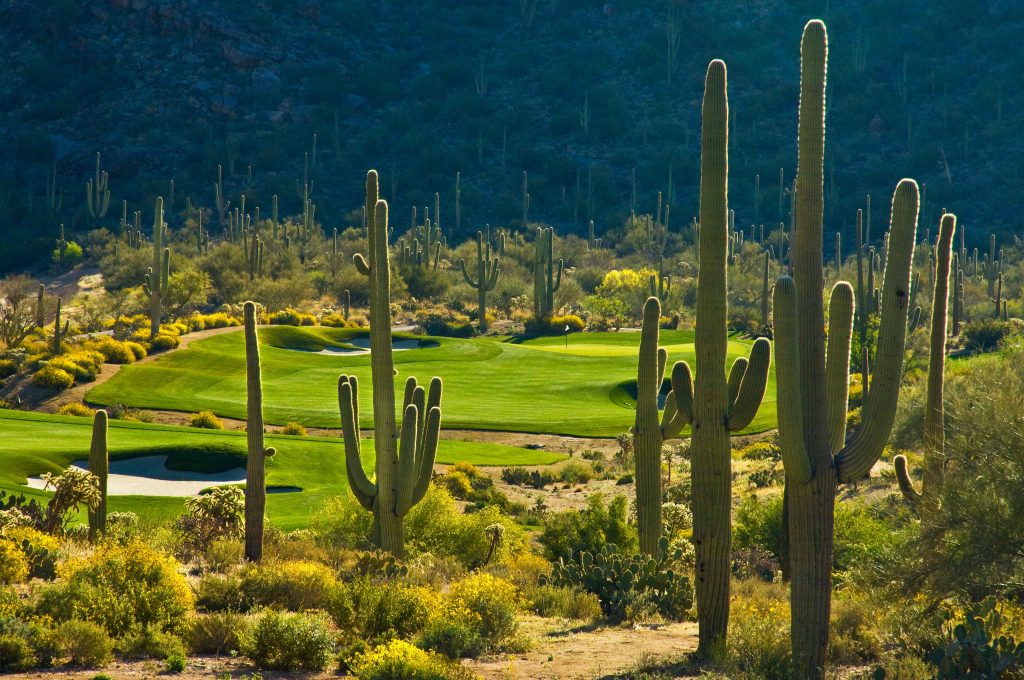
Tempus fugit, as the Romans uttered – and, as proof, it’s already that fabled time of year when Arizona transforms itself from the world’s largest outdoor sauna into a golfer’s Valhalla, especially in and around Phoenix, and more specifically, Scottsdale. There are likely more good golf holes around these here parts than anywhere in the Western Hemisphere – hell, make that the entire giddy globe!
Not that we’re revealing a well-kept secret or anything – Canadian snowbirds have been flocking to the desert annually come November and staying until spring for decades now. And the smart (make that “big”) money has been buying fairway-adjacent second and third homes in the area for quite a while as well.
Come here during the summer and those homes might as well be occupied by the ghosts of golf past. But there are surefire signs of life in the fall that will keep on burning until the snow melts in Calgary, Cleveland, and points beyond.
Speaking of the ancients, it was Heraclitus who said that when you step into a river twice, you’ve stepped into two different rivers. Same can be said for Scottsdale, which keeps morphing into a more desirable recreational and cultural escape with every season.
Golf resort properties keep sprouting anew or getting the old renovation once-over. The culinary scene has evolved from green-chile-or-red into a diverse and modern smorgasbord; and the sense of vibrant, urban excitement in the midst of natural beauty is unmatched almost anywhere.
We recently had a chance to visit the area and sample some of the new and revised wares and came away hungry for more.
If you wanna spice up that golf with some debaucherous revelry, you could make it a casino course destination. You could. Why not, instead, do the Real Deal? Why not Las Vegas?
So here in nutshell is your down and dirty guide to a Sin City golf getaway.
The 8th hole on the Wolf at Las Vegas Paiute Resort.
Howl me a riot act, go ahead, for I do love Shadow Creek. Shadow Creek also isn’t exactly open to most, and you can drop a few Benz payments, all in, for that afternoon at what is an American top-10 course.
Nope. We’re mortals here, sane, and golf nuts, and three beats one every time, anyway, as in Wolf, Snow Mountain and Sun Mountain. Save a bulkhead here, an island green, these are about the least “Pete Dye” Pete Dye courses in existence.
Situated on tribal land a half hour northwest of Glitter Gulch, a key takeaway from Paiute is no urban encroachments, no McMansions choking fairways and view sheds. There’s also not a lamb in the flock. Wolf it the most boisterous and visually contrasting. Sun Mountain is the designer clearly showing you his hand, and your skill determining the outcome. Snow Mountain is the trickster, the beguiling one, with a high R&R Rating – risk and reward. Simply Vegas’ best complete golf experience – courses, service, cost, value, scenery.
But, hey, it’s Vegas, so let’s do some over-the-top, and that comes courtesy of Cascata Golf Club.
The 7th green at Cascata
What began life as Caesars Palace’s answer to you-know-where has, in my estimation, matured from a showy peacock trying too hard into a place that just easily oozes perfection.
From the personal greeting at the front door to the forecaddies to a grill room staff that treats you better than your home club could ever muster, the word is service. Sure, it’s expensive, but so is your cable bill, and how much do you bitch about what your provider passes for content?
On the golf side, Rees Jones flung Cascata over the side of the craggy mountains out toward Boulder City. You will share your round with bighorn sheep because, absent golf carts, they not humans are the only things without wings acclimated to this type of terrain. And, yes, a river cascades down the mountain and through the clubhouse.
Steak, it’s what’s for golf trip. (And if you’re beef-averse, you probably play badminton, so you won’t be reading this.) Vegas does steak like the Church does guilt.
Pretty much every single casino-resort has at least one steakery, and freestanding chophouses dot the valley. By my reckoning, if it’s USDA Prime from a top domestic rancher, I can get a ribsteak or a strip loin of some caliber of volume and it meets an exceedingly sun-searing heat source for a very brief period of time, I’m good.
But choose we must and for this go around I choose the Palm at Caesars Forum Shops.
Yes, it is not indigenous to Vegas. Yes, the Palm has outposts across the map. It’s not like Puck or Lagasse or Flay are toque-clad and in that kitchen. The Palm is an institution in the really, really good meaning of the concept. Service is sharp and seamless. The servers are witty and collected, with enough vibe to remind you that this place started up eons ago in the Big Apple and the knowledge to get you to that just-right main. The bar is active and the entire atmosphere is charged. It’s a meal, a celebration, not a wake. Enjoy. Robustly.
There are three Vegases, and fans of each don’t necessarily get along.
There’s down(andout)town, the historic heart of all this mania and, truth be told, a helluva fun place to be.
There’s the Strip, which is either the world’s greatest assemblage of over-the-top excess matched step-by-step with luxury or a total farcical waste; that latter sentiment is blasphemy.
And then there is the valley, where the so-called gambler-friendly locals casinos reside, as do some of Vegas’ finest resorts.
We’ve been attracted to one, the JW Marriott Las Vegas, for some two decades now. Proximity to all that golf in Summerlin and being that much closer to Paiute is a plus; it is a GOLF trip. Every room in the joint exceeds the size of a typical urban flat and with far better fit and finish. The pool is subtle, big, relaxing. The spa is one of the best in town. And Spiedini serves up rustic Italian with regional breadth – Dear America, there is no singularity to “Italian” – in a subtly arty setting.
Travel and golf writer Ken Van Vechten is the author of three Las Vegas guidebooks, including Golf Las Vegas: The Ultimate Guide, and has written enough magazine and newspaper articles to fell a good-sized forest.
The only resort golf course on the Las Vegas Strip returns to Wynn Las Vegas on Friday, October 11, with the grand reopening of the Wynn Golf Club.
The original 18-hole championship course established in 2005 has been reimagined by legendary golf course architect Tom Fazio to give players a new golf experience from the first drive to the last putt.
“Tom Fazio has outdone himself designing a beautiful and unique new course that is even better than the one before,” said Marilyn Spiegel, president of Wynn Las Vegas and Encore. “We look forward to welcoming players back with a world-class golf experience that captures both the luxury of our resort and the excitement of Las Vegas.”
Fazio, this time joined by his son Logan, took special care to create a course suitable for players of all skill levels. New golfers will find it approachable and fun, while more experienced players will be tested by the movement of the land, locating the proper angles, and getting close to the pins on the large flowing greens.
“We are so excited about the return of the Wynn Golf Club,” said Tom Fazio. “The quality of the Wynn golf experience matches the ultra-high level that everyone expects from a Wynn resort. The playability of the course is second to none and the challenge of play for all golfers is exceptional. We are so pleased with the end result that I believe the players of the Wynn Golf Club will place this course in the category of their favorite places to play, and will agree that the Wynn Golf Club is a fabulous environment to enjoy the game.”
The course sits on 129 acres of the resort’s private backyard, with eight all-new holes and 10 revamped holes. Lush landscapes unique to desert golf include several water features and streams, 100,000 shrubs, and 7,000 mature trees, many of which date back to the 1950s when the land was home to the historic Desert Inn Golf Club.
Par is 70 with three par 3s and two par 5s on each nine, and a total yardage that stretches from 4,810 to 6,722 with a choice of four tees. A new 6,500-square-foot practice putting green sits adjacent to the first tee, along with a netted full swing warm-up area.
Significant changes begin on the first hole, which has been rerouted from its original design to dogleg right instead of left. Highlights include a 486-yard par 4 (no. 16) and a par 5 (no. 11) that tops out at nearly 600 yards. The signature 18th hole has been transformed from a par 4 to a par 3, which can be stretched to 249 yards, culminating on a green framed by a 35-foot-tall by 100-foot-wide waterfall for a truly spectacular finish.
More than 400,000 cubic yards of earth and 300 trees were relocated to accommodate wider landing areas, contours, and elevation changes to fairways throughout, as well as bunker alterations that make for easier access and egress. Each hole received an approximate 300-square-foot green expansion as well as a redesign and recontour to create new hole locations, while green surrounds were made more receptive with the addition of collection areas shaped to feed balls toward putting surfaces.
Completing the experience is a professional caddie program staffed with several PGA members, new on-course culinary program, lithium-powered golf carts, expansive pro shop, and luxury clubhouse.
Green fees are $550 in season. Golfers with a room reservation at Wynn Las Vegas or Encore can secure tee times 90 days in advance. Non-resort guests can reserve tee times 30 days in advance. For tee times and green fees please call 702-770-GOLF (4653).
Wynn Las Vegas invites golfers to experience the anticipated return of the Wynn Golf Club and be among the first to play the new Tom Fazio golf course.
The 18-hole championship course debuts on Friday, October 11 with a dramatically reimagined topography from the opening drive to the final putt. Guests can begin reserving tee times on Saturday, July 13.
Golf icon and course designer Tom Fazio, assisted by his son Logan, crafted a landscape of significant elevation changes set against water features and mature trees that are unique to desert golf.
The only course connected to a resort on the Las Vegas Strip, the new Wynn Golf Club sits on the historic site of the Desert Inn Golf Club, a legendary venue for celebrity and pro tour golf dating back to the 1950s.
“We are excited for the next chapter of our storied history with golf at Wynn Las Vegas,” said Brian Hawthorne, Executive Director of Golf Operations. “Golfers of all skill levels will enjoy the many new aspects of the course, which offers a private escape from the fast pace of Las Vegas supported by the five-star service Wynn is known for.”
Golfers with a room reservation at Wynn or Encore can secure tee times 90 days in advance starting Saturday, July 13. Non-resort guests can reserve tee times 30 days in advance beginning Friday, September 13.
For tee times and more information call (702) 770-GOLF (4653).
OK, you’ve made the leap and decided to do your next winter or spring desert golf jag in Phoenix’s West Valley, out beyond the big ol’ dome where the Cardinals play and the Super Bowl came around a few years back. Perhaps you’ve deciced to make the venerable Wigwam Resort your home base, played a round or two there, and you’re ready to check out the other green Sonoran jewels within easy driving distance.
Two tracks should be high on your list: The Golf Club of Estrella, centerpiece of a 20,000-acre development in Buckeye, a few miles south of I-10 and perhaps 35 minutes from the airport; and The Founders’ Course at Verrado, which began life as The Raven at Verrado on the western edge of Goodyear, tucked against the White Tank Mountains.
If you’ve got an extra day you can check out The Victory, Verrado’s brand new 18 designed by PGA Tour vet Tom Lehman (he partnered with John Fought on Founder’s).
ESTRELLA: TRIED AND TROON
The 17th hole at Estrella
Yes, someone named Nicklaus family can throttle back on the card-busting difficult design credo when he wants to, and Estrella, at least from the middle tees, is a welcome case in point. The Bear’s oldest son, Jackie, took the reins on this project, fashioning broad fairways, largely gentle greens and engaging but not daunting hole-to-hole variety out of a parcel that’s nowhere near dead flat but not overly hilly, either.
In other words, it’s contoured pretty much how God intended. Jackie found ways to leave cactus and brush-laden arroyos untouched even when you’ve got to play over them. He works a single saguaro into the target mix here and there, including on the mid-distance par 4 9th, the kind of hole where a judicious lay-up or gutsy big dog bash should get equal consideration depending on how the wind is blowing, or not blowing. No. 11 is a straightaway two-shotter pocked by more than a dozen bunkers, while back-to-back holes on the front nine — 5 and 6 — offer the course’s only water features.
If there’s a signature hole it’s No. 17, a classic desert par 3 playing slightly downhill over a stretch of native flora to a green that nudges up to a rocky hill. It begs for the sweetest 7-iron you can manage, and if you’re lucky enough to play it late in the day, get ready for a photo op of long shadows and even longer (as in hundred-mile) vistas of distant purple-painted peaks.
Such views are a running them at Estrella. By calling on Scottsdale-based Troon to run the day-to-day, Newland Communities kept their growing population of young families, empty nesters and snowbirds in mind, matching great conditioning with plenty of eye candy for a fun and relaxing round for residents and visitors alike — with drinks and grub awaiting at the Player’s Grill and Patio.
Stick around through sunset, feel the sharp temperature drop in the dry air, and nurse a nightcap around the firepit.
Out beyond the Goodyear cotton fields but with a clear view of Phoenix-Scottsdale glimmering to the east, Italian-themed Verrado has grown into one of the Valley of the Sun’s most popular high-end master-planned communities. It’s got the shops and the restaurants and the broad palm-lined boulevards, the heady mix of manmade luxury and stark natural beauty that, coupled with sweet winter weather, give the well-heeled gravitas of Palm Desert or La Quinta’s exclusive addresses.
It’s also got some damned fine golf.
Where Estrella comes a across as a comely lass, The Founder’s Course, which is open to the public but maintains a truly private club mien, has a fiery side to its personality thanks to its much more dramatic mountainous setting.
“Elevation change” inadequately describe what unfolds as the front nine moves along low ridges, in and out of box canyons and along rocky washes — slightly downhill at first, then inexorably uphill toward the back nine’s own amen corner, holes 12-14, which reaches its apogee on the 13th green after a sharply rising tee shot. Take in the view before heading back downhill, slowly and spectacularly, until reaching the all-over-water par-3 17th (a mere wedge from the middle tees) and the outstanding finisher, also over water on the approach, as much as a hybrid or as little as a short iron depending, of course, on the tee shot. Too far left and you have a wash plus the lake to clear; pull of the prescribed cut and you’ll have 120 or so yards in from a downhill lie, with one big distraction beyond the lake itself: The handsome terra cotta clubhouse, again offering a west-facing patio.
The Victory Course at Verrado
Chances are you’ll have a gallery looking on for that last pitch, so whatever you do, don’t three-jack — that cocktail will taste so much better after a hard-won par or better.
As for the new Victory Course, it’s young and still somewhat wild, sprawling across a very different piece of alluvial desert, seemingly rockier and definitely less mountainous. Lehman has always been a great iron player, and that’s where he puts the teeth in this track, demanding spot-on approaches to rangy multi-tiered greens to preserve any chance of a respectable number. A couple fun, almost linksy par 3s balance out the grit (one of them would fit right in if plopped on a Scottish strand). Overall, once it’s had a season to truly grow in and get comfortable in its own skin, it’ll move up to must-play level.
As host to the PGA Tour’s raucous Waste Management Open, golf-rich Scottsdale grabs many headlines among winter golf travelers, and understandably so. It’s one of America’s most potent golf destinations, loaded with top-tier layouts like Troon North, the Boulders, Grayhawk and, yes, TPC Scottsdale itself. But way over on the other side of town, what’s known as Phoenix’s West Valley deserves a look as your next home base for a week of desert fun. And the Wigwam Resort should be the center of that home base.
All it takes is a change of direction from Sky Harbor Airport, heading west on I-10 for about 15 miles or so, past University of Phoenix Stadium (the local affectionately call it “Stay-Puf”), and into a mix of established and newer suburbs punctuated by broad, surprising stretches of cotton fields — the same fields that led the Goodyear Tire & Rubber company to expand its Arizona operations and, in 1929, to the Wigwam, the pride of Litchfield Park.
WIGWAM WINNING
The Wigwam remains one of Arizona’s most popular and venerated resorts, especially after recent modernizing touches to its sprawling array of casitas and suites, homey and charming central lobby-restaurant-bar-events complex, and three excellent golf courses.
In fact, you’d be hard-pressed to find a better hub for a winter and early spring golf-centered stay. Besides its own Gold, Blue and Red courses, there are several top-notch, residential community-based tracks within a half hour’s drive, including Verrado’s 36 holes to the west and the Troon-run Golf Club of Estrella to the south. Put them all together and you’ve got plenty of tee-to-green variety — old school and modern, surprisingly lush and reassuringly “pure desert,” parkland-flat and starkly hilly.
GOLD, BLUE AND RED
Designed by Robert Trent Jones Sr., Wigwam’s original, championship-caliber Gold Course (opened in 1964) and shorter but just as scenic Blue courses attract the most play, while the Red — laid out by namesake architect Red Lawrence — rounds out the 54-hole bonanza.
The Gold hosts some of the nation’s top collegiate golfers each December, for good reason: It can reach more than 7,400 yards, with broad fairways laced between copious bunkers, old-growth palms and hardy desert deciduous trees; push-up greens that repel the slightest off-line approach onto wicked slopes and deep hollows; and water hazards both blatant and sneakily hidden, including a creek that snakes in front of several greens. Holes 3 and 6 rank among the toughest par 3s not only in Arizona but the entire southwest, the former stretching to 272 yards from the tips. Most par 4s are, as Jones loved to state, “easy bogeys and hard pars.” In all, the Gold is an exquisite challenge of wall-to-wall turf and well-framed danger.
The patio at Litchfield’s, The Wigwam Resort
The Blue is the Gold’s snappy younger and shorter sibling, topping out at only 6,000 yards but still managing to present a stern test. Jones put all the teeth in the greens and made each nine distinctly different, with plenty of water and wily bunkering to demand full attention. The Red falls somewhere in between, playing up to 6,800 yards and just as lush as the other two courses, with a closing stretch that, if you’re too bold, is every bit as brutal as the Gold’s.
STRAPPING ON THE FEED BAG
Wigwam’s clubhouse complex is the perfect pre- and post-round oasis. Red’s Bar & Grill serves a stellar breakfast buffet and lunch and dinner menus that strike all the right apres-golf notes, from hearty apps and burgers to sandwiches, salads, entrees like pulled chicken — all preferably washed down with a local craft brew.
Back at the main lodge is Litchfield’s, a West Valley stalwart named after Goodyear’s founder, with a farm-to-table menu created by inventive chef Jason Paterno — who, with advance notice, will preside over a family-style feast, conjuring Southwest-spiced delicacies from a pecan-fired grill. Like Red’s, Litchfield’s offers indoor and outdoor seating, as does the adjacent, popular Wigwam Bar — the resort’s central, European-style meeting place for its expansive terrace offering several fire pits and live music under the stars.
PURE DESERT COMFORT
When it’s finally time to retire, the Wigwam’s rooms await with a warm mix of casual accessibility and just the right notes of Old Arizona luxury in what’s dubbed the “Territorial Adobe” style. This isn’t an antiseptic hotel experience, but an invitation to bring the great desert outdoors with you indoors; open the windows to a vista of well-tended gardens with trees and turf beyond — and the golf courses, too, if you splurge for a Fairway Casita. Want easy access to the Red Door Spa? Opt for an Adobe Terrace Suite. Want something more secluded? The 90 rooms and suites in the Oasis Collection, with its own courtyard, pool, event lawn and cabana bar, might be the ticket.
A HUNDRED YEARS OF HOSPITALITY
While today’s Wigwam is a far cry from the original 1918 “Organization House” that put up Goodyear executives while they checked in on the company’s cotton farm operations, a thread of warm welcome and rarefied luxury runs through the resort’s foundation, from then to now, even as the West Valley has exploded around it over the past century. If you haven’t yet ventured to this not-so-distant hideway in one of the West’s great golf locales, now is the time.
In what may resemble golf’s version of mood swings, players will experience the lowest of lows and highest of highs in one day at the Hell 2 Heaven Golf Challenge. This bucket-list event, set for the summer solstice, June 21, 2018, is destined to be a marriage made in, ahem, Heaven!
Daring participants will begin their odyssey in Las Vegas by boarding (or self-drive) a deluxe motor coach for a 3-day/2-night journey to Death Valley and Mammoth Lakes, CA for an adventure guaranteed to provide lowlights and highlights during a one-day, 36-hole competition on two of the most contrasting courses imaginable on the planet.
“During my global travels, I’m always searching for out-of-the-box golf experiences,” said Robert Kaufman, chief architect of the Hell 2 Heaven Golf Challenge. “Luckily, I discovered one here in California where Mother Nature created some unbelievable landscapes to serve as a backdrop for a golf challenge that cannot be duplicated anywhere else in the world.”
Welcome to Hell: After spending the night at Death Valley National Park, the first 18 holes of the Hell 2 Heaven Golf Challenge will be contested at Furnace Creek GC, the world’s lowest elevated course situated 214 feet below sea level with lush fairways and summer temperatures that routinely hit 115-plus degrees. For us mere mortals, that qualifies this region as Hell, as well as deserving its own ring in Dante’s Inferno.
Redemption: Heated over your morning round? Don’t sweat it. Following a 4-5 hour journey alongside the majestic Eastern Sierra, enter a polar opposite universe at Mammoth Lakes with ideal summertime temperatures and a chance to atone at Sierra Star GC, the highest elevated course in the Golden State at 8,000 feet. Tip: modify club selection due to the altitude change. After playing in the valley of death, this four-season mountain playground is a heaven to die for.
Ready for the challenge? The Hell 2 Heaven Golf Challenge, a benefit for the Prostate Cancer Foundation and Southern California Golf Association Junior Golf, is open to golfers of any skill level. Cost for a two-person team is $1,900. Singles, at $950, will be paired. The all-inclusive package includes: two nights accommodations, two rounds of golf, transportation, meals, tee package, and much more. The winning team earns a 4-day/3- night golf getaway package for four people to The Boulders Resort & Spa in Carefree, Arizona.
For more information and to take advantage of the early bird registration (event is limited to 36 teams), visit Hell2HeavenGolfChallenge.com.
So what about Tucson golf? In the Grand Canyon State, greater Phoenix-Scottsdale has the capitol building, the population, the professional teams, the over-the-top golf event, scores and scores and scores of courses and a sense of superiority. Tucson cares not. For it has history, an artsy vibe, authenticity, balance; call ’em just righteous cool chops. Sure, sure, sure, Phil Mickelson went to college “up there.” But he got his first win in the Old Pueblo. Now it’s time for you to register a few Tucson golf wins of your own.
SEWAILO GOLF CLUB
Tucson moves at a languid pace, so a course hitting its fourth birthday is breaking news, and good news in this case. Known more for his friendship with Tiger Woods than his four tour wins, Notah Begay is now going to garner attention as a designer, if Sewailo Golf Club — out west of town at the comely Casino del Sol Resort — is the harbinger it appears to be.
Good design is something found — scrape back a bit of heather, dance about a meadowy wetland — or something made. The first requires architectural patience and staying out of the way, the other requires vision, and a good amount of diesel-fueled mechanical brawn. Sewailo is the second brand, a once bland and flat expanse desert rendered over well enough to serve as the home field for one of the nation’s best collegiate golf programs, the University of Arizona.
“Sewailo is fantastic,” says Wildcats men’s coach Jim Anderson. “For top players it provides a mix of scoring opportunities and demand. With the course and the facilities, it allows the team to prepare perfectly. It’s been a real blessing to the team and it’s a great recruiting tool, as is Tucson golf in general.”
And it’s not just pros-to-be. Begay has an Everyman’s Way about the design. When you get to town, make sure to block out two rounds at Sewailo, with the second experience affording a better understanding of the challenges and the shortcuts and options that might not be apparent the first time around. That’s not a slam and it’s not a suggestion of overbaked trickery. In most instances you can go where your gut suggests if not the obvious perception. Fairways jog and sweep with freeform margins set off by sharp vertical contrasts. On a course that gets props and mentions for an un-Sonoran landscape palate — forget saguaro stands and thickets of mesquite — and aquatic abundance, Sewailo will have you back more than twice because it is interesting to the eye and to the brain.
The Westin La Paloma Resort
THREE GREAT PLAY-STAYS
“I think it is a different experience for people. Tucson is a whole different deal,” offers Cindy Rarick, five-time LPGA Tour winner and part-time Tucson resident who grew up in the area. “Tucson is, first of all, so beautiful, so stunning. It is surrounded by mountain ranges; the sunrises and sunsets are like no other. Tucson is geographically, topographically gorgeous.”
Few if any settings around the valley compare to the northern foothills, where the deeply incised Santa Catalina Mountains push skyward, sentinels watching over some of Tucson’s most notable plays and stays, including Arizona National Golf Club, the Westin-affiliated, 27-hole La Paloma Country Club and that sentinel in the saguaros, Loews Ventana Canyon Resort.
The desert southwest is big on big resorts. For the most part, Tucson golf has taken a different tack; it is Tucson. Loews isn’t a period showpiece of tile-and-adobe casitas scattered among the cacti and palo verde trees. It’s not quaint in that it does sport 400 rooms and suites. What it is, is intimate, inviting, as it wraps a several-story, wide-armed embrace around the verdant, this-desert-ain’t-remotely barren foothills. The resort is of its setting, a Frank Lloyd Wright evocation of how the built environment need not stomp upon the native.
Play comes courtesy of the dual Tom Fazio tracks of the adjoining, private Ventana Canyon Golf and Racquet Club. The Canyon Course is rim-and-run golf, with holes stair-stepping the edges of barrancas cascading out of the Santa Catalinas, and then scampering about the mesquite-clad shoulders where the property offers up terra-less-crumpled. Mountain is more parkland in a desert arboretum sense, with lateral movement and right-siding shots the order of play. Generally held as the alpha of the group, Mountain’s third — 100-plus yards to a patch of green suspended above a tumult of rock and arroyo — and fourth, a bomber’s (cactus) cape of a par 5 with a tee perched high enough to serve up views all the way into Mexico — are about as photogenic as any two-hole passage not kissed by sea spray.
“I’m a professional golfer and I have options. I love the west, I love the southwest, and I think Tucson is awesome,” Rarick shares. “Look at the resorts. Look at the architecture. The cuisine, the people, the weather, the great diversity of golf courses. Tucson isn’t commercialized. It’s just doing its own little thing.”
BEYOND TUCSON GOLF: FIVE MORE MUSTS
After the round is done, let’s do Tucson in …
5. Nature
Mountain ranges ring the valley, multi-use recreational trails criss-cross it and the two halves of one national park bracket it. However you get your nature on, you can get it on in Tucson.
4. History
Southern Arizona history – and this is even excluding tribal Americans who figured out long ago how to thrive under the Sonoran sun – predates the American Revolution. Look it up. No, experience it.
3. Culture
The exuberantly painted casas of the barrio and the high-ticket galleries of the foothills, ballet and opera, live theater and street buskers, the Old Pueblo does the arts from chic to campy.
2. Food
A local tradition of putting bacon, pinto beans, mayo and the deconstructed elements of a really good salsa on a hot dog is, well, a local tradition, but the food scene has exploded. Farm-to-fork is cool – too cool? – and what makes it more than just a catchphrase here is that it appears in a UN array of cuisines. In fact, UNESCO tabbed Tucson as the first City of Gastronomy in the states.
1. Uh, More Golf
Tucson presents golf measuredly. That doesn’t mean lightly. From solid, affordable municipal plays to tourney hosting venues at Omni Tucson National Resort and the Ritz-Carlton Dove Mountain Resort, every stay can be deep in play.
There’s nothing at all wrong with going your own way. Might as well just call it the Tucson Way.
We-Ko-Pa Golf Club’s Cholla course in Fort McDowell, Arizona, is back and better than ever after a $1.8 million renovation project — an update to vital elements of an award-winning golf experience that invariably require attention with time.
“We’re very pleased with the way the renovation turned out,” said Matt Barr, general manager of We-Ko-Pa Golf Club. “Although the turf reduction and enhancements to No. 8 will be the most obvious features, the new greens, bunkers, irrigation infrastructure will positively impact playability and overall golfer satisfaction for years to come.”
Before the renovation, the fairway on the 605-yard, par-5 8th hole narrowed as it plunged toward a deep, dry desert arroyo that runs across the front of the green leaving a small target for a second-shot layup. The landing area has been widened and part of the arroyo was grassed to create a more realistic risk/reward scenario for golfers.
Other enhancements include replacement of tifdwarf bermudagrass on all 18 greens with a faster-rolling MiniVerde variety of ultra dwarf. New sand and drainage for all bunkers to improves playability and prevents pooling. New sprinkler heads, valves and field controllers were installed to allow for a more accurate and efficient watering of the golf course. Roughly eight percent, or six acres, of existing turf was removed without impacting playability and aesthetics. Native plants consistent with the surrounding Sonoran Desert will replace the turf.
“The project also helps us to be better stewards of the land in addition to a recognizable savings in electricity, labor, fuel, equipment and most importantly – water,” said Barr.
“The Cholla renovation is an example of investment in the We-Ko-Pa experience,” said Owen Doka, assistant general manager of We-Ko-Pa Golf Club and former Tribal Councilmember of the Fort McDowell Yavapai Nation. “Last year we made a number of enhancements to the clubhouse, as well as new cart paths on Saguaro. This year it was Cholla’s turn. We’re very proud of the honors Cholla has received in the past 15 years, and we’re committed to doing what it takes to maintain and improve the overall experience for our guests.”
Owned and operated by the Fort McDowell Yavapai Nation, We-Ko-Pa Golf Club is a 36-hole, daily fee golf facility featuring the original Scott Miller-designed Cholla course, which debuted in 2001. The Saguaro course, designed by Bill Coore and Ben Crenshaw, opened for play in 2006. Both courses are perennial favorites among industry-leading golf media including Golf Tips. Their popularity stems from the combination of solid golf course design surrounded by nothing but Sonoran Desert. The main clubhouse features the We-Ko-Pa Grille, recently renovated locker facilities and well-appointed golf shop. Just across the sprawling practice facility lies a smaller full-service clubhouse which serves the Saguaro course.
There are sleepers, and there are deep sleepers. In golf destination terms, St. George, Utah, is both. For quality of public-access courses, it’s as deep as the crimson-tinted canyons of Zion National Park, whose southwestern gate is just 40 minutes east — or even the Grand Canyon itself, the less-visited but more beautiful North Rim of which is within a two and a half hour drive.
It’s truly the anteroom to some of America’s most magnificent natural wonders, but, it turns out, it’s also among the West’s most impressive places to tee it up over the course of several days on courses that never fail to thrill and challenge in very different and distinctive ways.
Maybe it isn’t such sleeper after all, though the good folks who run southwest-ern Utah’s Red Rock Golf Trail golf marketing consortium still treat it as such. They work hard to get out the word about their stellar lineup of 13 affordable and visually stunning courses, great lodging, amazing restaurants, sweet spring and fall weather (their high seasons roughly run late September through November and March through May, with average daytime temperatures from the mid-60s to high 80s), hey-you’re-family-to-us service — and, surrounding it all, some of the Southwest’s most incredible variety of outdoor recreation, from river rafting to rock climbing and even snow skiing in winter at Brian Head Resort near Cedar City, just a jaunt up Interstate 15. And plenty of recreation of another, flashier kind — the gambling and glitz of Las Vegas — is an hour and a half the other direction, which makes this fast-growing high-desert town as accessible as many other more well-known getaway places throughout the region, including Palm Springs and even the Monterey Pen-insula. Fly into Vegas if you’d like, or blow right into St. George’s nifty little airport served by several airlines, chiefly Delta via Salt Lake City or United via Denver.
OK, now that we’re breathless with thoughts of St. George’s embarrassment of outdoorsy riches (or is it that we’ve just climbed up several stories of stair-stepped trails to the highest of Zion’s Emerald Pools?), let’s get back to golf. Lots of golf. Unforgettable golf of stand-out-against-the-desert green streaked with the red of oxidized iron-rich sandstone cliffs, the deep ochre and fuschia of wind-cut spires and various brown and gold hues of flood-chiseled canyons and craggy peaks.
The Ledges. Photo by Brian Oar
Start at the red cliffs jutting from the hills north of town — Snow Creek Canyon State Park, to be exact, where 18 eye-pop-ping holes of The Ledges Golf Club snake across a series of plateaus and arroyos in dramatic fashion, which makes sense since it was laid out by Matt Dye. Yes, THAT Dye family. Matt clearly carries some of Uncle Pete’s fool-the-eye design DNA, stationing green complexes against soaring moun-tain backgrounds that can play tricks with one’s club-pulling powers and asking for tee shots that must negotiate a whole lot of geological action to find safety — sage-stuffed fissures, rock outcroppings, canted landing areas and the like. Even a couple water features get in the game, on holes 9 and 18. The course is wholly exposed to the elements, several hundred feet above the Virgin Valley floor and therefore a few degrees cooler. Capricious winds can ratchet up the challenge factor — Dye’s green complexes put negotiating and the surrounding rust-tinted hills will threaten to grab your attention at every turn, so you might as well block out an hour before or after your round to explore them up close. And by all means stick around for break-fast, lunch or dinner in the clubhouse’s Fishrock Grille. The wraps and sandwiches are standouts, and the chefs have even managed to put their own crunchy spin on fish and chips (the best “fish sticks” you’ll ever taste). In the market for a golf school? The Ledges steps up with its own 4,000 square foot academy complete with three air-conditioned teaching bays outfitted with all the right gadgetry.
Not far from The Ledges is Entrada at Snow Canyon, a semi-private Johnny Miller design that helped put St. George on the golf getaway map when it opened in the 1990s. You’ll need to stay in one of the property’s high-end villas to guarantee access to the course and they’re technically not part of the Red Rock Golf Trail, but a stretch on the back nine — set among black lava and reminiscent of the great courses on the Big Island of Hawaii’s Kohala Coast — are alone worth the reservation.
While Ledges and Entrada anchor the golf on St. George’s western and northern flanks, you’ll head south and east for the greatest concentration of holes and widest variety of settings and flavors. Right in town is the charming 9-holer aptly named Red Hills, built by the city in the 1960s in a cul-de-sac of, yes, more red rocks. “It’s the course I grew up on, and we’d play it almost every day in the summer when I was a kid,” said photographer Brian Oar, who moved back to St. George a couple years ago after living up north in Park City and Sandy. “It’s one of prettiest nine-holers anywhere — and tougher than you think.” Tee times are at a premium as locals still flock to take on its tricky tee shots and small greens.
From there it’s just a short drive down Bluff St., past a gaggle of hotels (stay at the Clarion for solid, affordable rooms, a great pool, daily breakfast and easy access to everything) and onto I-15 to Washington City for a round at one of the best munis in the Southwest, Green Spring Golf Course. It’s more old-school in feel and function with of elevation change, design variety and drama and fine conditioning for so much play — everyone from late-afternoon kids to casual weekenders to serious scratch players (you get the feeling you wouldn’t want to put too many greenbacks on the line with a regular). After a bucolic, gently climbing opening quartet, holes 5 and 6 (par 3 and par 4) get down to serious desert golf business, ping-ponging across a wide ravine that marks the high point of the front nine. The back starts in a lowland, parkland setting, then climbs back up into the sage hills for a rollercoaster ride to the finish. No. 16 is a conversation-piece par 5 that wraps around another ravine with well-defined three-shot or two-shot options. No. 17 is a cliffhanging but not overly long par 3, cradled in rock and sage and begging for a photo, while the home hole moves quickly downhill toward the clubhouse with great views of the moun-tains above.
Sky Mountain Golf Course. Photo by Brian Oar
Those same mountains — the Pine Valley Range and their highest point, 10,369-foot Signal Peak — also draw the eye and imagination at the two courses in nearby Hurricane (the locals pronounce it “Hurricun”), Sky Mountain and Sand Hollow, plus Coral Canyon, another locals’ favorite in Washington just off I-15.
Coral Canyon is more high desert in feel in the Vegas/Scottsdale mold, with holes built around rock outcroppings, lots of downhill tee shots, elevated greens, some water features, forced carries over wetlands and ravines, and interesting shot angles. The drama starts right away with a No. 1 box that teeters atop a rocky knoll, and doesn’t let up from there. The tee sheet fills quickly, even in summer when temperatures regularly nudge above the century mark. It’s very playable, engaging and convenient to downtown, with a friendly clubhouse grill serving healthy helpings of smiles along with its fine breakfast and lunch fare.
Sky Mountain could be the most aptly named course in Utah. It’s all about both natural features working in tandem to conjure a thrilling golf experience, starting with one of the most incredible practice range views in the world, overlooking a canyon and wind-sculpted red sandstone rocks. The course itself ranges among several rounded hills and into ravines, with the final stretch hugging the canyon itself for yet another rousing finish. The 17th tee clings to a precipice overlooking a deep wash; you just want to grab an old ball, aim at a right angle to the fairway and bust one out into the ether. Go for it. It’s fitting, and the shot will burn into your memory forever. This place does drama golf right.
Then there’s the coup de par, Sand Hollow Golf Resort, which sits out by itself, visible from the highway but remote from civilization in general, as if ensconced in a magical desert world of its own making. One golf scribe called it “perhaps the greatest unknown golf course in America,” and he’s right, though the “unknown” part is changing. Word of mouth is out and the raves keep coming. This place is special.
Sand Hollow is a full-fledged destination resort with a big boy golf course whose front nine rolls and plunges through high-desert sage dotted with stunning red sand bunkers with a decided links vibe (that’s right, we said it, and it’s true even though there’s no ocean within 500 miles). Then you make the turn and can almost hear the cinematic musical soundtrack kick in. No. 10, a straightforward par 5, leads you to hit No. 11, a pretty downhill par 3 playing to an infinity pool-like green. That’s where you catch a glimpse of the extreme golf calendar-worthy 12th tucked along a natural ridge. On the right are eon-pocked cliffs; to the right is a 200-foot drop to the Virgin River valley. The tee shot asks you to thread to needle between, though the fairway is wider than it looks. Even a big push to the right has a chance, as one Golf Tips writer can attest — a fortuitous carom took his ball from certain oblivion to center-cut perfection in a breathless instant.
From there through hole 15 it’s like the desert version of Pebble’s most famous stretch, the Pacific-hugging 6th through 10th. Every shot surpasses the last for eye candy and shotmaking pucker-factor, culminating with the simply stunning tee shot on No. 15 from between hulking red rocks (play from that box even if it’s closed; it’s that good), across a ravine and onto a long, narrow cliffside green. Then it’s back up onto the plateau for a settle-your-nerves final trek to the beautiful clubhouse with floor-to-ceiling 180-degree views — from the gateway to Zion in the east to the sere desert mountains to the west.
But wait, there’s more: Sand Hollow also has a lovely links nine with blowout bunkers (think Bandon Dunes on Mars), with another nine on the drawing board. Rent a six-club set of replica hickories available in the clubhouse, ditch the cart for shoe leather (or golf sandals if you’ve got ’em), and have at it. It’s a pure blast.
In fact, that’s one of the phrases that’ll no doubt bubble up every time you think of your first foray into St. George golf. Blast. Beauty. Big sky, big mountains, big shots, big food and big fun, all wrapped in a surprising package of high-end comfort mixed with that ageless, raw, multi-hued beauty that gave Native Americans their bound-to-the-land culture, enticed gen-erations of American explorers in the nation’s earliest days and continues to enthrall us today, from any given green complex to the soaring cathedral-like cliffs of Zion. One visit to this epic corner of creation and you’re hooked, in the best possible way.







 When it’s finally time to retire, the Wigwam’s rooms await with a warm mix of casual accessibility and just the right notes of Old Arizona luxury in what’s dubbed the “Territorial Adobe” style. This isn’t an antiseptic hotel experience, but an invitation to bring the great desert outdoors with you indoors; open the windows to a vista of well-tended gardens with trees and turf beyond — and the golf courses, too, if you splurge for a Fairway Casita. Want easy access to the Red Door Spa? Opt for an Adobe Terrace Suite. Want something more secluded? The 90 rooms and suites in the Oasis Collection, with its own courtyard, pool, event lawn and cabana bar, might be the ticket.