September 12, 2026

Lessons

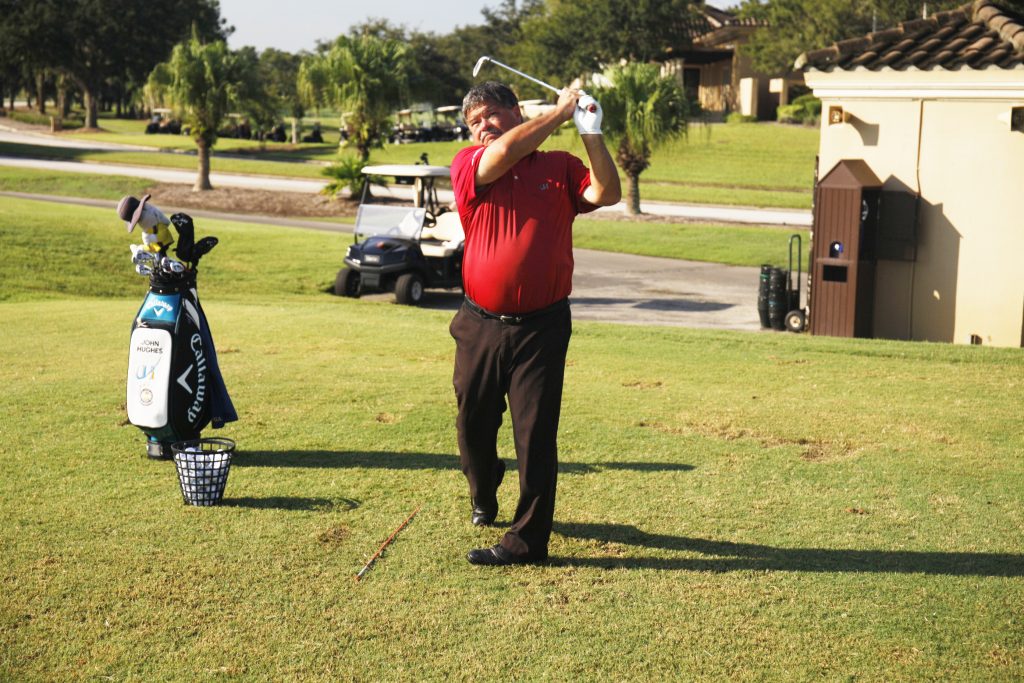
Ball Below Feet Pic 4

After hitting your tee shot on a short par-3, you discover that your ball has not only landed in the greenside bunker but is well below your feet. There’s no mistaking it; this is a difficult shot even for the pros. 

With a few adjustments to your setup, even a high handicapper can execute this shot with ease.

  • Lower your center of gravity to help reach down to the ball. 
  • Open the clubface just slightly, unlike for a normal bunker shot. This will help to dig down in order to get the ball out. 
  • Play the ball just forward of center. Too far forward, and you will likely blade the shot. 
  • Pick the club up quickly in the backswing, and abbreviate the follow-through to maintain your balance.

Incorporate these into your bunker play next practice session, and you will hit this shot with confidence. 

golf milestones 4 break 100

The holidays. Less daylight and colder weather are now upon us, creating fewer opportunities to break through your golf milestones before the end of the year.

Don’t panic! You can still make this happen. Being patient and allowing your current skills to take you there will work.

But if you’ve determined that next year is the year to break through your Milestone, you can start working on that plan now.

golf milestones 4 break 100BREAKING 100

Set-Up—The First Cornerstone to Achieving your First Milestone

Without a great set-up, you’ll only advance as far as your current athletic abilities will take you. At some point, a proper set-up will be required for you to achieve any milestone.

Some of the greatest players in the game have used winter to their advantage to obtain improved and superior set-up positions that provide them the best possible start to the new season ahead. They see the golf set-up in the same way as setting up any machine you’re using before turning it on. If the machine is not properly set up and you turn it on, there’s a high likelihood the machine produces an unwanted result. Same goes for setting up to each shot you hit.

The basics of set up are:

  • Alignment — Be sure to aim to the target you intend to hit.
  • Balance — If you can’t balance, you can’t swing. Be sure to keep your weight evenly distributed between toe and heel, and from the belt down equally balanced between left and right.
  • Posture — Too much bend in the knees or bending forward will make you out of balance. Bounce in your knees and natural bend from the hip joint forward is all you need to get started.
  • Grip — Observe how your hands hang naturally from your shoulders to each side of your body and attempt to replicate the angle at which they hang as you grip the golf club. Use your fingers to hold the club, not the palm.
practice to play golf forever opener

practice to play golf forever openerOne of the biggest things that all of us feel as we get older (I’m 48!) are the random aches and pains after spending too much time on the practice tee or working on short game. We need to learn to practice to play golf as long as we can. Hopefully forever.

Let’s face it, swinging hard and/or bending over for too long can play havoc on your whole system. Take Tiger, for example: in his comeback leading up to his Masters win he repeatedly told us he could no longer stand on the tee or on the practice green practicing like he used to, due to the issues with his back. Thus he had to practice SMARTER, not HARDER, as he had in the past. At his age and with his physical condition he cannot outwork his peers like he once did, so Tiger, like us all, has now been relegated to practicing in a more efficient way to get better.

If you are standing on the lesson tee without a plan you are wasting the shots you have in your system for that day. Sometimes you have 500 shots in your body, while other times you might only have 200 — use them wisely or feel the effects later. This is a fact!

improve at golf featured

There are many things in life we can’t control. As a golfer, we can’t control the weather, how the golf course is set up, and many other items. So they may not figure directly on how you can improve at golf.

Then there are things in our lives we do have control of. Once placed in a priority list, these allow us to live our lives consistently and successfully. As a golfer you can control a lot of things — how you practice, how you prepare to play, how you make decisions, how you evaluate your rounds, and how you choose your improvement path.

The key is finding and understanding those simple yet vital priorities in your game over which you have complete control. Once you you find the correct combination of items to work on, you’ll most likely become a more consistent golfer.

Here are five of the most common and simplest items most golfers can control.

practice to play golf slider

If you’re one of the predictably large majority of golf fans who will pass on The Match between Tiger Woods and Phil Mickelson on Nov. 23 — what, two fortysomething gazillionaires playing for $9 million of someone else’s money doesn’t rivet you to the tube? — allow Golf Tips to offer you a wealth of ideas on how to spend that $19.99 you’re saving on your own game. Instead of digesting that Thanksgiving feast by raking leaves or scouring Black Friday ads (actually, check out our Holiday Gift Guide instead), how about venturing to your friendly local practice tee with that double sawbuck and get in some great golf practice — satisfying, productive and fun work on the skills that will help you prevail the next time you put a few bucks on the line with your buddies?

May we recommend these tips from some of our Top 25 Instructors

center of the club face

Arguably the two most important clubs in your bag are the driver and the putter. You must put the ball in play with your driver to enable you to score with your putter on the green. The extreme opposites of each other in your golf bag have one thing in common when it comes to playing to your potential: you must hit the center of the club face, the sweet spot, all the time.
How do you do that? It’s relatively easy to learn to hit the sweet spot of both your putter and your driver using simple household props. Used correctly, rubber bands and water bottles can be some of the best swing aids you’ll ever use.

practice to play golf opener

Do you practice to play golf?

In other words, are you making the most of your range sessions?

practice to play golf downrangeIn a lot of the clients I see are golfers looking to gain an edge and reach not only the next level of play, but at least one level beyond. They spend time at the golf practice facility to engrain new motion habits and to have a sense of confidence that their improved swings will perform for them when it matters, on the golf course.

But many of them fail to recognize that you must test these new-found improvements under the same pressure that you face on the golf course, opting instead for the current craze of producing a perfect golf swing, influenced by current the instruction industry trend to emphasis technological master of swings and strokes.

Do you fall into this trend when it comes to your practice habits? If so, keep reading.

LEARN TO SWING VS. LEARN TO PLAY

If you fall into this trend, you are learning to swing. At some point, you must ask yourself, “how much more learning of the swing do I need to accomplish to achieve the objective of lowering my score?” The answer is relative to your priority system and where golf fits in. For most, golf is not one of your top five priorities, but close enough for you to spend more time practicing golf than other priorities. What you are forgetting is golf is meant to be “played,” and if you are spending no time during practice learning to play, you are in theory just exercising your muscles, and not the one muscle that matters most, your brain.

practice to play golf pick your shotLearning to play is altogether different than learning to swing. Learning to play breeds confidence and wisdom. Learning to play teaches you how to handle pressure and think in the moment versus outside the moment. But most importantly, learning to play during your practice sessions provides the vehicle for your swing to repeat in the heat of battle, so you can be less thoughtful of what you need to do and be more instinctive.

Let’s explore ways in which you can learn to play during your practice sessions, with and without aids, to assist you with bringing that fantastic swing you have honed at the practice facility to the golf course and feel confident it will work.

SKILLS TESTS

Testing your skills without any thought to how to perform the skills is an essential part of anyone’s learning curve. Just like role play exercises assist sale people to be better sales people, or a doctor utilizing virtual patients to practice real procedures prior to doing so to real patients, testing your golf skills, under pressure, is a must if you are looking for the time you spend practicing to pay dividends to your game.

I am fortunate to be a FlightScope Ambassador and use the ball flight technology to confirm what I see as a golf coach to my clients. But are you and your coach using this technology in a way that objectively measures your skills under pressure situations? And are you using the technology to teach you real time problem solving skills essential to lowering your scores? My use of FlightScope is heavily weighted towards using its “Skills Application” to create and administer skills tests to new clients which we can use as bench marks for their improvement plans. We also use FlightScope to create individually designed skills games my clients can use independently of me to increase their ability to handle pressure situations that mimic the same situations they face on the course.

practice to play golf skills testA simple way of determining your current skills is designing a simple 5-8 target Skills Test that incorporates short, medium, and long shots as well as a shot requiring you to hit your driver. You don’t need a launch monitor to administer this test to yourself. Just clearly defined targets at vary-ing lengths with specific landing areas that allow you to score points.

I use a simple skills test that all my clients take their first sessions with me called “The Evaluation.” It consists of hitting four balls to varying length targets, with accepted landing areas becoming larger as the target becomes longer. A predetermined amount of time is used to provide ample time to complete the test but not enough time to waste. This recreates the same amount of time a golfer faces when needing to speed play up or deciding upon the best option to use when faced with a difficult situation. The test’s maximum score is between 150 and 200 points based on how many targets we use. And the test measures everything from where the client’s missed shots tend to land to club data, to trajectory and grouping patterns.

The information we gather from a client’s skills test results provides the information we both need to make instant improvements to their game while determining the most significant part of a client’s game we need to focus on first. After so many hours of coaching and so many rounds of golf played, each client retakes the evaluation to compare their game now versus when they first take the evaluation, as well as deter-mine if there are other aspects of their game that now need to become the priority of their improvement plan.

I have similar skills tests for chipping, bunker shots, and putting, which I created from ordinary drills I administer to clients. All these tests serve as the initial bench mark of determining their current skill set within each aspect of their games as well as their ability to play simulated games, under pressure, to improve their ability to handle pressure on the course.

SCRIMMAGE YOURSELF

During each practice session, you should devote the last 25 percent of your practice to scrimmaging yourself. That is, playing games on the range to test the skills you were just practicing. But a good scrimmage must have a realistic outcome or consequence based on the level of success of the scrimmage. Golf provides an outcome and consequence with every shot you execute. The consequence is what provides the realistic measure of whether your game can withstand pressure. Not leaving the practice area until you succeed, doing push-ups or sit-ups, running laps, or sacrificing your favorite after practice beverage, or any other negative consequences can be applied to any negative outcome of your scrimmage. The flip side of this is if you succeed within the scrimmage, you should have a positive consequence occur that rewards you for your acceptable efforts. But stick to what you promise yourself, good or bad, based on the results of your scrimmage. Doing so maintains the pressure you need to effectively handle and simulates pressure you may face during any round.

Here are some simple yet effect scrimmages you can very easily incorporate into your practice routine that will provide immediate feedback of your current skills and while honing your new skills to be more consistent. These scrimmages cover the three essential skills that must always stand up to pressure; your putting, your short game, and your ability to make the same swing with all clubs, regardless of circumstance:

FULL SWING

Call the Shot – Similar to the evaluation I administer, you’ll be hitting to various targets. Difference is someone else will call the shot you need to hit (distance, shot shape, acceptable landing area, etc.) and hand you the club you will use to achieve the result. This is a great scrimmage to share with a practice partner, and your job as the golfer is:

  • Never look at what club you are hitting. Trust you practice partner provided the right tool for the job and focus on executing the shot.
  • Never judge the shot before it lands.
  • And evaluate each shot you hit based on your current abilities to perform the shot under pressure. Let your practice partner be the one to score each shot.

A great consequence for this scrimmage is not being able to end practice until you achieve a set number of agreed-to shots prior to the start of the scrimmage, or not going on to the next shot until you achieve the desired results.

Same Swing-Different Distance – It is imperative you know how far each club can make the ball travel in the air. You only have a certain amount of control over each shot, that being how far it carries. By understanding how far each club each club performs, you can make a simple need to know distances into a highly effective scrimmage.

  • Determine a starting distance – for example’s sake, let’s use 100 yards.
  • Determine an incremental amount of difference you want each shot to land. For example, using 100 yards as the starting point, I plan to hit each subsequent shot no less than 8 yards farther and no more than 11 yards farther then my starting point.
  • Pick a club that will travel 100 yards
  • Determine a consistent swing you can repeat for all clubs, that will allow the club you chose to hit carry 100 yards.
  • Swing the first club. If it lands within three yards of your intended target, you can move on to the next club. If not, continue to hit that club until you can achieve the objective.

Swing The Next Club – if it lands between 108 and 111 yards, great, you achieved the objective. If not, go back to the be-ginning and hit the 100-yard club again.

The concept of this drill is with one chance only, be able to make a swing, being totally confident in the club you choose and the swing you make, to carry the desired difference in distance to the next target. To start, I’d limit this to five targets. As you improve, increase the number of targets until you can hit every club in your bag using the same swing, to achieve a consistent difference in distance. This is a great drill to use when it comes to learning to control your distances with your wedges. Only difference in how you perform the drill is by varying your set up positions (hands up or down the grip; club square, slightly open or closed to target; stance square or open, etc.) to achieve smaller differences in distance you can use each club.

Play the Course – This practice scrimmage has been highlighted in many publications throughout the past few decades. As a reminder, it is imagining a golf hole at the practice area and hitting the clubs you need to hit the green in regulation or working through a difficult situation of one shot puts you into virtual trouble. Here are a few ideas to add to this time-honored scrimmage that can enhance the effectiveness of the exercise while at the same time instilling some consequence to its outcome:

  • Be target specific and focused – Find a way to make your target smaller and be visually more focused on the target throughout each shot. Your brain loves small targets and when you are focused on smaller targets, your ability to let yourself “swing to the target” greatly increases.
  • Be specific with your shot shape – Don’t just hit the target. Determine a specific shop shape prior to hitting the shot so you learn to hit different shots so you can adapt to different circumstances.
  • Always be pin high – There is a direct correlation to being at or past a pin and the chances of you making birdie.

When hitting a virtual approach shot, be sure the shot lands pin high or with-in an acceptable landing area past the target, so you get used to hitting shots the proper distance.

Do Not Finish Practice Without Making Par – It’s not worth leaving practice until you are confident in yourself. And I have never felt more confident than leaving practice on a positive note. Do so with this game too. Just because you ran out of balls does not mean practice is over. Go buy a few more and insure you leave making par or better on the last hole you virtually play.

SHORT GAME

practice to play golf chippingMake it Chipping – Chips shots are not to be taken lightly, and when you are thinking about just getting it close, you are missing out on a great opportunity to pick up a stroke. Make it Chipping is an easy scrimmage focusing on you making chip shots, not just getting them close:

  • Pick a hole on the green that represents the typical chip shot you experience any given round.
  • Place five balls just off the green, and at 5 feet, 10 feet, and 15 feet off the green.
  • Object of the game is to make at least one chip shot from each distance be-fore moving back to the next distance. You can use any club necessary to achieve the objective. If you do not make a chip, you stay at that distance, retrieving the five balls you just hit, until you do.

Be sure to go through a consistent routine for each shot. Don’t just rake another ball over. You go through a routine on the course, so why not use it here? What you’ll end up creating is a better routine to gather more information to increase your chances of making the chip shot. Use that same routine when on the course, it will in-crease your odds of making a chip shot on the course too.

  • You can use this scrimmage for bunker shots as well small distance pitch shots too.
  • Be willing to vary lies, roll, and different situations you will face, such as hitting over sprinklers, bushes, or over casual water.
John Hughes is a PGA Master Professional based at Falcon’s Fire in Orlando, Florida, and 2013 PGA of America Horton Smith Award recipient. Visit him at www.johnhughesgolf.com
Lower Golf Scores Patri 1

I probably give far more playing lessons then the average bear. Let’s be clear: on the lesson tee I’m a teacher, on the golf course I’m a coach, and the whole plan, clearly, is to achieve lower golf scores for my clients, and that means not thinking about score.

During a playing lesson I ask the student to refrain from asking any technique questions regardless of the shot outcome. I want on course time to be all about management skills. Therefore, if you hit the first pitch out to deep right center field, let’s go find it and figure out how to best minimize the damage. I talk a lot about “damage control.” The best players in the world hit those “where the heck did that one come from?” shots. The difference is they don’t play a high-risk recovery shot.

Get your ball back in the short stuff the safest way possible and live to fight another day. Imagine if the next ten times you played you never made over a bogey. You completely took the big number off your card. How many shots to the good would you be?

Let me give you a few thoughts and explain how I manage the golf course.

In Photo 1 above I’m playing the 9th hole at Bulle Rock, the home of my summer TPGOLF Schools in Havre De Grace, Maryland. Hole 9 is a bear. From the tee I’m playing it plays 430 yards left to right and slightly uphill. There are two very penal bunkers right and just for good measure a big slope headed directly for a not-so-friendly pond to the right of those bunkers.

Lower Golf Scores Patri 2If I hit my Sunday best I can clear the second bunker and considerably shorten the hole. However, if I miss hit that tee shot a whole lot of hurt awaits me over in that direction. By playing a full 15 yards left of those bunkers (which is my normal play on this hole) I’m adding between 10 to 15 yards to my second shot. So instead of hitting a 7 iron and once in a blue moon an 8 iron in I’m hitting a 6 iron and sometimes a 5 iron. I make a bunch of 4’s on number 9 and rarely exceed 5. Remember, one swing of the club can’t make your round but one swing can certainly ruin it.

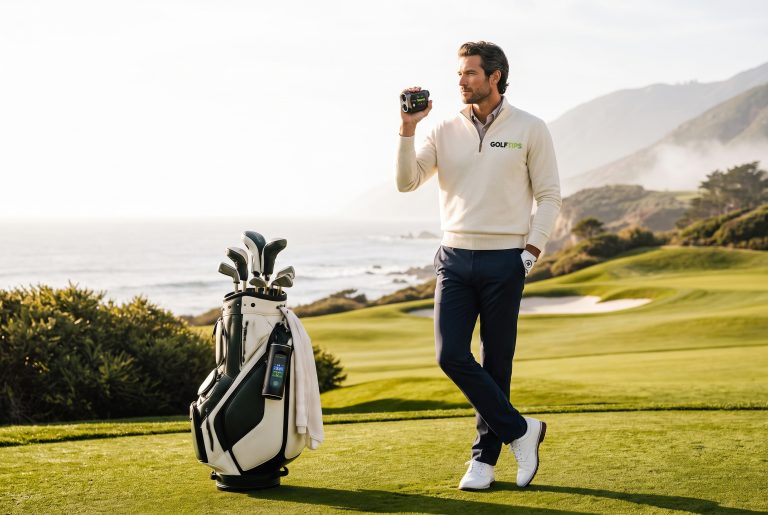
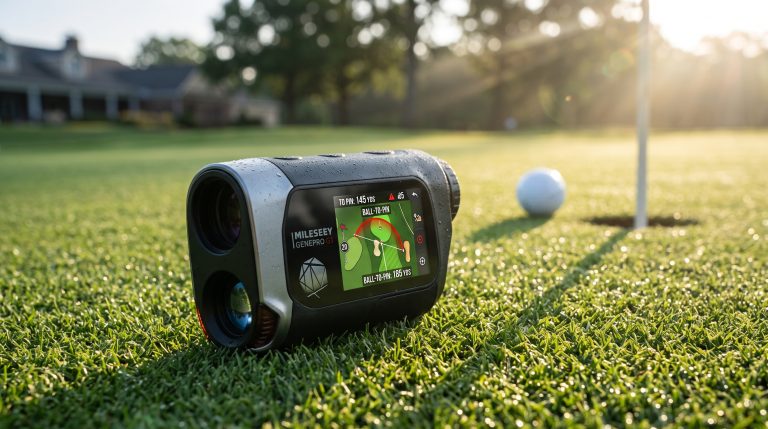
Technology in the form of a quality rangefinder, as I’m using in Photo 2 (the operative word here is quality) can be a highly valuable tool, provided you actually know what to do with it. First thing I do with mine is shoot targets on the practice range whenever I practice. You see I’m not on “Fantasy Island” about EXACTLY how far I carry every club in my bag. Knowing how far you carry (carry over bunkers, water hazards, etc. is critical information). Each club in your bag should allow you to make highly comfortable choices when selecting a club to hit a particular shot when it counts. You’d be amazed how few recreational players are even in the ball park with their carry distances. Make real club choice decisions based on real information after a quality and repetitive practice session.

Lower Golf Scores Patri 3-4Once you have established “real” numbers, you’ll be on your way to more greens in regulation as well as fewer big numbers because you have a very real sense of what each club can do comfortably. This is critical.

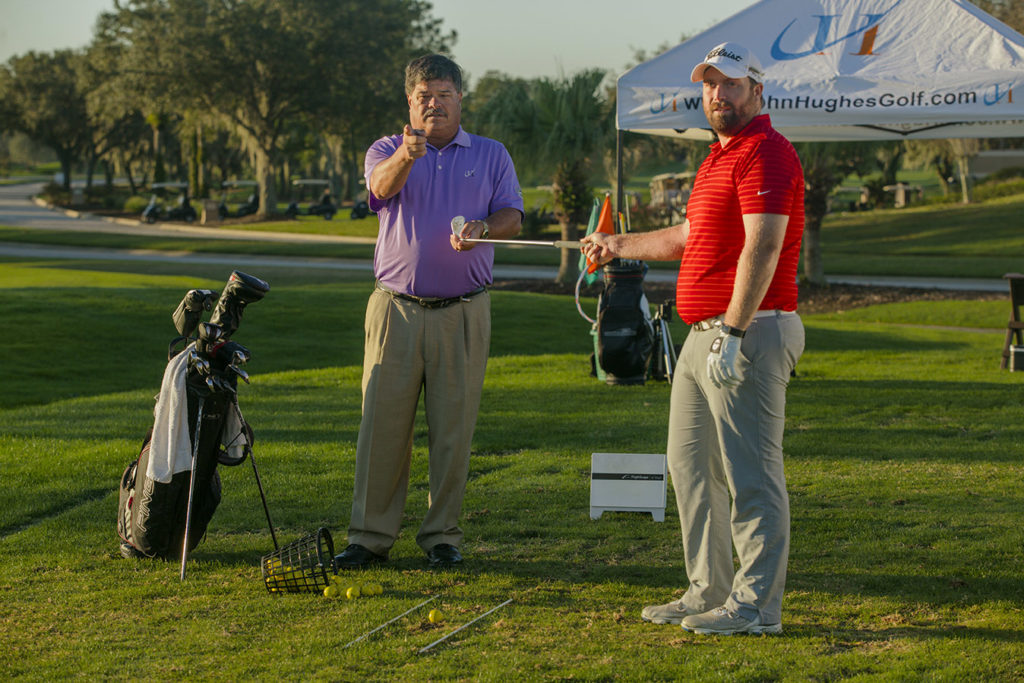
During a playing lesson I discuss your personally best scoring opportunities via making sound decisions that will not stress your golf brain (Photo 3). Also, after each playing lesson I will generally sit with the student to review all that we did to be sure everything is rock solid and crystal clear, as I’m doing in Photo 4.

As an on-course coach who has done this for 36-plus years and given as many playing lessons as any teaching professional on this planet, I’m here to tell you that if every recreational player made solid decisions based on patterns within their game that they truly understood and played — only safe, conservative lines — they would be 6-10 shots to the good tomorrow.

Think, be patient, truly know your limits. Play the smart shot every time.

Tom Patri is president/founder of TP Golf in Naples, Florida, GolfTips Magazine Top 30 Instructor and PGA Quarter Century Member. Reach him at tpatri@mindspring.com or visit him at www.tompatri.com
practice-purpose-alignment

The great Allen Iverson once said, “Listen, we’re sittin here talking about practice, not a game, not a game, not a game, but we’re talkin’ about PRACTICE.” So what does this have to do with your golf practice?

As a golf professional and an avid writer I noticed that we generally write awesome articles about how to fix a slice, or how to change a grip, or read a putt, but very rarely do we ever talk about how to practice. As I give lessons during the day I see hundreds of golfers beating balls without a plan, mindlessly raking ball after ball over to hit it in another crazy direction. This couldn’t be further from how you need to practice.

All my students know I’m a stickler for practice, and doing it correctly involves three types of different practice: Block Practice, Skill Building, and Competition/Score Based Practice.

practice-purpose-alignmentBLOCK PRACTICE

Block Practice is the most common type of practice and generally the only type a lot of golfers tend to do. Essentially, this is the act of working on something and repeating it over and over again until the motion of the feel is ingrained. What I generally like to see from this type of practice is some sort of feedback to allow the golfer to recognize if they are performing the task properly on every swing or repetition.

Example of good block practice: If you are working on your full swing and specifically on a certain piece or part, using alignment rods as obstacles helps the golfer feel the exaggerations necessary and allows them to have immediate feedback on whether the task is being completed properly. One of my favorite drills is to place an alignment rod roughly 15 to 20 feet on the target line to work on starting the ball left or right of the intended target.

practice-purpose-shortgame

SKILL BUILDING

This is a much-overlooked aspect of most golfers’ practice sessions. Skill building is the act of taking what you have diligently worked on and applying it to a course-type environment. For example, if you are working on your chipping and pitch shot mechanics during your block practice sessions, you would then go to the practice area and work on up-and-downs from around the green. The key to this is never hitting a shot from the same spot more than once. I will always stress to my students that it’s very important during this part of the practice routine to always play the ball down after you drop it and also repeat your entire routine as if you were on the course. The key here is to make sure that you are applying the concepts from your block practice into your skill-building practice; even if the results are not ideal you will get accustomed to performing your new motion and swing thought under a course condition.


practice-purpose-compete

COMPETITION/SCORE BASED

My favorite and final practice method is Score Based Competition. This is where you apply your block practice and skill building practice to a game or competition where there is a score and the potential for stress, nervousness, failure to solidify your new skills under playing, and tournament type pressure. The biggest factor in this is there has to be a ramification for not accomplishing your goal. Staying with short game, you can practice 20 up-and-downs from around the green and need a certain percentage of successful up-and-downs. Set a reasonable bench mark and make it increasingly more difficult as you get better. If you are putting, grab a partner and play a 9-hole match to add pressure. If you are practicing on the course, attempt to hit a certain amount of consecutive fairways or greens in regulations.

Adding pressure allows you to be uncomfortable so when you get into a tournament or competitive setting, you can be as comfortable as possible. Follow these practicing guidelines and you will be guaranteed to be playing some of your best golf.

Scott Yurgalevicz is a PGA Teaching Professional at Chester Valley Golf Club in Malvern, Pennsylvania

Welcome To ‘The Six Spoke Approach To Golf’

Beginning with the June-July 2016 of GolfTips I will share with you what I have learned and come to strongly believe in during my nearly 40-year teaching and coaching career. My journey as a teacher-coach is headed towards its fourth decade and a few years back eclipsed some 50,000 plus lesson hours given. I would like to think along that long dusty trail I have learned a thing or two.

My Six Spoke Approach was nurtured and matured over many years and inspired by all of my wonderful students who, knowingly or not, both taught and inspired me to grow as a teacher – coach. Thank you one and all.

In the fall of 1993, I had the epiphany: That something was missing in my presentation to my students. Every year, at the conclusion of my teaching season (both my northern season or my southern season in Florida), I sit down and ask myself a few fundamental questions.

1. Did I help my students in every way possible?|

2. Did I miss anything?

3. Did they actually improve per the level of effort they put in?

That fall, as I reflected on the lessons of the season, I concluded that I was missing something. Those who know me well, know I hate to miss something! I at first couldn’t put my finger on it, but as time passed and I wrote notes, the fog began to lift and I began to see the missing pieces. They were not yet crystal clear but I had found (at least I believed I had found ) a starting point. It was becoming increasingly clear to me that for any player passionate about improving his or her game, the standard “Xs and Os” golf lesson we had come to know was a very small part of a much larger picture.

During my 11 years as Director of Instruction I was extremely blessed to meet so many wonderfully talented people who influenced who I have become as a teacher-coach. Talented people like Bill Strausbaugh, John Kennedy, Eanna Rushe, Dr. Andy Weiland, Peter Sanders, Jim Flick, Peter Egoscue, Evan Schiller, John Elliott, Randy and Ross Henry, Fred Shoemaker, Rick Jensen, Tom Shea, and Jim Mapother. There are so many more . If you Goggle each of the above names you’ll realize how incredibility blessed I was. I pushed forward in my journey to truly understand how to develop the motor skill we call golf.

My book finally went to print in 2005 with the guidance and encouragement of a dear friend and student of mine, Sean Moran, and his wife, Julie Moran. Sean believed I had a powerful message to share when not many others did not . Well, many years and so many recognitions and teaching awards later, I’m both honored and humbled that GolfTips and editor Vic Williams have asked me to update you one “Spoke” at a time over the next six issues.

Although not much has changed in my basic belief system as it relates to the Six Spokes, technology and research has allowed us to better understand the enormous power of this approach . Eleven years after the book was first putt on shelves, I’m most proud that advanced technology and research have proven that my “blueprint for success,” as I call it, was 100 percent right on.

Therefore, follow along with me over the next year’s worth of GolfTips as I take the 2005 version of The Six Spoke Approach and update it in 2016 terms. If you want to understand the birth of the philosophy of my belief system, you can find a copy on both Kindle and Amazon to study and help guide our journey together.

I will tell you the following without hesitation: If you get a copy of the book and follow the next six communications in GolfTips and adapt the blueprint of success as your daily improvement game plan, you’ll be on your way to the best golf of your life!

I’m excited to share my Six Spokes with everyone. Please tell a friend and see you in the next issue with Spoke No. 1 — The Body

Welcome To ‘The Six Spoke Approach To Golf’

Golf requires seven essential physical attributes: proper posture, a full range of motion, strength, stability, balance, speed, and coordination. Unlike gymnasts, jockeys, ballerinas, and basketball players who tend to share certain physical attributes, talented golfers come in all shapes, sizes, and ages. There’s no such thing as ‘built like a golfer.’ — From Part 1 of our series

Foreword By Fred Couples

When Tom and I met, I wasn’t Fred Couples the Tour Player and he wasn’t Tom Patri, one of the Top 100 Golf Teachers in Amercca; we were just two kids in college chasing a dream. I was at the University of Houston and Tom was at Florida Southern College. During the spring of my sophomore year and his junior year, we met while playing in the 1980 NCAA Championships at Ohio State on their fabulous Scarlet Course.

The University of Houston was a perennial favorite, and Tom had qualified as an individual by finishing second in the NCAA Division II Championships. Though we’d met briefly the fall before, we ran into each other again at Scarlet during the practice rounds and on the range. We talked at length and just seemed to hit it off. (I’m pretty quiet by nature, and if you haven’t met Tom in person, let’s just say he isn’t.)

The NCAA had a 54-hole cut for both teams and individuals and, although I’d made cut as an individ ual, both the University of Houston and Tom found themselves just outside the cut line. Later on, I found Tom trying to make a plane reservation home. Since my team and I were trying to escape the wrath of our coach, Dave Williams, for missing the cut, we were on our way to play at nearby Muirfield Village and asked Tom if he would like to join us. He quickly dropped the phone, and we were on our way. That afternoon we had a blast. We’ve been good friends ever since.

Since then, I have watched Tom’s career grow, and have witnessed the development of his sound teaching philosophy, the Six-Spoke Approach, which I support wholeheartedly. Tom’s Six-Spoke Approach to Better Golf — or, as he also calls it, a “blueprint for learning” — is an outstanding method for improving your play. When Tom first discussed it with me, I knew that he was on to something that would help players of all levels reach their potential. I saw, too, that his approach mirrored the approach that a lot of us on the PGA Tour utilize on a day-to-day basis.

Many of my peers work with a sports psychologist — not merely to survive, but to find the edge that will take them to the next level. A very high percentage of us work on our physical well-being, especially through the use of exercise programs specifically aimed at improving the physical skills needed to play golf as well as prevent injury. I personally have had to work very hard on my fitness to ensure that I can play the events that are important to me and my career.

In addition, most of us chart our progress statistically, many with computer-assisted analysis. This is the only truly objective method of Uncovering where valuable shots are lost. Time management is certainly one of our biggest challenges, and one that all Tour players face. We are all interested in tweaking our equipment and finding that edge through the latest technology. And hardly any of us do not work with a coach to refine our technique on a regular basis.

Please allow my pal Tom to help you design your blueprint for success using the Six-Spoke Approach. We both wish you great success on your journey.

Sincerely,
Fred Couples

0
0
Your Cart
Your cart is emptyReturn to Shop