September 24, 2026

General

pre-shot routine 1-4

If you polled a combined group of PGA Tour Players and a deep list of the very best golf instructors, asking them to list the top 30 Golf Swings from 1970 to present, the great Jack Nicklaus might not make their list. Poll the same two groups as to the greatest Pre-Shot Routine of all time, and Jack would easily be No. 1.

The Pre-Shot Routine is a cornerstone of my teaching, and I feel strongly it is a must-needed skill to teach and coach the recreational player. Let me be clear: to be a great player, an EXACT, repeatable, and clearly understood routine, every single time you attempt a golf shot, is an absolute must.

The Pre-Shot Routine can be individual in design to fit the needs of a specific player. However, there are definite fundamental and essential things it should in fact address and accomplish.

Let’s discuss several of the things I like to I teach and coach every one of my students who need to establish a sound Pre-Shot Routine.

pre-shot routine 1-4

I believe one of the main purposes of a Pre-Shot Routine is to establish a solid cadence. This allows the player to stay in a rhythm never getting too fast or too slow. Untrained players often unknowingly speed up after a bad shot due to the anxiety they experience. Likewise, they sometimes speed up after an exciting shot or birdie. Conversely, they think that after a bad shot  they should “slow down.” In fact, neither is correct. Simply stay in your routine.

I remember being at The Buick Classic at Westchester Country Club one year, sitting in on a session watching David Leadbetter work with Nick Faldo – using a stopwatch and counting steps from behind the ball to establish a time formula to take to the course.

pre-shot routine 6-8I often ask my students what they think is the No. 1 most common trait among world-class players. Of course, I get a boatload of answers, mostly of the mechanical, in swing-type. After they have exhausted their thoughts as to the possible answers and I have continuously shaken my head, they then exclaim, “so what IS the most common trait?”

I look them straight in the eye and calmly reply, “they are boring …they do the same exact thing every time.”

pre-shot 9-11

Of course, I’m referring to their Pre-Shot Routine. In other words, the players I generally like the most are the ones you show up to watch midway through their rounds and you can’t tell if they are eight under or eight over. You watch them closely and their cadence from shot to shot is identical. Again, Jack was the master of this skill.

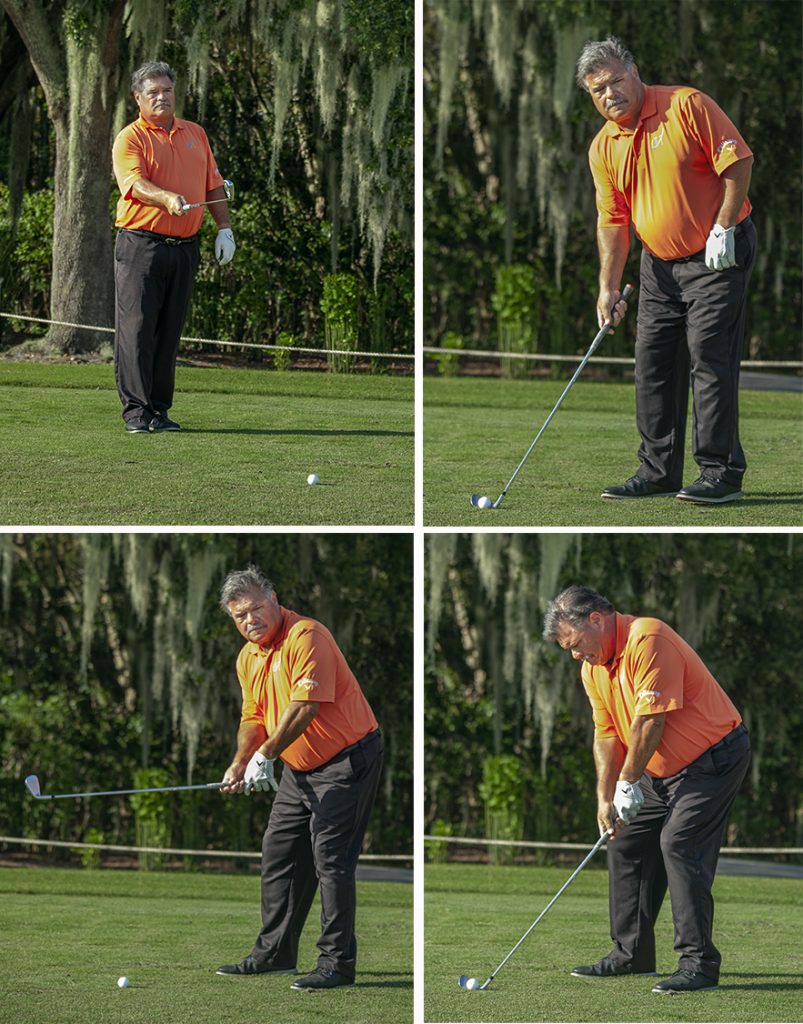
As you peruse the photos in the article and read the captions, these are the exact steps I have taken when preparing to hit a golf shot for the last 40 years of my life, without exception. I worked extremely hard at this during my playing days as both a college player and then during eight years playing professional golf.

In this regard, Jack was my model. It seemed his routine kept him in a protective cocoon, shielded from the surrounding pressures of professional golf. While players around him lost the rhythm, deviated from their less-structured routines and crumbled, Jack cruised on home to collect the hardware.

pre-shot 12-14

Now I want to be clear that we are all individuals, and no two routines are exactly alike – nor need be. That said, I want to dis-cuss that one part of all routines that I refer to as “The Critical Juncture.” This one area of the Pre-Shot Routine is in fact critical, because it is at the moment in time when so many parts of the “launching pad” are established and come together.

As you walk toward your shot and you turn the corner to first face the ball (making your body perpendicular to the target line), that’s when all of the following must instinctively fall into place:

  • The grip-club face relationship is established
  • The aim of the club face as it relates to the target
  • Your stance, its width and your ball position
  • Your distance from the ball
  • Your posture

I continually talk with my students, pleading with each of them to make one of their goals to become a set-up expert. Build a Pre-Shot Routine that is your very own, making absolutely sure it gets you into a sound launching pad condition. Own your routine and never, ever violate it.

Once you do, in fact, own a solid repeat-able Pre-Shot Routine, so many of those silly lost shots you hit during your round will simply go away.

Tom Patri, PGA, is a former Met PGA Teacher of the Year and South Fl0rida Teacher of the Year, and founder of TP Golf School in Naples, Florida. Reach him at www.tompatri.com

milestones breaking 70 2

Here we are on the cusp of not only a new year, but a fresh decade (at least as it’s commonly defined; technically the decade doesn’t begin until 2021, but we’ll go with it). Definitely an apt time to churn up those golf resolutions that nag us every time the calendar flips.

Let’s tackle them in two sentences or less and back them up with links to some of Golf Tips’ favorite lessons and equipment pieces from the last decade.

The best part: We’ve got 10 whole years to actually pull them off.

  1. Practice more, and practice better, even like a Tour player. Enough said.
  2. Practice short game more. From 100 yards in is where most scoring takes place, so why keep mindlessly banging balls on the range when you can hone those wedges and putter to a fine point?
  3. Sign up for a series of lessons from an accomplished, well-trained and passionate pro – a coach – that you know and trust.
  4. Play with purpose, every time. That doesn’t mean getting stressed and putting undue pressure on every shot, or chewing yourself out when things go wrong, but taking it just seriously enough to approach and enjoy the game as the ever-beguiling craft it is.
  5. Get your golf clubs fit, and keep them fit, including replacing the grips every year if you play a lot, every other year if you’re a more casual golfer. That goes for your putter, too.
  6. Get your body golf-fit with exercises and routines, including yoga, actually designed for the purpose.
  7.  Introduce a non-golfing friend, or better yet, a kid, to the game, get him or her proper lessons, and watch your own joy for golf increase mega-fold.
  8. Study, learn and abide by the new and improved (again, we’ll go with it) Rules of Golf, even the ones that seem capricious or just plain nonsensical. It’s a dimension of the game that far too many of us amateurs ignore or downplay, to our deep detriment.
  9. Set realistic scoring goals that take into account your current ability, the time you have to play and practice and level of commitment. Then conquer them, and feel free to puff up your chest a bit.
  10. On that note, for goodness’ sake, play more, in whatever form possible — join a club, play par 3 courses, six holes at sunup or sunset, set up a standing tee time at your local muni (which deserve our undying support, by the way) … whatever. Make the 2020s your ultimate golf decade.

Got some resolutions of your own? We’d love to hear them. E-mail editor Vic Williams at vwilliams@madavor.com or comment on Twitter or Facebook.

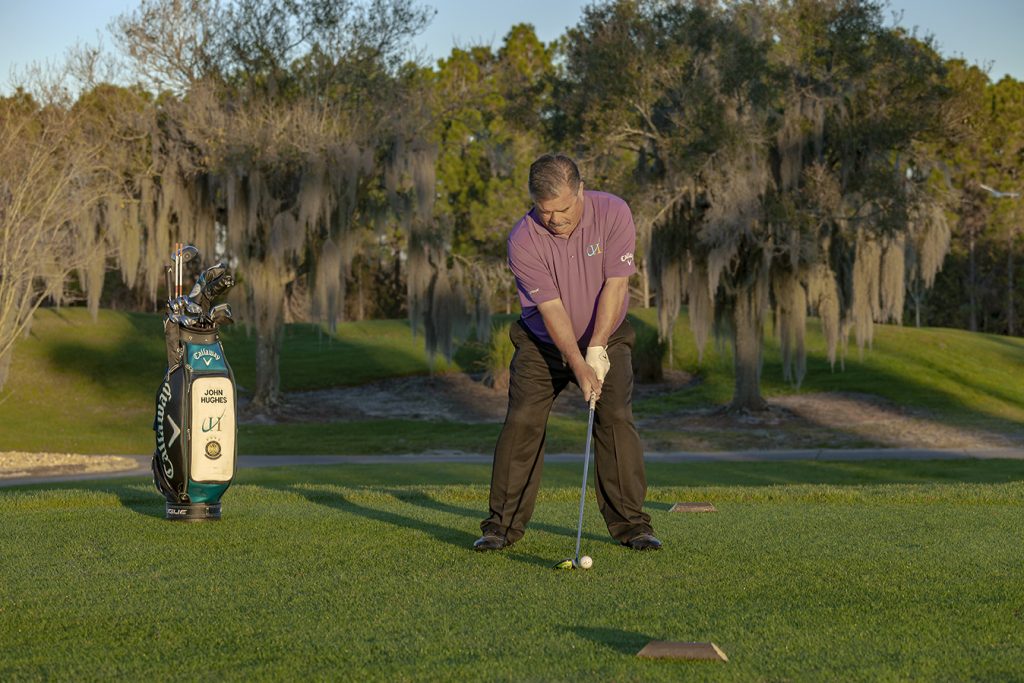
John Hughes Golf Tips October 2019

It’s time to get started with your plans to reach or exceed your golf milestone goals for 2020. Breaking through your barriers this year starts now, no matter what the weather conditions.

BREAKING 100

Is Your Pre-Shot Routine Ready?

Whether you realize it or not, you routinely do the same things each time you execute a golf shot. From pulling the club out of the bag to all the gyrations you make before starting your swing, this sequence of events may not be as efficient as you need to break 100. And if it is disrupted in any way, you’re less likely to come close to breaking 100.

golf milestone 2020 1 break 100

Let’s get your pre-shot routine consistent. Doing so breeds consistency in your swing.

  • Always take a deep breath as you exit the golf cart or stop at your ball while walking. Doing so sends extra oxygen to your body and relaxes you.
  • Assess the lie you have. Is a perfect lie or do you have some variables you need to think about? Take each variable one at a time, starting with a flat or uneven lie. Then move on to how much turf you have. Understanding how to balance and how to swing is more important at your current skill level versus whether grass or no grass behind the ball will affect your shot.
  • Determine the total carry distance of the shot. You can only control how far the ball carries, not how far the ball will roll.
  • Choose the correct club for the lie and the distance you will need to accomplish.
  • Stand behind the ball for practice swings. Practice swing should not be how you’ll swing at your current skill level. Practice swings are about maintaining the relaxation you started with the deep breath you took. Making practice swings behind the ball also allows you to:
  • Look down range at your intended target. Taking another deep breath, envision your shot traveling to your target, from behind the ball. You’ll have a better chance of setting up correctly if your eyes and brain can make the connection of how straight the intended target line really is and how the ball can fly there.
keep your head down vangellow
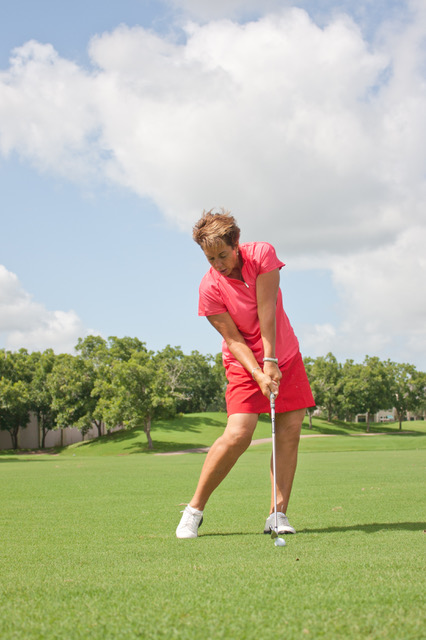
Deb Vangellow at impact.

Fall is right around the corner. The kids are heading back to school and the weather here in the state of Texas will be perfect…for golf! So many folks can now commit to learn to play golf — the wonderful game we all love.

If you are new to golf and are starting with golf instruction, do consider the “Success Progression.”

What is the Success Progression? Simply, this is acquisition of skill for transfer to play, working from the putting green back to the tee.

This is simply the best, most logical way to begin to learn the skills from the smallest swing (putter) working towards the biggest swing (driver). This progression ensures a clear understanding of the skill areas in a chronological fashion, where the order of movement slowly gets introduced and each new skill area builds on the one before.

I like to call this growing the size of the swing or working from grace to power—short game and then long game. This seems to work for most new golfers and the success you will feel from the start will give you a boost of confidence for sure. You will be playing on the golf course in no time.

Consider these key points for your learning sessions in the Success Progression.

pga jr. league high five

Twelve facilities have been named host sites of the 2019 PGA Jr. League Regionals presented by National Car Rental, which will take place throughout September. 

At each of these competitions, four co-ed All-Star teams of junior golfers ages 13 and under (48 in total) will compete to earn one of 12 spots in the 2019 PGA Jr. League Championship presented by National Car Rental, held Oct. 11-14, at Grayhawk Golf Club in Scottsdale, Arizona.

“From first-hand experience as a PGA Jr. League Coach, the fun and competitive team atmosphere of the PGA Jr. League Postseason presented by National Car Rental is so exciting to watch,” said PGA President Suzy Whaley, PGA/LPGA. “To host the Regional competitions at 12 PGA facilities only adds to the unique experience. PGA Jr. League is an outlet for girls and boys to learn and enjoy a lifetime sport, and we’re proud of the PGA and LPGA Professionals who are leading the charge.”

2019 Regional Competition Host Sites

Region 1: Cranberry Valley Golf Course – Harwich, Massachusetts (Sept. 14-15, 2019)
Host PGA Professional: Roman Greer, PGA Director of Golf

Region 2: Seaview Golf Club – Galloway, New Jersey (Sept. 14-15, 2019)
Host PGA Professional: Alex McGann, PGA Director of Golf

Region 3: Springfield Golf & Country Club – Springfield, Virginia (Sept. 21-22, 2019)
Host PGA Professional: Josh Tremblay, PGA Director of Golf

Region 4: PGA National Golf Club – Palm Beach Gardens, Florida (Sept. 7-8)
Host PGA Professional: Jane Broderick, PGA Director of Golf

Region 5: Nemacolin Woodlands Resort – Farmington, Pennsylvania (Sept. 14-15)
Host PGA Professional: Eric Johnson, PGA Director of Instruction

Region 6: Olive Branch Country Club – Olive Branch, Mississippi (Sept. 21-22)
Host PGA Professional: Daniel Yeargin, Head PGA Professional

Region 7: White Hawk Country Club – Crown Point, Indiana (Sept. 14-15)
Host PGA Professional: Duane Borcherding, Head PGA Professional

Region 8: Glen Oaks Country Club – West Des Moines, Iowa (Sept. 14-15)
Host PGA Professional: Steve Watt, PGA Director of Golf

Region 9: Lodge of Four Seasons – Lake Ozark, Missouri (Sept. 14-15)
Host PGA Professional: Dan Hilker, PGA Director of Golf

Region 10: The Club at Las Campanas – Santa Fe, New Mexico (Sept. 7-8)
Host PGA Professional: Brad Lardon, PGA Director of Golf

Region 11: Gold Mountain Golf Club – Bremerton, Washington (Sept. 14-15)
Host PGA Professional: Daryl Matheny, PGA General Manager

Region 12: Boulder Creek Golf Club – Boulder City, Nevada (Sept. 14-15)
Host PGA Professional: Andrew Schaper, PGA Director of Golf Operations

Click here for a Regional map color-coded by participating Sections in each event.

PGA Jr. League brings boys and girls together to learn and play golf on co-ed teams with expert coaching from PGA and LPGA Professionals. Kids wear numbered jerseys and play on teams with friends, competing in a two-person scramble format that builds confidence and encourages sportsmanship. 

Following the Spring/Summer Season, 10-player All-Star teams are formed from a combination of players in each league. These teams move through Section Championships in August to earn a spot at one of 12 Regionals held across the country in September. Twelve Regional champions advance to the PGA Jr. League Championship presented by National Car Rental, which has been held at Grayhawk Golf Club since 2016, and will stay through 2022.

While the focus of PGA Jr. League is primarily on the developmental nature of its Spring/Summer and Fall Recreational Seasons, the PGA Jr. League Postseason presented by National Car Rental presents competitive golfers a fun and aspirational finish to Spring/Summer Season play.

PGA Jr. League is the flagship youth pillar program of the PGA of America’s 501 (c)(3) foundation, PGA REACH, with the goal of making the program accessible to all interested kids in the United States and around the world.

PGAJrLeague.com

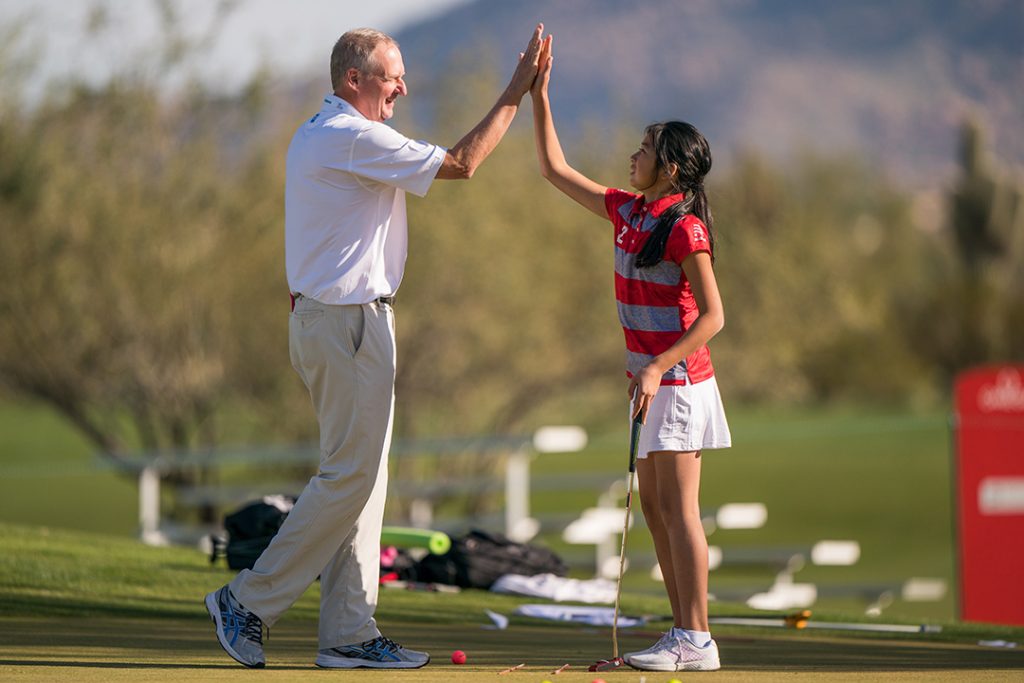
Photo above: Captain Kevin Weeks (l) and Allyson Duan (r) of Team illinois during a Practice Round for the 2018 PGA Jr. League Championship presented by National Car Rental held at Greyhawk Golf Club in Scottsdale, Arizona on November 16, 2018. (Photo by Darren Carroll/PGA of America)
golf milestones featured

It’s high summer, and now is the time to start measuring your progress toward achieving your Golf Milestones. How close are you to breaking through a milestone? Are you one or two strokes away? Did you start thinking about your scores too soon before the round is complete, believing you had a chance to break through?

Let’s explore some ways you can shave a couple strokes off your score to break through your next Milestone.

MARK YOUR GOLF MILESTONES PART 1

MARK YOUR GOLF MILESTONES PART 3

milestones 1 opener

Our lives are filled with milestones — significant dates and events within our lives that mark your coming of age. Whether it be the day you married, the birth of your first child, the wedding of a son or daughter, or the day you retire, milestones play a significant part in each person’s life. With the arrival of each milestone comes a new goal, a new adventure. And milestones provide us all the inspiration to continue our life’s journey.

As a golfer, milestones are part of your life too. The day you break 100, your first birdie, your first hole-in-one, and the day you shoot your age are all simple yet very important milestones in your experiences as a golfer. Yet, the milestones that mark your maturation of scoring sometimes seem too distant to reach.

Each milestone you meet and exceed requires a plan. Beginning with this issue, Golf Tips Magazine plans to help you build your plan to reach your golfing milestones.

MARK YOUR GOLF MILESTONES PART 2

MARK YOUR GOLF MILESTONES PART 3

caddie grand del mar

caddie grand del marPlaying a round with a skilled caddie can be one of the most enjoyable experiences in golf. Unfortunately, many golfers today have rarely had this opportunity, and when it arises, the prospect can sometimes evoke a sense of intimidation.

To help put players at ease, Sean Benz, caddie master of The Grand Golf Club at Fairmont Grand Del Mar in San Diego, has answered a few of the most common questions or concerns: 

Caddies make me nervous. What can I do about that?

The best approach is to simply introduce yourself to the caddie on the first tee box and give the caddie a brief rundown on your game – “I’m a 15 handicap and I don’t play with a caddie very often.” This will help set up the caddie with a good reference of what to expect, enabling the caddie to adjust to your playing level and concerns. Another good thing to remember is the caddie is nervous too. He or she wants to do the best job possible. Providing some basic information at the start will help the caddie do so.

Can a caddie really save me strokes?

The caddies should know the greens better than anyone else, and they absolutely can save you strokes. Every good caddie knows this is where they make their money. I train my caddies to tell their players “I am here to help you read the greens. If you would like my assistance, just ask.” This way players can read their own greens if they prefer or get help from the caddie when they feel they need it.

Sean Benz with a Grand
Sean Benz with a Grand Del Mar caddie

Should I really let my caddie tell me which club to hit?

As I’ve mentioned, the caddie will know the golf course better than almost anyone. The caddie will adjust his or her club suggestion by taking into account all the factors of a shot – wind, elevation change, distance, etc. I train my caddies to give players the actual distance to the pin and then the playing distance. You can help in this process by telling your caddie how far you typically hit a certain club. He or she can adjust from there. The more information you give your caddie, the better your experience will likely be.

What if I disagree with my caddie?

Disagreeing with your caddie’s advice is likely to happen at least once a round. A good thing for the player in this situation to say is “I’m going to go with my instincts here.” The caddie shouldn’t get upset and will respect the decision, knowing players need to determine what to do on their own from time to time.

If I’m struggling, can I ask my caddie for swing tips or playing advice?

I wouldn’t go down the road of asking my caddie for instruction. Caddies are there to guide you around the course, not to help you fix your slice. That is where professional instructors come into play. Things can go downhill pretty quickly trying to fix your swing during a round. All caddies have a couple of simple swing fixes in their back pocket, but they should offer no more than that.

When, how and how much do I tip my caddie?

Before your round simply ask the caddie master or the golf shop attendant about the tipping procedure. Either will be able to tell you what the customary tip is for caddies at their club. Tips on the 18th green are always appreciated, or you can tip your caddie in the staging area after the round once he or she has finished cleaning your clubs.

What it all boils down to, according to Benz, is to simply relax and enjoy the experience. He said all caddies want to do a great job for their players. They’re on your side. Let them guide you to the best round you’ve ever had.

The Grand Golf Club at Fairmont Grand Del Mar is San Diego’s only Tom Fazio-designed golf course. With stunning Los Peñasquitos Canyon as his canvas, Fazio created a masterpiece of dramatic elevations, diverse bunkering and lush fairways. The Grand Golf Club is graced by Pacific breezes from the nearby coast and awash with Southern California glow, making it a must-play in San Diego.

To make a tee time,  visit www.fairmont.com/san-diego/golf/. Information about available golf packages at Fairmont Grand Del Mar is available here.

alignment stick swing plane drill

Who would have ever thought that an alignment stick would become a golfer’s must-have accessory? You can now find an alignment stick in almost everyone’s bag, regardless of their handicap.

But alignment sticks are not just for alignment. An alignment stick can be used for improving a golfer’s swing and ball flight. So if you don’t have one, you’re missing out on a sure fire way to improve your game.

Here are my 10 best drills using an alignment stick for something other than aiming.

alignment stick swing plane drill

Swing Plane Drill

Swing plane is a commonly used term in golf but often misunderstood. Swing plane simply means controlling the club shaft position during the swing. To swing on-plane, the shaft needs to swing back and down on an angle that matches the club’s lie angle (the shaft angle with the club soled flat on the ground).

If you can swing on plane, your shots will be more consis-tent, more accurate and more powerful, while an off-plane swing will lead to a host of problems including an incorrect swing path, missing the center of the face and a poor Angle of Attack (AOA).

To set up this drill, match the alignment stick to the club’s lie angle, and then shove it in the ground (as pictured). Place another alignment stick on the ground so you are swinging toward a specific target. Then take several practice swings trying to match the club shaft’s position with the alignment stick on the backswing or downswing.

diamond resorts tournament featured

The hype leading up to the inaugural Diamond Resorts Tournament of Champions, which kicks off the LPGA 2019 season Jan. 17-20 at Tranquilo Golf Course at Orlando’s Four Seasons Golf and Sports Club, has been relentless, fun and justified. There’s nothing else like it in golf.

Actually, it’s actually two events in one, featuring 26 LPGA champions from 2017-18 playing for $1.2 million over 72 holes of stroke play while, at the same time and in the same groups, 49 sports and entertainment celebrities compete for $500,000 in a Modified Stableford format. Sure, it’s serious business with so much cash and prestige on the line, but it’s also a recipe for all-out fun under the Florida sun.

But how does the event figure into the larger golf landscape in terms of what quality of play the golfing public can expect to see either in person or over four days of coverage on the Golf Channel and NBC, especially with all the new Rules of Golf changes? And how will the celebs stack up against the world’s best women players at the Diamond Resorts Tournament of Champions? What kind of synergy will result, and will we learn anything new? What tips will the celebs pick up just watching the gals tee it up in competition?

Golf Tips editor Vic Williams joined several other journalists to asked those and other questions over two recent phone interviews with two LPGA champions, Marina Alex and Brittany Lincicome, and three of the celebrity tour’s most recognized names — former Atlanta Braves ace and Fox Sports baseball analyst John Smoltz, 1992 Super Bowl MVP Mark Rypien and former Arizona Cardinals quarterback Carson Palmer.

0
0
Your Cart
Your cart is emptyReturn to Shop