November 17, 2026

Instruction

McLemore_18C_6-22_WebReady
 
Golf Tips Magazine – 3 Day Golf School
 
Visit McLemore Resort this fall atop Lookout Mountain, Georgia. Take your game to the next level with world class golf instruction by 3 of Golf Tips Magazine’s, Top 25 Instructors.
 
Join Golf Tips Magazine’s 3 Day Golf School – October 27th – 29th, 2023.
 
For details email: editor.golftipsmag@gmail.com
HURRY! Limited Spaces. “BOOK NOW!” https://form.jotform.com/232096447523155
 
Play Among The Clouds
 
Experience one of the southeast’s golf treasures. Located atop Lookout Mountain in northwest Georgia, the McLemore Highlands Course, is an award-winning, cliff-edge par 71 course re-imagined by Bill Bergin and Rees Jones that plays 7,055 yards from the tips. McLemore’s second course, The Outpost, will boast five cliff-edge holes and is scheduled to open in early 2024.If you are new to McLemore and want to experience golf above the clouds, simply join our Friends of McLemore opportunity or reserve a cottage or home in our Stay & Play program.
 
 
The Creag “Clubhouse”
Overhead view of the 6 hole short course

Olde Cypress

The Club at Olde Cypress, one of the most vibrant, active and welcoming private clubs along the Sunshine State’s stunning Paradise Coast, has named Gary Shea its new head professional.

Before arriving at Olde Cypress this month, Shea was the first assistant at Foxfire Country Club, a 27-hole Arthur Hills-designed course just 20 minutes away. He’s lived in Naples since 2009, when he started at Foxfire, and has been a Class A PGA Member since 2021. An avid and highly-skilled player, Shea plays in numerous South Florida PGA Sectional tournaments throughout the summer offseason. He first played Olde Cypress in 2011 and last year finished second at the challenging P.B. Dye-designed course during the Southwest Chapter Pro/Pro.

“Gary has such a passion for this wonderful game and is already developing a powerful connection to our members who appreciate his commitment to the product and experience,” says Olde Cypress Director of Golf Joe Conforti, PGA. “We’re excited to welcome him to Olde Cypress and to have him as part of our valued team.”

Shea arrives at Olde Cypress during an unprecedentedly exciting time, as the club has undergone numerous enhancements over the past two years. In 2021, the course reopened following a multi-million-dollar investment by owner STOCK Development. The expansive project entailed resurfacing all 18 greens, practice green and chipping area with TifEagle Bermuda. Tee boxes were enlarged, leveled and re-grassed with Bimini Bermuda, and a new subsurface drainage system was installed for rapid expulsion of excess water. The course’s 98 bunkers were also refreshed with new edging, contouring and visually-stunning sand.

“The unwavering commitment to Olde Cypress by ownership, management and these wonderful members made this an easy decision and incredible opportunity,” says Shea. “That, and I’m a true believer that this is one of the state’s best golf courses and operations. I’m proud to be a part of the team and look forward to creating an amazing experience for our members and guests.”

The experience is now punctuated by a recently renovated 34,000-square-foot clubhouse that reopened in September last year following a full-scale interior renovation by Winter Park-based Soco Interiors. The golf shop, welcome area and offices were recast in a contemporary palette of crisp whites, sophisticated grays and layered neutrals with accents of deep blue.

The woodwork was painted a cool gray, blending seamlessly with new silver and wood-accented pendant lighting and a modern sphere-shaped chandelier. Countertops were finished with Calacatta stone tops, and revamped display areas for clothing and shoes create a neutral backdrop for displaying the latest fashion trends.

The Club at Olde Cypress is operated by STOCK Hospitality, which provides innovative solutions uniquely tailored to club communities. Creating exceptional member experiences is the cornerstone of all Stock Hospitality services, which range from club operations and golf course maintenance to membership marketing and programming. New members can choose from three categories of membership carefully crafted to offer something for everyone.

Widely considered one of the most vibrant, active and welcoming clubs in Southwest Florida, Olde Cypress is home to the first P.B. Dye golf course in Collier County. Other amenities include tennis and pickleball courts, fitness center and pool and a 34,000-square-foot clubhouse featuring both casual and fine dining. The club and surrounding 540-acre gated community are just minutes from Naples’ famous beaches, world-class shopping on 5th Avenue, and the Southwest Florida International Airport.

For more information about Olde Cypress and all it offers along Naples’ Paradise Coast, visit www.oldecypress.com.

pre-shot routine 1-4

If you polled a combined group of PGA Tour Players and a deep list of the very best golf instructors, asking them to list the top 30 Golf Swings from 1970 to present, the great Jack Nicklaus might not make their list. Poll the same two groups as to the greatest Pre-Shot Routine of all time, and Jack would easily be No. 1.

The Pre-Shot Routine is a cornerstone of my teaching, and I feel strongly it is a must-needed skill to teach and coach the recreational player. Let me be clear: to be a great player, an EXACT, repeatable, and clearly understood routine, every single time you attempt a golf shot, is an absolute must.

The Pre-Shot Routine can be individual in design to fit the needs of a specific player. However, there are definite fundamental and essential things it should in fact address and accomplish.

Let’s discuss several of the things I like to I teach and coach every one of my students who need to establish a sound Pre-Shot Routine.

pre-shot routine 1-4

I believe one of the main purposes of a Pre-Shot Routine is to establish a solid cadence. This allows the player to stay in a rhythm never getting too fast or too slow. Untrained players often unknowingly speed up after a bad shot due to the anxiety they experience. Likewise, they sometimes speed up after an exciting shot or birdie. Conversely, they think that after a bad shot  they should “slow down.” In fact, neither is correct. Simply stay in your routine.

I remember being at The Buick Classic at Westchester Country Club one year, sitting in on a session watching David Leadbetter work with Nick Faldo – using a stopwatch and counting steps from behind the ball to establish a time formula to take to the course.

pre-shot routine 6-8I often ask my students what they think is the No. 1 most common trait among world-class players. Of course, I get a boatload of answers, mostly of the mechanical, in swing-type. After they have exhausted their thoughts as to the possible answers and I have continuously shaken my head, they then exclaim, “so what IS the most common trait?”

I look them straight in the eye and calmly reply, “they are boring …they do the same exact thing every time.”

pre-shot 9-11

Of course, I’m referring to their Pre-Shot Routine. In other words, the players I generally like the most are the ones you show up to watch midway through their rounds and you can’t tell if they are eight under or eight over. You watch them closely and their cadence from shot to shot is identical. Again, Jack was the master of this skill.

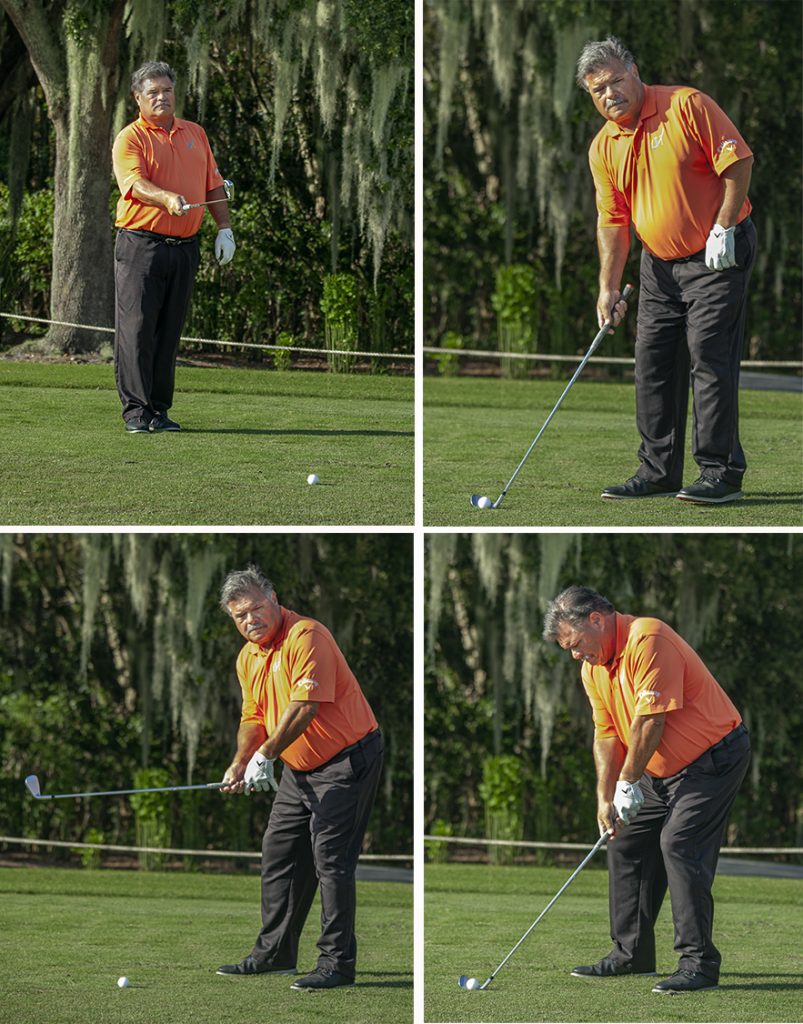
As you peruse the photos in the article and read the captions, these are the exact steps I have taken when preparing to hit a golf shot for the last 40 years of my life, without exception. I worked extremely hard at this during my playing days as both a college player and then during eight years playing professional golf.

In this regard, Jack was my model. It seemed his routine kept him in a protective cocoon, shielded from the surrounding pressures of professional golf. While players around him lost the rhythm, deviated from their less-structured routines and crumbled, Jack cruised on home to collect the hardware.

pre-shot 12-14

Now I want to be clear that we are all individuals, and no two routines are exactly alike – nor need be. That said, I want to dis-cuss that one part of all routines that I refer to as “The Critical Juncture.” This one area of the Pre-Shot Routine is in fact critical, because it is at the moment in time when so many parts of the “launching pad” are established and come together.

As you walk toward your shot and you turn the corner to first face the ball (making your body perpendicular to the target line), that’s when all of the following must instinctively fall into place:

  • The grip-club face relationship is established
  • The aim of the club face as it relates to the target
  • Your stance, its width and your ball position
  • Your distance from the ball
  • Your posture

I continually talk with my students, pleading with each of them to make one of their goals to become a set-up expert. Build a Pre-Shot Routine that is your very own, making absolutely sure it gets you into a sound launching pad condition. Own your routine and never, ever violate it.

Once you do, in fact, own a solid repeat-able Pre-Shot Routine, so many of those silly lost shots you hit during your round will simply go away.

Tom Patri, PGA, is a former Met PGA Teacher of the Year and South Fl0rida Teacher of the Year, and founder of TP Golf School in Naples, Florida. Reach him at www.tompatri.com


downswing hip slide 1

downswing hip slide 1One of the most prevalent issues that I see with my students is sliding the left hip (right-handed golfer) too far toward the target in the downswing.

Most of us, when we first started playing the game, were told to hit against a firm left side. When the left hip moves well past the left foot, there isn’t a whole lot of firmness. There isn’t a whole lot of rotation. And without rotation, power is dramatically reduced.

Here is an analogy that might help put you back on track: Maybe you have a fenced-in back yard with a gate. If you don’t, humor me and just pretend that you do. If the post that the gate is attached to is straight up and down, the gate opens and closes perfectly. If the post is tilted, good luck with the gate.

downswing hip slide 2Same with your golf swing. At impact, if the left hip is over the left knee and left ankle and forming a straight, vertical line, your right hip will rotate perfectly, just like the gate. If the left hip slides past the left foot, rotation is diminished – along with power and accuracy.

Here is a drill to help you get the hang of it: stand in a doorway with the outside of your left foot touching the door jamb. Cross your arms across your chest. Make a backswing turn and then a through swing turn. During the latter, allow your left hip to move laterally, just enough to make contact with the jamb. That amount will put you in a vertical left leg position, the perfect place for maximum hip rotation.

Hip rotation translates to more power, which we all want.

John Marshall, PGA, has been voted one of the top instructors in Georgia, is a two-time American Long Drivers Association super senior national champion and five-time RE/MAX World Long Drive finalist.

goldstein-putt

Clearly, when it comes to putts from 20 feet or less, we have one goal. Hole it! Make the putt!

From 50 feet, getting it close and two putting is fine. Well done. BUT if you are not trying to make every putt inside 25 feet, you will lose to someone who is.

The worst miss from this distance is short. Ugh! Even thinking about leaving a makeable putt short hurts. There are four misses: Long, left, right, and short. We don’t love any of them, but short is the worst.

goldstein-putt

This great drill will assist your feel with feedback so you avoid leaving those putts short.

Lay a mid-iron down two and a half to three feet behind the hole. Use three balls and your normal routine for each putt. Simulate playing conditions just like you are on the course. The goal: You can’t leave any putts short. You must get every putt either in the hole, or past the hole, yet short of the golf club behind the hole. This is feedback. Practicing without it just gets you sunburned. Practicing with feedback can make you great!

As you can see in the first photo, no good. I left it short. In the second photo, I was able to roll the balls with good speed and not leave them short. I know this drill will help you make more putts.

Challenge yourself: In time, practice this drill until you make nine putts and leave nothing short. The penalty for leaving a putt short? Fetch it and start over at 0. Not easy, but it will 100% make you a better putter, with great speed control.

Barry Goldstein is Director of  Instruction at Inverrary Country Club in Lauderhill, Florida

straight golf shots grip

One of the most common full swing mistakes amateur golfers make is leaving the right side (trail side) of the body “behind” through impact and the follow through, with no release. This is why many players feel the need to strengthen their grips in order to square the clubface and hit straight golf shots, even though the results are usually poor.

Here’s why: the squaring action of the club face has to be performed by the turning and pivot action of the whole body as opposed to “throwing” your hands at the ball. This is also why, no matter how strong a player might grip the club, he or she can slice the ball terribly by sliding on the downswing.  And if body releasing does happen to occur, the dreaded duck hook is the result.

straight golf shots grip

The first thing to do is to make your grip more neutral by letting both hands face each other when you grip the club, as I’m doing above. You want to see a 2.5-knuckle grip of the front hand, and a two-knuckle grip of the back hand.

The key here can be equated to the simple act of walking. Think about the physical act of advancing with your feet and legs: you simply impulse your body weight without stopping it. You let it go. If you do not do this, then you are not moving dynamically. It would be like  walking on stones to cross an arroyo, making sure the next stepping stone is firm enough for secure footing. This is not dynamic. You don’t walk on pavement like that, right?

straight golf shots downswing

The golf swing is no different. You have to let go with that same “free-transporting-ride” from the top of the swing all the way through to the finish.  And the key is the rounded motion of the trailing knee, hip and shoulder.

A good check point is to get onto the big toe of the trail foot with no effort, in one single motion, from the top of the backswing to the finish.

straight golf shots finish

If you focus on the rounded motion of your right side, you can now swing as far left as you want from the top of the backswing and fully release the club with confidence. You will find your body performing the much-desired “forward body weight shift” in the correct way.

Antonio Reynante is Head Golf Professional at Quivira Los Cabos in Mexico. Visit the resort at www.quiviraloscabos.com.

milestones breaking 70 2

Here we are on the cusp of not only a new year, but a fresh decade (at least as it’s commonly defined; technically the decade doesn’t begin until 2021, but we’ll go with it). Definitely an apt time to churn up those golf resolutions that nag us every time the calendar flips.

Let’s tackle them in two sentences or less and back them up with links to some of Golf Tips’ favorite lessons and equipment pieces from the last decade.

The best part: We’ve got 10 whole years to actually pull them off.

  1. Practice more, and practice better, even like a Tour player. Enough said.
  2. Practice short game more. From 100 yards in is where most scoring takes place, so why keep mindlessly banging balls on the range when you can hone those wedges and putter to a fine point?
  3. Sign up for a series of lessons from an accomplished, well-trained and passionate pro – a coach – that you know and trust.
  4. Play with purpose, every time. That doesn’t mean getting stressed and putting undue pressure on every shot, or chewing yourself out when things go wrong, but taking it just seriously enough to approach and enjoy the game as the ever-beguiling craft it is.
  5. Get your golf clubs fit, and keep them fit, including replacing the grips every year if you play a lot, every other year if you’re a more casual golfer. That goes for your putter, too.
  6. Get your body golf-fit with exercises and routines, including yoga, actually designed for the purpose.
  7.  Introduce a non-golfing friend, or better yet, a kid, to the game, get him or her proper lessons, and watch your own joy for golf increase mega-fold.
  8. Study, learn and abide by the new and improved (again, we’ll go with it) Rules of Golf, even the ones that seem capricious or just plain nonsensical. It’s a dimension of the game that far too many of us amateurs ignore or downplay, to our deep detriment.
  9. Set realistic scoring goals that take into account your current ability, the time you have to play and practice and level of commitment. Then conquer them, and feel free to puff up your chest a bit.
  10. On that note, for goodness’ sake, play more, in whatever form possible — join a club, play par 3 courses, six holes at sunup or sunset, set up a standing tee time at your local muni (which deserve our undying support, by the way) … whatever. Make the 2020s your ultimate golf decade.

Got some resolutions of your own? We’d love to hear them. E-mail editor Vic Williams at vwilliams@madavor.com or comment on Twitter or Facebook.

John Hughes Golf Tips October 2019

It’s time to get started with your plans to reach or exceed your golf milestone goals for 2020. Breaking through your barriers this year starts now, no matter what the weather conditions.

BREAKING 100

Is Your Pre-Shot Routine Ready?

Whether you realize it or not, you routinely do the same things each time you execute a golf shot. From pulling the club out of the bag to all the gyrations you make before starting your swing, this sequence of events may not be as efficient as you need to break 100. And if it is disrupted in any way, you’re less likely to come close to breaking 100.

golf milestone 2020 1 break 100

Let’s get your pre-shot routine consistent. Doing so breeds consistency in your swing.

  • Always take a deep breath as you exit the golf cart or stop at your ball while walking. Doing so sends extra oxygen to your body and relaxes you.
  • Assess the lie you have. Is a perfect lie or do you have some variables you need to think about? Take each variable one at a time, starting with a flat or uneven lie. Then move on to how much turf you have. Understanding how to balance and how to swing is more important at your current skill level versus whether grass or no grass behind the ball will affect your shot.
  • Determine the total carry distance of the shot. You can only control how far the ball carries, not how far the ball will roll.
  • Choose the correct club for the lie and the distance you will need to accomplish.
  • Stand behind the ball for practice swings. Practice swing should not be how you’ll swing at your current skill level. Practice swings are about maintaining the relaxation you started with the deep breath you took. Making practice swings behind the ball also allows you to:
  • Look down range at your intended target. Taking another deep breath, envision your shot traveling to your target, from behind the ball. You’ll have a better chance of setting up correctly if your eyes and brain can make the connection of how straight the intended target line really is and how the ball can fly there.
circle drill featured

One of the most important things I can do as a coach and instructor is to help my students understand why they hit the ball well—and what they are doing when they are not hitting it well. I always feel that their poor shots give the teacher and student the greatest opportunity to learn. Often, it’s the student’s concept that is off. This is a great visual that I use to help the student understand both path and face: It’s the Inner and Outer Circle drill.

There are two semicircles we deal with in the golf swing: The inner that the hands are on, and the outer that the club is on. In the accompanying photos, I’ve drawn “inner” and “outer” lines on the turf with red paint to illustrate how they  work together.

Address: Hands establish the inner circle and club is on the outer

In the photo above I show how my hands match the inner circle and the club matches the outer circle at address.

circle drill photo 2
The proper backswing: Hands on inner circle, club on outer

In the backswing, the hands stay on the inner circle and the club head stays on the outer. Often, players’ faults are caused from this relationship getting off, right from the start.

circle drill photo 3
The ideal downswing: The hands drop back down on the inner circle and club head moves outward to the outer circle

The key move is on the downswing. The hands need to come back down and inward and get on the inner circle, while the club head needs to come out slightly and stay on the outer circle.

circle drill photo 4
Impact: Hands and club stay on their proper circles

Where instruction tends to stop is at impact, which I’m re-creating in the photo above.

The forward part of the swing and arc is not explained enough to students. They need to understand that the hands and club don’t break away towards the target—they stay on those circles.

circle drill photo 5
Forward part of the arc and swing: Hands still on inner circle around body and club has moved around to the left. Face square to the path

As I demonstrate in this photo, the hands move inward toward the front hip/heel and the club head moves quickly left of the target line. By maintaining this relationship, the club face stays square to the path, which minimizes excessive opening and closing. This also creates a much lower rate of closer resulting in straighter shots and less need to time up the face.

Players can hit half shots with these circles on the ground as well.

Faults and Fixes

circle drill photo 6
Fault: The club and hands are both on inner circle
  • In the downswing, if a player has both the hands and the club on the inner circle, their impact will tend to be shallow and path to the right, re-sulting in hooks, pushes, fats and thins.
circle drill photo 7
Fault: The club and hands are both on outer circle
  • A player whose hands and club both go out on the outer circle in the downswing will be too much above the plane, resulting in pulls, slices, chunks, and tops.

This concept gives my students a clear understanding on how to correctly deliver the club to the ball. Again, explaining to them why they are not hitting it well is one of the many keys to great instruction—and learning.

Krista Dunton is Director of Instruction at Berkeley Hall Resort in South Carolina, LPGA Top 50 Teacher and 2006 Carolinas PGA Teacher of the Year.

kpmg women's pga whaley

The PGA of America announced the schedule for the 2020 KPMG Women’s PGA Championship Golf Clinics, a nationwide series of 12 full-day clinics that will welcome and empower women to learn more about the Game of a Lifetime.

KPMG Women’s PGA Championship Golf Clinics, previously known as the PGA Golf Clinics for Women, will continue to be managed by the PGA of America in conjunction with Jane Blalock, a 27-time winner on the LPGA Tour, and KPMG, the title sponsor of the KPMG Women’s PGA Championship. 

The KPMG Women’s PGA Championship Golf Clinics will bolster the 28-year foundation of women’s clinics created by Blalock by channeling the prestige and platform of the KPMG Women’s PGA Championship, one of the LPGA’s five major championships.

The 2020 KPMG Women’s PGA Championship will be contested at Aronimink Golf Club in Newtown Square, Pennsylvania, June 23–28.

“We received so much positive feedback last year from our debut of the KPMG Women’s PGA Championship Golf Clinics, and yet we’re working to make 2020 even better,” said Suzy Whaley, President of the PGA of America. “We’re calling on women of all skills levels, whether you’re new to this game or played it in college. These clinics are very social and offer a terrific opportunity to network with women who appreciate golf. They are also designed to introduce and share the game’s many virtues, but more than anything, we strive to encourage these women to actively participate in golf for years to come.”  

Clinic participants of all skill levels will learn the fundamental aspects of social and business golf during an action-packed schedule that includes plenty of personalized coaching, play and assessments from PGA/LPGA Professionals, a keynote speaker, breakfast, lunch, and a networking reception to cap off the program.

In 2019, over 1,200 women aged 18 to 64 were trained in golf and energized in spirit by 120-plus PGA/LPGA Professionals during 12 KPMG Women’s PGA Championship Clinics. 

Additionally, on social media, PGA Golf Clinics for Women have merged with @KPMGWomensPGA across Facebook, Instagram and Twitter. Follow @KPMGWomensPGA for all of the latest news and updates from the golf clinics.

The 2020 KPMG Women’s PGA Championship Clinic schedule begins April 27 at El Niguel Country Club in Laguna Nigel, California and concludes on October 26 at Seagate Country Club in Delray Beach, Florida. All clinics are held on Mondays, with the exception of the May 19 event in Hartford, Connecticut, which falls on a Tuesday. The full schedule:

DATE CITY SITE
April 27 Los Angeles El Niguel Country Club / Laguna Niguel, Calif. 
May 11 Boston (1) Renaissance Country Club / Haverhill, Mass.   
May 18 West Orange, N.J. Crestmont Country Club / West Orange, N.J.  
May 19 Hartford, Conn. Brooklawn Country Club / Hartford, Conn.   
June 15 Chicago Westmoreland Country Club / Wilmette, Ill.   
June 22 New York Old Oaks Country Club / Purchase, N.Y.  
July 13 Minneapolis Braemar Country Club / Edina, Minn.   
July 20 Charlotte, N.C. Charlotte Country Club / Charlotte, N.C.   
July 27 Boston (2) The Cape Club of Sharon / Sharon, Mass. 
August 24 San Francisco Stanford Golf Course / Stanford, Calif.   
September 28 Dallas Gleneagles Country Club / Plano, Texas   
October 26 Delray Beach, Fla. Seagate Country Club / Delray Beach, Fla.  

To register for or obtain information about the KPMG Women’s PGA Championship Golf Clinics: KPMGWomensPGAClinics.com

0
0
Your Cart
Your cart is emptyReturn to Shop