September 16, 2026

Mental Game

open-close-mind


Having the best equipment, playing on a top course, or having endless knowledge about the golf swing will never yield success in the game if the golfer doesn’t know how to use his mind on the course.

Things like anxiety, emotional reactions, and distractions can all cripple a golfer’s ability and keep him from success. Overcoming these obstacles is the key to lower scores and the only way to do that is “To Clear Your Mind.”

To improve, you have to keep your mind ‘Open’ to new techniques and instruction. It has been often said that a beginning golfer tends to be more open minded to instruction than an expert golfer who tends to view instruction with a skeptical and closed mind.

A great many golfers come to a lesson with so many preconceived ideas about their swing that they are unable to digest anything the instructor introduces. When receiving instruction you must be willing to try different techniques and put practice time in to perfect it. Withhold any judgment about the new technique until you have put it into practice for awhile.

Ben Hogan comes to mind as a perfect example of keeping your mind open. He was one of the greatest ball strikers of all time, practiced relentlessly, and never seemed to tire of trying new techniques, in fact, he delighted in it because he believed there was always more he could learn. He kept his beginners mind, meaning he was always open and receptive to new things and ideas.

On the course you have to open your mind to letting go of stress, anxieties, distractions and reactions. These are negative components in a game. Deep breathing before each tee can release tension and promote relaxation, which will help you achieve a more relaxed swing.

While on the sidelines visualizing successful shots can eliminate emotional reactions instead of beating yourself up for a previous blunder. Also, keeping your mind on the game is critical for success. Instead of getting distracted by conversation, golfing tips from fellow players, text messages vibrating in your pocket…use your time to focus your mind on how techniques are working for you.

Keep your mind clear, open, and free from distractions.

shutterstock_309088538 - Copy


The Scenario 

You hit a pretty good drive, but as you step off the yardage to the green you discover that you’re 5 yards farther than you comfortably hit your 8 iron, and 5 yards shorter than you would hit your 7 iron. So what do you do? 

Here’s the Solution 

Learning to take yards on or off the distance you hit each club is an important skill. If you don’t have it, then the only time you will get close is when you are at exact distances from the pin with each of your clubs. The odds of that happening are not very likely, so you need to be able to make adjustments in order to give yourself options. Below are clues to help you decide between hitting a hard shot with a shorter iron or a soft shot with a longer one.

Hit The Longer Club If… 

  • The hole plays uphill
  • The wind is in your face
  • There’s trouble short. 

Plus, make sure the distance you’re sitting at is to the pin, not the center of the green. If you only know the distance to the center, play the longer club if the pin is in the middle or back of the green.

Hit The Shorter Club If… 

  • The hole plays downhill
  • The wind is at your back
  • There’s trouble long
  • If you only know the distance to the center, play the shorter club if the pin is in the front of the green. 

To add or subtract 5 yards off that club you need to incorporate the following techniques. 

How To Add 5 Yards To An Iron 

Step 1 – Play the ball just back of center and lean the shaft forward. This will de-loft the clubface, turning your 7 iron into a 6 ½ iron. 

Step 2 – Make a full backswing. From the top, feel like you’re about to pinch the ball between the clubface and the grass, as opposed to picking it off the turf. 

Step 3 – Be sure to accelerate to a full finish.

How To Subtract 5 Yards From An Iron 

Step 1 – Play the ball forward, more towards your left heel, and set your hands directly above the ball. 

Step 2 – Make a ¾ backswing, so your hands reach about shoulder height. 

Step 3 – Swing to a ¾ finish on the follow through, but make sure to fully turn toward the target. Because you are not making a full turn, be sure to keep an even tempo in your swing. It’s easy to rush in the backswing or downswing on less than full shots. So think “Smooth” when you execute the ¾ shot. 

Another “Key Point” to remember. When hitting your longer club, choke down an inch or two on the handle when taking your grip, it shortens the club making it easier to control. If you keep this in mind next time you’re faced with shots that are in-between your normal distances, you will find that you will be able to better handle the situation. This is a great tip to practice next time you visit the practice range, having the skill to execute these shots will give you a world of confidence on the course.

golf learner 1

golf learner 1One of the best things you can do for yourself is find out what learning style you are. While the validity of learning styles has long been debated by neuroscientists, many great educators feel they are not only valid, but are invaluable for teaching and learning. Knowing your learning style — what kind of golf student you are — can increase your awareness during practice, lessons, and on course play.

Let’s say you need to go somewhere you have never been. You don’t know how to get and are not allowed to use a map or your GPS. Would you want me to:

  1. Tell you how to get there?
  2. Read written directions?
  3. Look at a map?

golf learner 2This is a simple way to discern which style you might be. I have created a longer version which you can complete online (see below), but for now, this will do.

If you said, “Tell me how to get there,” that would mean are an auditory learner. If you said, “I want to read written directions,” you would be more of a kinesthetic learner. If you want to see a map, you are a visual learner.

How can you use this knowledge to play better golf? For me, creating swing keys that I use while playing help me stay focused on the task at hand.

Let’s say you have a habit of being quick from the top.

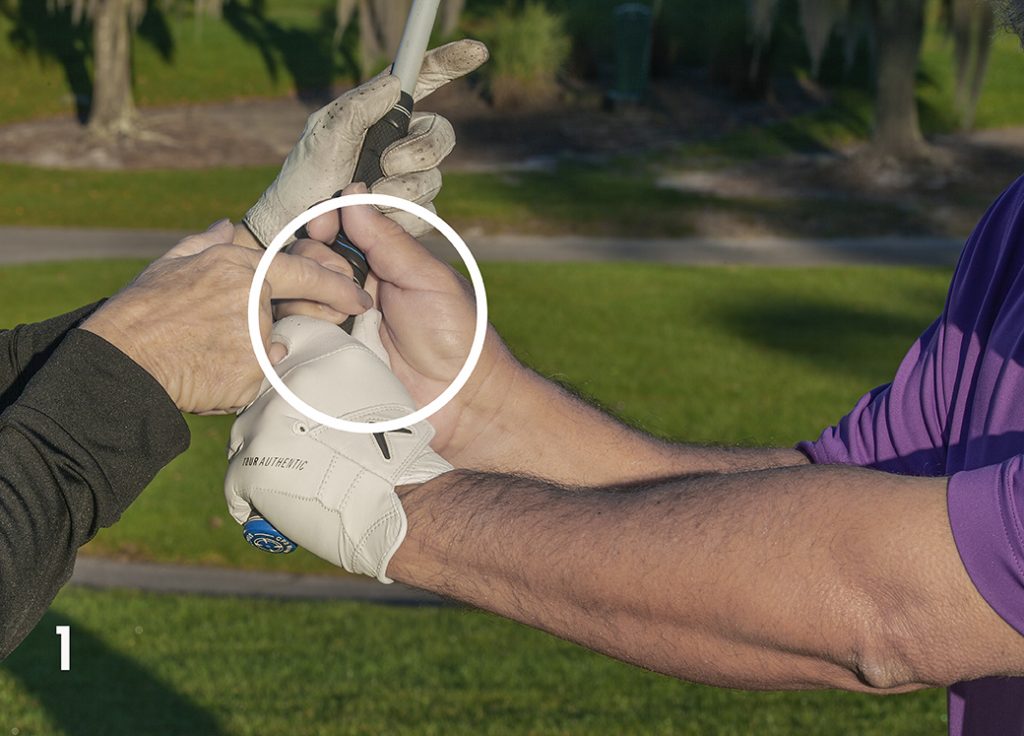
If you are someone who needs to feel their swing, I suggest you try to feel the club resting on your thumb at the top of your backswing (Photos 1 and 2). For a right-handed player, you would feel the club resting on your left thumb at the top of the backswing. (Left handed players would feel it on their right thumb).

If you a visual player, you can use the logo on your glove to be sure your hands are correct at the top of your swing (Photo 3). Typically, you can see this out of the corner of your eye as you take the club back, I am not asking you to lift your head, just move your eyes as the club starts back. This will ensure the face to square.

golf learner 3If you need to hear it, I suggest you create a mantra while you swing. I use the rhythm,

One – And – Two – And  

or

One – Two – Three – Four

In a golf lesson, you will learn and retain more if you know what your personal style is. If you are a visual learner, ask your teacher to show you what they want you to do. When they visually demonstrate you will learn easier. You can also as them to video tape you.

If you are an auditory learner, ask them to tell you exactly what they want you to do.

If you are kinesthetic, ask them if they have notes you can read to be sure you understand what they are telling you.

I guarantee if you learn to better understand yourself, your game will improve. Visit here if you’re interested in the online version.

golf_mental_game

Editor’s note: In January, Hawaii-based mental game and performance coach and author Cary Valentine interviewed several Tour players at the Sony Open — major winners Zach Johnson and Stewart Cink, Champions Tour standout Kenny Perry and PGA Tour veteran Anirban Lahiri — about how they prepare mentally and spiritually for competition and keep focused on peak golf performance, between the ropes and off the course as well. Here’s what he found.

Stewart, where you were in contention to win numerous tournaments in 2018, did you make changes that caused you to step up your game?

Think Like A Pro - Stewart Cink
Stewart Cink. Photo By Vic Williams

Cink: During the first half of the year,  I was kind of languishing around and not  getting much out of my work — just generally uncommitted even though I didn’t know it at the time, ’cause when you’re in it, you don’t always realize it.

Then I went to the Memorial, where I’ve played pretty much every year; it’s one of my favorites. I’ve got some pretty good performances there, I always felt  at home playing there, and I played terrible — that was an eye-opener for me.

After that tournament, I missed qualifying for the U.S. Open, so I was stuck there for two days with nothing to do.

I decided to do a little mirror time, so to speak — you know, looking in the mirror and figuring out what are you doing, get committed. I went back and looked through some of my notes from the past year and a half, that I keep as a log — swing thoughts, spiritual things, confidence boosters, routine related items, anything. I just jot little notes down and I tried to do that after every round.

I went back in and rediscovered a few thoughts and a few commitment items that translated into immediate, sharper focus, better decision making.

My caddy, Taylor, and I call it “cleaner golf.” I like to separate the decision making and the execution, and felt like I was quite gray before, then suddenly things shifted to black and white. It just translates into better golf. I struggle being a little older now. The focus part of it is a little bit harder to grasp onto than when I was young.

It just seems like a few shots here and there, where I was a little bit asleep — I don’t catch a little something that I would have caught 10 years ago, and I don’t reboot. That’s a big key in golf.

Golf is one of the only sports that let you re-create the present. Something enters your mind that you don’t like, it gets you distracted and you have a choice to make — you either need to start over and get clear or you can go ahead and hit it anyway. I call those “anyway shots,” and they are usually quite destructive.

Either you’ll get an immediate bad result or you get a good result, and it lulls you into thinking that you can continue those “anyway shots” until you do get disruptive results. For me, that’s kind of like the sweet spot of focus, being able to recognize those moments where I need to probably start over and yet I sometimes don’t.

I’m now really diligent after a round. I’m looking back and trying to do my best in those moments, because that’s what I’ve identified as being the most destructive as far as results.”

How do golfers deal with nerves and anxiety on the golf course?

a game photo

As Dr. Bob Rotella titled his famous book, “Golf Is Not A Game Of Perfect.”

Unfortunately, very few golfers really accept this to be true. Instead, they go out on the course expecting perfection and their “A game” to show up, and then struggle to cope when it’s not there.

I heard an interesting statistic recently, from a reliable source: Tour players (on average) make 80 percent of their money in a season from five events.

What does this tell us? It tells us that they have their A game a handful of times in a season. The rest of the time they are managing their B or C game.

But one of the reasons that they are Tour players is that they are generally very good at dealing with misses and not letting them affect their ability to score, with whatever game they have on that day.

Golf is easy when you have your A game, but the fact is you are more likely to have your B or C game during any round. Golf is a difficult game most of the time. It’s not just about how many good shots you hit, but also about how well you’re able to deal with your misses.

If you can do this well and learn how to bounce back, you can still achieve success with your B or C game

I recently had an in-depth conversation with one of my Tour player students about strategies to bounce back from bogeys (or worse). She admitted that, in her last tournament, she didn’t do the best job of it and let some of her misses create doubt and get herself down, leading to more bogeys than normal.

We worked through the strategies she has in her “mental game tool box,” to recover quickly and I’d like to share some of them with you.

golf mind cuccaro

Jim Flick, Jack Nicklaus’ long-time instructor said, “Golf is 90 percent mental, and the other 10 percent is mental too.” How is your golf mind?

In 2018, golf enthusiasts spent $6 billion on equipment, apparel, and supplies. If the game is overwhelmingly mental, why don’t golfers devote more time, effort, and dollars on how to improve what’s going on between their ears?

Since 2006, Matt Cuccaro has helped juniors, collegiate champions, and professionals competing on the PGA and LPGA tours with the mental side of the game.  As the Director of Performance at Sea Pines Resort Cuccaro also shares his passion for elevating a golfer’s mental game with Hilton Head, South Carolina, vacationers.

Mind Games Risk Factor

Cuccaro’s classroom is the Sea Pines’ Golf Learning Center at the beautiful Atlantic Dunes Golf Course. Whether he is working with a child, an All-American collegiate golfer, an Olympic medal winner, a PGA professional, or a 20-handicapper on vacation, Cuccaro encourages his clients to lean into the fear of whatever is ailing them as a golfer.

“I’m striving to identify a level of willingness and comfort to take appropriate risks and fail in the presence of one another,” Cuccaro said.

Cuccaro often begins a first session by asking his client to choose between making one foot, five foot, or 10-foot putts. What evolves out of this practice is the fine balance between expectation and success. The golfer expects to make the one-footer, and the expectations lessen considerably when attempting a 10-foot putt. The five-footer is often where things go haywire in a golfer’s mind. This is true if he or she is playing among friends or playing for the club championship on Sunday afternoon.

When the Easy Shot Isn’t So Easy

“Golf fully exposes an individual in front of others. Unlike other sports where there are numerous athletes competing simultaneously, golf only allows one player to execute at a time. All eyes are on a single competitor and the effort the individual gives on every shot. Poor results associated with a high level of effort lends itself to embarrassment. Often the shots that appear easy, like a five-foot putt or a short wedge to the green, can be the most nerve racking,” Cuccaro said.

Choosing to embrace golf’s challenges, while also recognizing that the easy stuff isn’t so easy, is a starting point for Cuccaro’s clients. Cuccaro reminds clients that when overcoming challenges and feeling competitive emotions both golf and life can be more fulfilling and enjoyable.

A willingness to miss is key. We need to recognize that we have limited control over shots and situations we encounter. When an individual understands what their best effort looks, feels, and sounds like in their head, at this point we’ve clarified the mental game and created a blueprint for optimum performance.

How to Know When Your Mind is Right

How does a golfer know when he or she is mentally on track? Cuccaro reflected, “When a player chooses to challenge themselves in training or in competition on a regular basis, and enjoys these challenges, that’s when I know they are on the right path to maximizing their potential.”

More on Matt Cuccaro

Tim Cotroneo is a Minneapolis-based freelance writer specializing in travel, business, and golf. Find more of Tim’s work at www.timcotroneo.com


inner-golfer-book-cover

inner golfer book coverAs far as Jerry Brown is concerned, there’s a great inner golfer inside every able-bodied human on earth. All we have to do is get out of the way and let him or her through, smiling and relaxed and ready to enjoy the game without giving all those pesky swing mechanics and repetitive drills and Trackman numbers a second thought. Or even a first thought.

A soft-spoken New York native and former insurance agent who now lives in Santa Fe, New Mexico, Brown could be called the “anti-teacher.” His new self-published book, Awaken Your Inner Golfer: Finding Your Flow (available at www.keepitsimplegolf.com), includes 40 “exercises” that open the door to self-learning: To tapping into one’s innate athletic ability via kinesthetics — the oft-referenced but less-understood “mind-body connection.”

“I want to make golf more joyful for people,” he said during a phone interview from his home in the high desert. “That’s one of the big incentives for me.”

A glance at some of his exercises show what Brown is getting at. After spending the first part of his brief and easy-to-read book in a more traditional teaching realm — making sure readers have their all-important grip and posture fundamentals down — he gets down to the blissful business of relying on instinct and creativity, on the right brain, to find one’s “flow.” In one exercise he asks you to imagine tossing a bag of trash into a dumpster; in another he directs you to move the hips in a figure-eight motion, “allowing your body to respond to the movement.”

It’s freeing, fun stuff, the result of five decades of golf exploration on Brown’s part.

His bio states that he “grew up hitting golf balls on a narrow strip of land in his grandmother’s yard on Long Island, New York, with trees on one side and a road on the other. By age ten he had learned how to hit a ball straight and solidly through feel rather than strength.”

Brown was what one would call a natural athlete, but at age twelve he broke a leg while skiing and was soon diagnosed with other health issues. But he wasn’t about to give up golf.

Qualifying for his college golf team as a senior, he played among a group of highly ranked Division II athletes, including a future PGA Tour winner. For the next 30 years he played competitive golf in the New York metropolitan area until the late 1980s, while facing yet other serious medical challenges, from partial loss of hearing to vision problems. He refined a series of exercises to maintain his golf game.

In 2012, he moved to New Mexico, where he combined his practice of golf with a growing interest in Eastern philosophy and spiritual lessons, incorporating an “inner” approach to developing a pure golf swing. His love of coaching led him to this, which he hopes will improve golfers’ games and inspire them in all walks of life.

GT: Most golfers play their best when they’re not thinking. What was the light bulb moment for you as a golfer to take a path toward instinctual play?

Brown: Physically I couldn’t play golf the way I used to in my 20s and early 30s. I developed these exercises for more play and fun. I invited a friend to explore them. He said, “I never felt like that hitting a golf ball … you’re onto something.” A few times I would fool around the putting green. I’d ask people to look at the hole while they chipped. The first two times they chipped in. I decided, “Yes, I am onto something.”

GT: So it worked for your friends, leading you to look into the instinctual side of learning, into Eastern philosophy.

Brown: You’re right on. My journey in health, turning to holistic wellness instead of medicine, had a lot to do with it. Wellness has an approach to empower the individual to get in touch with their innate healing abilities rather than medicine tending to treat symptoms. I felt a lot of golf instruction treats symptoms rather than stimulating one’s instinctual abilities. So my journey through health led to my present approach to awakening instinct.

GT: You talk a lot about grip and posture in your book. The grip is the only connection between the person and the club, while posture is the only connection between a person and the space around them. How did those figure so prominently in your approach?

Brown: I’ve been a student of golf for over 50 years, and I’ve seen so many people exerting effort trying to swing the golf club, rather than using it as it’s designed, to swing the weight of the golf club. I can see from a distance that they have the grip in the palm of their [left] hand, which doesn’t allow them to leverage the weight of the club — letting the wrist and hands function as they are anatomically designed. So many people think it’s their swing, but it’s their grip. They don’t have a chance without an effective grip.

A lot of golf instruction treats symptoms rather than stimulating one’s instinctual abilities.

GT: So assuming they fix the grip, why does the game remain such a struggle for most of us? Even the highest level pros, when they get under stressful situations, you can see them fighting their swings, fighting the left side of their brains, trying to analyze their way out of an issue.

inner golfer jerry brownBrown: Society teaches us to be analytical, left brain-oriented. To minimize the right brain, creativity, the arts. It’s in our education system, which teaches us to pass tests rather than expressing intrinsic knowledge.

I have a quote by Einstein: “Learning is experience, everything else is just information.” You learn by doing things. That’s how children learn to walk. It’s actually playful for them to fall down and adapt. That can be a big part of people improving and enjoying their golf game.

I’m just rereading a book by Stuart Brown called Play. He calls play a biological need, how we develop our brains. It’s intriguing to me, and has had some influence, along with many other books that support this same approach to learning by experience. Our education system focuses primarily on the brain, but how we learn is how we move our bodies — the body-mind connection.

GT: What is it about golf that lends itself to this type of exploration? It’s an individual pursuit. Why do people become so obsessed with it?

Brown: A big part of it is, in golf we’re starting in a static position. That unfortunately stimulates our analytical way of thinking, but our motor skills are generated by our subconscious. Most every other sport, except for maybe archery, is a reactive sport, so you’re reacting from a subconscious instinct. In golf, the static start leads people to start trying to direct their muscles to perform the golf swing. As long as they start with the basics, grip and posture, they have the instinctual ability to make pure impact, if they can trust it. That’s a big part of what my exercises are about — to facilitate people trusting their innate instinctive kinesthetic intelligence.

GT: Describe a couple of the exercises from the book that might lead people to believe, “This has nothing to do with golf.”

I’ve seen so many people exerting effort trying to swing the golf club, rather than using it as it’s designed, to swing the weight of the golf club.

Brown: Most are for shots of 50 to 100 yards, because when we try to change motor movements at full speed, our brains don’t have time to process it. But with a shorter shot, the brain does. One that is always effective is what I call the crossover exercise. Start with a closed stance and the ball opposite the left foot — so with this exercise, after impact, allow your right leg to swing and step over the target line. It encourages a natural rotation of the body without “trying” to rotate.

Another one is a pre-swing exercise: Visualize you’re carrying a small bag of garbage in your right hand and behind your right buttocks, and imagine you are swinging the bag around to toss it into the dumpster. Nothing to do with a golf swing, but everything to do with it. Your instincts take over: you know how to rotate through the golf ball — it’s like tossing the trash.

Another one that I love: Have a paint brush in your right hand, and imagine there’s a wall floor to ceiling about six feet to your right, as you’re addressing an imaginary ball. Dip the brush in paint and splatter the wall to your right, ceiling to floor, in one motion, and repeat a few times. Nothing to do with a swing, but actually that’s your forward swing. It encourages “lag” without trying to implement it. It engages your instincts.

GT: You can’t consciously engage in lag.

Brown: Exactly.

GT: Are you seeing in “traditional” instruction, any of these ideas come through? For instance, in one video Jason Dufner, he institutes something similar to your crossover exercise to get that feeling of hitting the inner quadrant of the ball, how the club just naturally gets on the right path in the downswing.

Brown: The only place I have seen a somewhat similar approach is in pre-swing activities. I noticed one teacher on the Golf Channel demonstrating not exactly the same things in my book, but something similar. He’s awakening instinct, similar to my approach. That’s the only place I’ve seen something.

Traditional instruction, because of technology, computers and cameras and lasers, they all bring a focus more to positions and mechanics, and we forget about our instincts. They are playing to what society teaches us — try to get the body to do this or that. It appeals to left-brain oriented people.

GT: Some old school teachers get their students out on the course, playing the game rather than doing drills on the range.

Brown: I was out with a friend yesterday, chipping and putting, and I said, “let’s see if this feeling of pure impact on these short shots, you can carry over to the longer shots. He was able to do it several times, but not all of the time, because I could see he was in his analytical brain. So I said, “You know what, next time let’s just go out and play and see what happens.” That’s how you learn.

The Zone is getting past your limitations, which are often conditioned by society — mostly unconsciously.

GT: So there’s the oft-used phrase “The Zone.” How does your theory, the principles in your book, how do they relate to what people think of as The Zone?

Brown: The exercises help quiet the mind and engage the body. The only focus through your swing is to feel the palm of your right hand turn toward the ground after impact. Bingo — you’ll never slice again if you can feel that. So my focus is on feeling parts of the body; it quiets the mind. When we are in our subconscious, it encourages what I call the “flow,” or zone. That’s when the new, the possible, the potential can express itself, rather than the left brain, the conscious brain, taking over. When we can access the subconscious, we can get in the flow. Even in basketball or football — when Joe Namath won the Super Bowl, he said he didn’t feel like he was playing the game. “The game was playing me. I wasn’t trying to do anything, I just responded instinctively.”

GT: You can tell when someone is at their best, playing in that state. Nobody was better at it than Jack Nicklaus. Tiger would get there at his best, especially on the putting green. He and Jack were the two great visualizers in the game.

Brown: I picture all those putts Tiger made at Bay Hill, and during the U.S. Open at Torrey Pines. He’s so deep into his instinct, it’s like he’s controlling the ball with his subconscious mind.

I don’t know if the public is ready for this, but Tiger makes me think about it: When you get deep in your subconscious, are you connecting with an energy, an intelligence, that is beyond our humanness?

GT: That could carry over to just about any artistic endeavor you can think of. Ask any musical composer, any poet, from Bob Dylan right on down the line. They have no idea where this stuff comes from.

Brown: That’s similar to responses I’ve gotten from people doing these exercises. “What was that? What did that exercise do?” My standard answer is, “It awakens instinct. You’re just tapping into your potential; you have the ability. The Zone is getting past your limitations, which are often conditioned by society — mostly unconsciously.

GT: You have said there are further books you want to write. What will be the gist of those?

Brown: One thing I think would be popular and productive and rewarding, is I have a lot of slice fix drills. Like the palm of the right hand turning toward the ground. I have a bunch that develop instinctually. The crossover exercise is anti-slice. I have one in the book about how to have a split grip, with both thumbs wrapped on the sides of the grip. Hit some 50 or 100-yard shots. It’s amazing. That’s what it feels like to release the club through impact. If someone can embody that, they’ll never slice again. An anti-slice book would be effective, because that’s what most people do.

GT: It could even help people with certain physical limitations that keep them from making a complete shoulder turn, help them get around that.

Brown: I like to call them exercises rather than drills, because drills gives the indication of forcing something in, while exercising is manifesting something you already have. Drills play to “trying,” while exercises allow your genius to express itself. And learning by experience tends to have more permanence; once you experience something in your body and mind, it tends to become more permanent.

GT: That would be a great title for the next book: Trying vs. Allowing.

Brown: Maybe that’s it! I’ll write that down. One more quote by Aristotle: “What we learn to do, we learn by doing.” I can’t do any better than that.

CHECK THE PRICE ON AMAZON!

finau-ping
Editor’s Note: During the 2018 Sony Open in Honolulu, Hawaii-based inner-game coach, author and musician Cary Valentine interviewed four current PGA Tour players — one-time Tour winner Tony Finau, second-year cardholder J.J. Spaun, two-time winner James Hahn and six-time winner and 2009 Open Champion Stewart Cink — to find out what makes them tick in terms of mental preparation, dealing with adversity and turning doubts into dollars. Together they put forth plenty of great tips for golfers of all ages, levels and abilities. It’s time to think like a Tour pro.

Tony Finau

‘It Can Always Be Worse’

Think Like a Tour Pro - Tony FinauAny challenges that you’ve overcome that can be helpful for amateurs?

Yeah, I think everybody is different in being mentally prepared. The experience of playing golf professionally at a higher level has been everything for me. I have learned from my mistakes and just try to move forward. You learn so much about yourself as you compete and play. I’m big on taking notes — what I’m feeling, what I’ve learned about some experiences. Those kinda help me. I think my mental game has gotten better and my game has gone better because of the mental aspect.

What has been your approach when you have had some difficult weeks on tour?

I always know things are gonna get better. You just have to stay patient and sometimes wait for the rainbow to happen, after the rain. Unfortunately, we may not have control on some of the bad things that happen in life. If you have a good attitude it helps, as I know it’s not going to be rough forever. It can always be worse.

I’ve been through some tough times in my life. My mom passed when I was 20 years old in a tragic car accident. Sometimes you look at situations like that and you’re like, okay, but it can still be worse. It’s tough to experience that but with what I believe, you have to have faith that things are gonna get better. You have to enjoy sometimes the process and part of the process is going through the valley and not always going for the peak.

Has faith or prayer helped you be stronger or clearer?

No question. Faith is everything for me and everything to me. I think having faith and having hope and believing in something takes a lot of pressure off you in your life. If you believe in something and believe it to be true, then everything else goes after that.

And helps build you up inside?

Yes, confidence is everything. I think if you walk around with confidence, you feel like you know who you are and you act accordingly to the way you were raised. That’s what I feel like has helped me for sure. I feel like I’ve done some good things on the golf course. Off the golf course, I feel like I’m a pretty good person and try to say hi to people and acknowledge them. Being a Polynesian, I think it helps.  We are a very respectful to people; I learned that at a very young age. Little things like that. Golf is a great vehicle; hopefully kids can look up to me. I think if you just try to be a good person, then you walk around with that kind of confidence and no matter what happens on a golf course, you’re still a great person.

J.J. Spaun

‘Don’t Force Anything’

Think Like A Pro - J.J. Spaun
Photo by Claus Anderson/PGA Tour

Towards the end of your rookie year you were in contention to winning a few tournaments, what was that like for you?

Things were falling into place, I wasn’t trying too hard, I just was playing well. My confidence grew to the next level and I felt the euphoria of being in the zone in situations I was never in before — leading a tournament and the cameras following every move I made. It was part of the learning process and yet I felt comfortable.

At some point, to win out here you’ve got to get over the hump by making better course management decisions, roll with the emotions — and sometimes you’ve got to fail before succeeding. At Sea Island, I was fighting for second trying to hold my own. I played well and didn’t fumble going down the stretch.

What did you learn from last year to raise the bar for 2018?

I learned I don’t need to force anything or put extra pressure on myself. I’m going to continue to work on the process and I know I’ll be put in that position again. I have handled it successfully before even though I didn’t win; I’m not afraid of it.

There have been times where I’ve been afraid to win. I want to win but I was so afraid of failing. It can be scary so I started to think if I finish second or third that’s okay because it’s hard to win and there is fear sometimes.

Would you consider turning that around? Having negative thoughts of doubt in your head to remind you of the complete opposite because you are about to rise to a new level.  Address the thoughts and don’t let them be the pink elephant in the room. Recognizing the limiting doubtful thoughts are testing your resolve to step into to a new level of success.

For example, instead of running from these voices saying you are going to fail, stop. Contemplate the thought. Pay attention and translate these apparent negative voices. They are letting you know you’re in a new area that you haven’t been before. Literally breathe into that and accept it. The nervous feelings will subside. Get excited, realizing you are rising up to this new level right now.

By addressing it, the doorway of success opens for you to experience the success you are yearning for. Bring it on. This is good. Then say an anchor or affirmation, such as, “I choose to rise up to the next level now” a number of times — then sink the putt and actualize your win.

Yeah that’s helpful.  Like when I was in Vegas leading the tournament for two rounds, in the back of my head I had limiting thoughts, it was there yet I couldn’t ignore it. I wasn’t telling myself that but it was in there.  Like, “if someone shoots ten under and I lose, well whatever.” Instead of focusing on winning the tournament. It’s what I dealt with at Sea Island where I tried my best to push and put pressure on the other players, not allowing them catch up to me.

Getting more comfortable winning, the bar will raise again out of the negative voices, like an inner sparring coach. Voices will say, for instance, “you won last week yet you can’t win a Major.” If that doubt is showing up, turn it around because you need to translate what it really is saying, “you are going to win” and “I’m showing up to test your resolve.” Exciting. This is a great sign!

Right. Exactly. It’s something that a lot of golfers have to get over in order to be successful and that’s why they never win.

On the pro tour, what’s the difference, the gap, to win? Is it the physical abilities or the mental state?

I think it’s mostly mental; to have a positive attitude, self-belief, and confidence. I don’t hit the ball the longest like Dustin Johnson or Tiger in his day, yet I hit the ball solid, I hit a lot of greens. My putting can get a little better, then I wouldn’t have any doubts about my physical abilities. The only thing that holds me back when I’m not playing well is my putting. Mentally, I am getting a lot better as I noticed I was complacent at times.

From when you were playing college at San Diego State do you see an arc of enhancement of your mental game?

Yes. I used to get so mad in college, cussing, screaming, throwing clubs. I definitely have gotten better in this area during my professional career.

In my university days, I’d have a bad hole and I then would make another bogey and another bogey. Then the whole round would collapse and you can’t afford to do that at this level.

Now, I’ll get mad but then let it go and birdie the next hole.

For an example, like today on hole 2, I missed a five foot birdie putt and I was like “that was an easy birdie I should have made it.”  I was a little upset and then let it go and then the next hole I made a 30-foot birdie for the bounce back.

Any suggestions for those who get frustrated quickly to help them bring them back to center, so they don’t blow a round?

Sometimes, you get ahead of yourself and start thinking of the result too much instead of controlling what you can control. The longer we lurk and complain about what just happened it will keep lingering and maybe never go away. When it comes to a golf shot, if you hit a bad shot, a shot where you feel like I didn’t execute, learn from it. Of course, ink some situations it’s hard. You have to react yet try your best to stay in the present. Not look too far back and not look too far ahead. So you limit the time of being in the downs.

James Hahn

‘I’m Going To Prove Them Wrong’

Think Like A Pro - James Hahn
Photo By Vic Williams

What has been the biggest mindset piece that has helped you go from playing golf in college at UC Berkeley to the pro tour?

The number one thing that I’ve always held on to since I was a kid is the unwavering belief that I would make it out here and win. That’s the number one drive that kept me going and every hurdle, every challenge, every obstacle that I’ve had in my career was just going make me stronger and be part of my story.

I have to really be tuned to the person that I am and my tendencies. My tendency is I don’t push myself hard. I don’t wake up at four a.m. because people are encouraging me. I wake up at four, in the gym at five, last one to bed in spite of what people are telling me — that I can’t become a world champion golfer.

That gets me up in the morning because all the haters out there in the world who tell me that I can’t make it, that I’m not good enough. That my parents don’t have the resources to put me in the best country clubs and get golf lessons and swing tips from Butch Harmon, Sean Foley and these guys. I’m going prove them wrong. That motivates me more than someone saying, “you can do it.” And as long as you have an unwavering belief that you will be successful in whatever you do, the sky’s the limit.

For NCAA players who are looking to become a pro or for a weekend golfer to better their game, what suggestions might you have for them to improve their have approach to their mental game that has helped you?

I’ve always been a big believer in following the greats of the game, not necessarily golf, but other sports. Jerry Rice said, “I will do what others won’t, so tomorrow I can accomplish what others can’t.”

For college players, I’d let them know that they’re special, that they’re unique. Yet you’re competing against a million other people wanting to do the exact same thing that you do and there’s a limited number of spots. I feel like what brought me to the next level was being able to sacrifice whatever needed to be done to get to the next level, that was the most inconvenient. It’s easy to sacrifice watching cartoons at 10 o’clock at night and go to sleep, but try sacrificing the biggest party of the year at 5 p.m. on a Friday night to do your homework to get some work done. Those are harder decisions. It’s easy to make the easy sacrifice, it’s hard to make the harder sacrifices, and there are very few people I know who do this. I see a lot of them out here on the tour. It’s all about making the right choices day in and day out.

Stewart Cink

‘It’s A Never-Ending Tug of War’

Think Like A Pro - Stewart Cink
Photo By Vic Williams

Can you explain your strong interest in exploring the psyche?

I would call it as an exploration of perceived weakness because that’s what it is. When you feel a little bit scared, a little bit intimidated or maybe it’s like you’re not quite up to the task, that’s a perceived weakness, that you sort of put on yourself unfairly.  A great way to uncover those things about yourself is through golf. What it feels like to shake over a putt or over a drive or be afraid of a lake or out of bounds or anything. That’s what’s great about the game. Every shot really unfolds a little bit differently in front of you.

It gives me a really good canvas to filter through my little fears, joys, peace, anxieties and all that stuff. It flushes it all out and I’ve gotten a chance to really learn all about the way I work and think about the way many people work. I’ve used it for mostly good, but more continues to uncover itself. It’s just a never-ending tug of war. I choose to battle it and learn a bit about it. That is sort of my way of battling, as I educate myself and figure out why it is that I’m feeling that way, why my heart rate accelerates on a certain shot or putt.

I find that it really comes down to self-consciousness and self-centeredness and transforming it into self-awareness.

There are a lot of things you need to know about yourself in the way you react in situations that you need to channel that to be your best self.  It’s a fine line and every day I’m working towards getting closer towards self-awareness.

Can you share about how playing golf has helped you deepen your relationship with God?

I’m privileged to be one of the people who have been able to have a great long career on the PGA Tour. I get to come out here and enjoy my relationship with God every day, playing golf. I’ve been able to exercise that relationship and explore it and I get to use golf to trust God. This teaches me obedience and trains me in lowering and lessening myself while raising and intensifying him — because golf is humbling me, I know. I have humbling moments and I have triumphant moments. I try to exist somewhere in between all those.

Your play has excelled over the past year and you have been higher up on the leaderboard. Do you have a sense of why that has been?

I think I can explain that. It has a lot to do with [my wife], Lisa. In 2016, Lisa got diagnosed with breast cancer; it was pretty advanced, stage four. Only five percent of cases are stage four at diagnosis. When I saw the way she dug in and fought, the courage she showed, it really inspired me.

I couldn’t fight for her. I could help her and I could fight for myself. So I tried to tap into a bit of courage and confidence and the fight that I saw with her and the obedience and the trust in God to dig in, fight, search myself and figure out if I could dig a little bit more. I thought I was doing everything I could do before, but then I really looked and really examined what I was doing. It took a bit of honesty and I decided that while she’s fighting, I’ll fight and I realized that there are a few parts of my game that needed more attention than I was giving.

I don’t know what it feels like to wake up in the morning and wonder if you’re going to survive. She’s told me it doesn’t feel very good. And I got something out of it. I had a better year putting as I learned a new way to practice putting and I started working with a new coach, Jim Murphy, honing some new things.

One thing I’ve really not done before is use my faith for my performance. I felt those two things were separate. Now, I rely heavily on my faith when I am out performing. I more than welcome my faith into what I’m trying to do on a golf course because it helps me be more confident and it gives me something to be more confident in.

Any suggestions for amateur golfers to help their mental game that you see when you’re out playing?

The thing I hear in the pro-ams is the first tee jitters. When they get in front of the crowd and there’s a little buzz with the people, I hear the fear. The players are afraid they’re going to hit a poor shot, be embarrassed and feel inadequate. I wish the golfers would take just a second to really think; stretch their mind and realize the people applauding are actually cheering them on.

A certified inner game coach, best selling author and host of the Inside Out Radio Show (KKCR.org), Cary Valentine utilizes his unique, scientific, patent pending approach and passion of the mental game to coach PGA players, NCAA teams and amateurs to actualize their potential, lower their scores and improve their enjoyment on and off the course. For more information visit RaiseTheCup.net or CaryValentine.net
Golf Mannerisms Feedback Loop

What is sport psychology, and how can using its theories help you build great golf mannerisms and manage your game around the course? According to the American Psychological Association, “Sport Psychology is a proficiency that uses psychological knowledge and skills to address optimal performance and well-being of athletes, developmental and social aspects of sports participation, and systemic issues associated with sports settings and organizations … Although there are many specific concepts within applied sport and exercise psychology (e.g., goal setting, concentration, motivation, relaxation, imagery), the general goal is to teach mental skills necessary to perform consistently in training and competition, increase adherence to exercise programs, and to help individuals realize their potential.”

How do these definitions fit into improving your score on the golf course? In short, they mean you should improve how and what you think about prior to a shot and make shot selections that give you the highest percentage for success.

NO MORE ‘DONT’S’

When managing your golf game, the term “self-fulfilling prophecy” can and will affect the outcome of your shot. When playing golf, your mind doesn’t interpret your thoughts of “good or bad” or “do or don’t”; however, it does interpret your thoughts of left, right, water, out-of-bounds, etc. The best thing you can do to improve your score is to eliminate the word don’t before making a stroke. When your last thought before making your stroke from the tee is “Don’t go left,” that’s usually where the ball will go because your mind, which controls your swing, understands left. If you want the ball to go to the right you need only to think “go right” and it usually will go to the right.

The point is that positive thoughts will help you keep the ball in play, which leads to a better score.

I was working with a university student who had hooked his drive into a hazard on the left side of a par 4 hole. The fairway was wide and there was more open room for a miss to the right of the fairway. Before his shot, we had discussed a plan for the best outcome for his tee shot. After his shot went into the hazard, I asked him what his thought was prior to making his swing. He said, “Don’t go left.” His shot to the left was a self-fulfilling prophecy.

Our brains work so quickly that there is no time to change our swing after we have put it in motion. This is due to what is known as open-loop control. The golf swing takes about one second to complete — it’s done before your muscles can stop the swing. So, when the last thought you had was about going left, that’s where the ball will go.

Golf Mannerisms Feedback Loop

In the diagram above, the eye represents your senses, vision, touch, hearing, and kinesthetic sense (basically the feelings in joints and muscles). Internal feedback comes from within your body, external KP is “knowledge of performance” that lets you know where the ball went and how well or poorly you hit it, and integration is what your brain does with this information so you can think about it after the swing has been completed. In about one and a half seconds you see the club head when addressing the ball, feel your muscles tighten in your body as you make your backswing and downswing, and hear the contact of the club head to the ball. If you have selected the best shot and you execute it correctly, you will have a good result.

SELECTION AND EXECUTION

Golf Mannerisms 1-2Two types of errors plague athletes, especially golfers: errors of selection and errors of execution. You can choose the correct shot but mis-hit it. That’s an execution error. Or you can choose the incorrect shot — a selection error. Sport psychologists will tell you to keep your thoughts positive prior to hitting the ball by thinking about or visualizing the ball following your intended line and ending up where you want it to finish. Although positive thoughts are best, too many times golfers make the wrong choice when managing their game — a shot selection error — and no amount of positive thinking will help. For example, you may have a positive thought about hitting under some branches to reach a green in regulation (Photo 1). Usually, with a low percentage shot like this, your ball hits the branches and stays in the rough. This was poor course management by making a shot selection error. Good course management tells you that the better selection would have been to chip the ball into the fairway and then hit the ball to the green.

The same type of poor course management comes when you are short sided next to a green in behind a bunker (Photo 2). Too often golfers try to be “too cute,” another selection error, to get the ball close to the hole and they leave it short of the green. The good miss would be to fly the ball onto the green so it has a chance of staying on the green or rolling into the fringe so you can putt rather than having to make another pitch shot out from the grass or the bunker. Good course management is executing the high percentage shot not the high risk shot.

So, remove the word “don’t” from your golf vocabulary, think of where the shot should go, and select the shot that will give you the highest odds of successfully executing the shot so you can save par or make a bogey. These changes will lower your score.

Dr. Nelson Neal is the head coach of boy’s golf at Lakeridge High School in Lake Oswego, Oregon. He was the assistant golf coach at Marywood University, Scranton, Pennsylvania. Dr. Neal was a Professor and taught university students who were studying to be Physical Education teachers and coaches.

Menta Game Relax

Menta Game Relax

Most of us are familiar with the old expression: “Golf is 90 percent mental, and the other 10 percent is in your head.” How true. While ingraining the fundamentals, learning the proper techniques and dedicating yourself to plenty of practice is vital to lowering scores, so is building a reliable mental approach to every swing and every round, especially under the pressure of competition. The following Six Rs of Mental Game Success— which I’ve developed through years of teaching golfers of all levels and studying the best in the game — are competitive skills learned and developed, just like a fundamentally sound grip and setup. Review this list
in preparation for competition and take a post-round inventory of how well you performed your Six Rs. Soon your Competitive IQ will be resilient!

Relax

Focus on deep rhythmic breathing and calming down your heart rate. An attitude of gratitude, and a quiet mind thinking in the present, is the key to calming yourself under pressure.

Mental Game RhythmRhythm

Through the bag, from driver to putter, the glue that keeps a swing together is rhythm. It should be a constant thought and feeling of focus, especially when feeling the heat of the moment.

Mental Game ReadRead

Assess the situation and trust your intu-ition. Let’s break that word down to better understand this powerful tool that we often neglect to use during competition. “In-tuition”: Taking the first part, “in,” short for our inner voice that we often choose to ignore, especially when dealing with a difficult situation, and, the second part, being “tuition,” which is the price paid for skills and knowledge. Your history of being in similar situations and how you handled it, successfully or not, is the price that you have paid. Sometimes our decisions create huge loss and heartache. But as long as we can grow from it, then the tuition paid is well worth it. When we learn to listen to our inner voice is when decisions under pressure will become easier for us to choose the correct way and mitigate damage.

Routine

Every great player, past and present, became great from being habitual. Often referred to as the process, it should begin with seeing what you want the outcome to be. Once we have a picture of what we want, we can begin rehearsing the feelings of our shot choice in a rhythmic way. It is now time to walk into the ball because you are on purpose.

Mental Game ReadyReady

Take action without delay, with focus on the target and shot intention. Many players over-think while over the ball, causing fear, uncertainty and doubt to take over and — a mis-hit. When you are ready to go, do it without delay and with intention.

Mental Game ReactReact

How we react immediately after a shot is often more important than the outcome of the shot itself. If the shot was good, we need to celebrate, because what we give energy will grow. If we didn’t pull the shot off, it’s even more important to replace what just happened with a vision and feeling of what you wanted to happen. You will see the best players in the world making a few practice swings to get the feel back before they move onward. The worst thing we can do is drag it down the fairway with us and into the very next shot. It is inevitable that in tournament golf we are going to make mistakes. How fast we bounce back by focusing confidently and intently on what we want is how to finish on top.

For more on the Brad Brewer Golf Academy, visit www. bradbrewer.com or call (407) 996-3306

0
0
Your Cart
Your cart is emptyReturn to Shop