

No time to practice? No clubs allowed in your office? A lot of items on the “honey do” list? No worries! You can play better, or should I say “smarter golf,” with the skills you currently possess, and lower your scores.
Most golfers put very little “thought” into their games, for good reason. You do not want golf to be like work! I get it. But if you make simple decisions, almost automatic decisions each day with what amounts to mundane tasks, why not apply the same methodology to your golf game?
This will take some effort at first, but once ingrained, you’ll see more consistency in your game. And you’ll also realize when you are making that “stupid” mistake before attempting a stroke.

Be More Precise with Your Targeting

Tour pros are often quoted as aiming to very precise, smaller targets. The adage of “aim small, miss small,” is a fantastic way of thinking of this concept, and applies to every shot.
Don’t just aim at a tree, aim at a specific part of the tree. If you’re going to aim to a bunker, what part of the bunker? Homing in on a small part of a larger objective stirs the chemicals in your brain and heightens your awareness of not only your target, but the situation you’re in.
As you make smaller targets a part of your pre-shot routine, be sure to incorporate a smaller target that lies within your peripheral vision as you address the ball. Most golfers know to aim to a smaller target in front of your ball that lies on your target line. But of-ten I see golfers aiming to smaller targets five or more feet away from your golf ball. This almost forces you to look up, a lot, and possibly maneuver your body to a position that is not in line with your target. Find a divot, discolored grass, broken tee, anything, that is two or three feet in front of your ball, and you’ll find it easier to keep yourself in line with the smaller target you picked.

Play Pin High Approach Shots
There is a direct correlation between you hitting an approach shot that reaches the flag or past, versus ending up short, and your score. For the average golfer, if you end up short of the flag by more than 20 feet, your chances of making par or better drop to only five percent.
Whether you’re short, long, left or right of the green, hitting an approach shot that covers the total distance you need to carry the shot is essential to your success. The one common mistake most golfers make is trying to hit the “career” shot when it comes to yardage. This is the distance you hit perhaps once ever with any given club, versus the “average” length yardage you tend to hit a club. It’s amusing to witness on the course and very easy to correct, once you understand Career Shots only happen once.
Hitting “pin high” approach shots is easy to accomplish. Choose the right club, the club that hits an average carry distance. Don’t max out any club in your bag. Instead of making an overly aggressive swing with any club, opt for one more club and make a normal swing. You’ll probably find yourself pin high or just past the hole more often.
Play to the Middle of the Green
Most holes are designed with trouble to either side or in front of the green. When pins are tucked close to those obstacles and you “accidently” miss a shot in that obstacle, that is a stupid mistake that is easily correctable.
I had a young competitive Junior Golfer a few years back that always, no matter what the shot, would play to the pin. This left him short-sided for most of his misses off the green, with almost impossible short game shots to salvage par. I placed a soda can in the exact middle of nine greens one day and walked him around the edges of each green, asking him to pace off the distance from a potential place where a hole could be cut, to the soda can. Because most greens average about 33-37 paces from any end to the opposite end, he never had more than a 30-foot putt. This convinced him to always target the center of the green. The next tournament he played, he used that strategy to shoot three sub-par rounds in awful conditions and won the tournament by eight shots.

Moral to the story: If you want to shave some strokes off your game immediately, without any practice, change your strategy as you determine where to hit your approach shots. When in doubt, always aim for the middle of a green. The worst position this can create for you, with your ball lying on the green, is a lot better than the worst position you can be in if your ball is not on the green.
Know the Course
Ever been tempted to hit a drive and cut a corner, only to find your ball in a hazard you could not see around the corner?
Or have you estimated yardage to a flag, only to realize you under or over-estimated, placing your shot in a condition you did not know about?
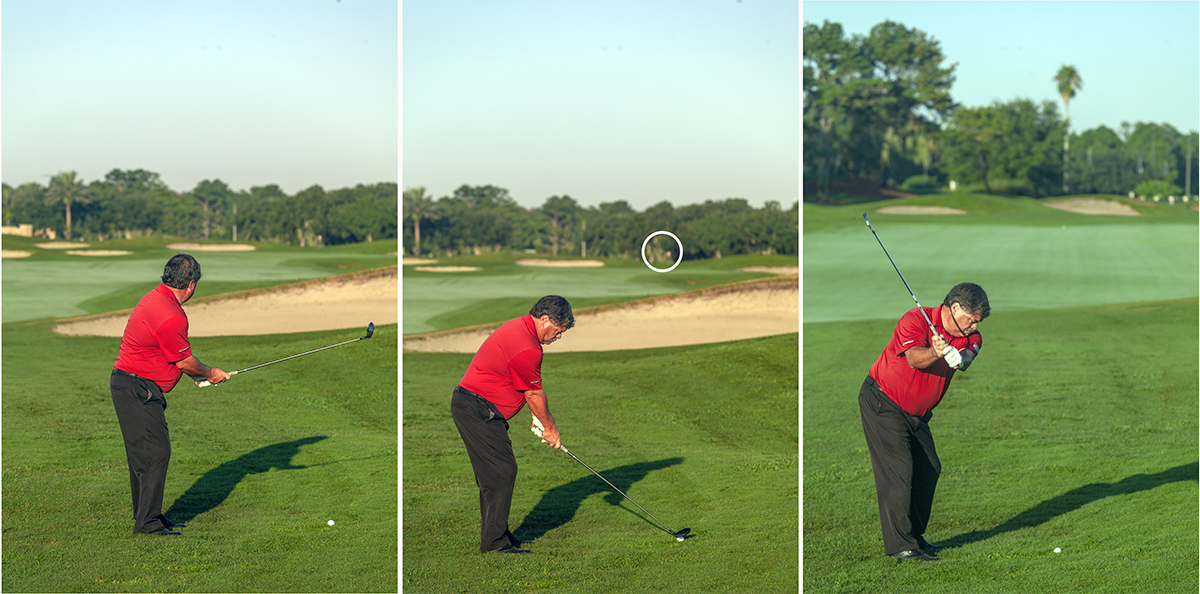
Understanding the course you’re playing as well as what is in play from certain angles your game may place you in, can create easier strategic decisions and in turn, lower scores. It’s your responsibility as a golfer to understand the course you’re playing and know what obstacles are in play versus what obstacles are designed into the course to use as targets. It’s also your responsibility to avoid being tempted into making shots you can’t execute (more about that later). Here are three simple items of thought you can use as you under-stand the course better and make better pre-shot decisions:
- Understand what is in play versus what is not in play – Know your yardages to certain landmarks as well as understand that what you can’t see from the shot you’re attempting to execute may be in play
- Aim for landmarks that you can’t reach – If a tree, bunker, or other landmark is in direct line with your intended target line, but is not reachable, you have a green light to take dead aim at that landmark
- Understand slopes and use them to your advantage – Ever tried to have a shot hit a slope and carom back to your target? Of have you purposely aimed wider of your intended target to marginalize the slope your ball is on? Being able to creatively use slopes, and or avoiding slopes altogether, can shave a couple stokes off your game.

Play to Your Strengths
One of the most common flaws all golfers make is attempting a shot that you are not capable of pulling off. Professionals included, this most often hap-pens when trying to rescue your round from a difficult position. Attempting the super hero shot from extremely difficult positions can quickly create a double-digit score for one hole of your round, making the rest of your round worthless.
Playing to your strengths can sometimes be humbling, in good ways. You’ll recognize what skills you need to practice. Or you’ll realize that practicing trouble shots a couple times before going out to play may pay dividends later. Most importantly, it’s humbling to play sideways versus forward. Doing that more often than not will definitely have you buy into these three suggestions to play to your strengths:
- Choose clubs you know are accurate executing — be willing to give up a couple yards of distance to keep your shot in play
- Shape your shot to the design of the hole vs. attempting to hit a shot you can’t — If you hit a fade, align yourself to an intended target line that allows that shot to happen, even if the hole is designed to favor a draw. Doing so may place you a few yards behind where you’d ideally like to be, but most times than not will keep your ball in play from a safe position
- Play to yardages you are comfortable with — If in doubt that you can hit a shot that requires a longer distance without placing your ball in a compromising position, opt to lay up, especially the second shot of a par 5, to a distance you know you can stick 90 percent of the time or better. Sacrificing a shot in the fairway may allow you to eliminate an extra short game stroke or putt.
Conclusion
Playing smarter is all about making great decisions. It’s easy to do and requires no more effort than making decisions that allow you to play your game without compromise.
I’ve always told my son there is a difference between dumb and stupid. Stupid knows better. All five suggestions above are now in your brain, and you should know better the next time you’re playing golf not to make a “stupid” mistake. Playing smart golf now can lead to immediately reduced scores, only if you stay true to yourself and committed to making smarter decisions.
John Hughes is a PGA Master Professional, 2023 Northern Florida PGA Teacher & Coach of the Year, founder of John Hughes Golf in Orlando, Florida. Reach him at www.johnhughesgolf.com
About the Author





