When Derek Mortel and his longtime friend first started musing about a solid business in which to “park some investment capital,” the business-savvy duo’s conversations led them to a very modern take on golf entrepreneurship. Stocks, crypto, the usual suspects — none of it scratched the itch. “None of those was a physical asset we could actually use,” Mortel recalls. “We wanted something tangible. Something we could enjoy and share.”
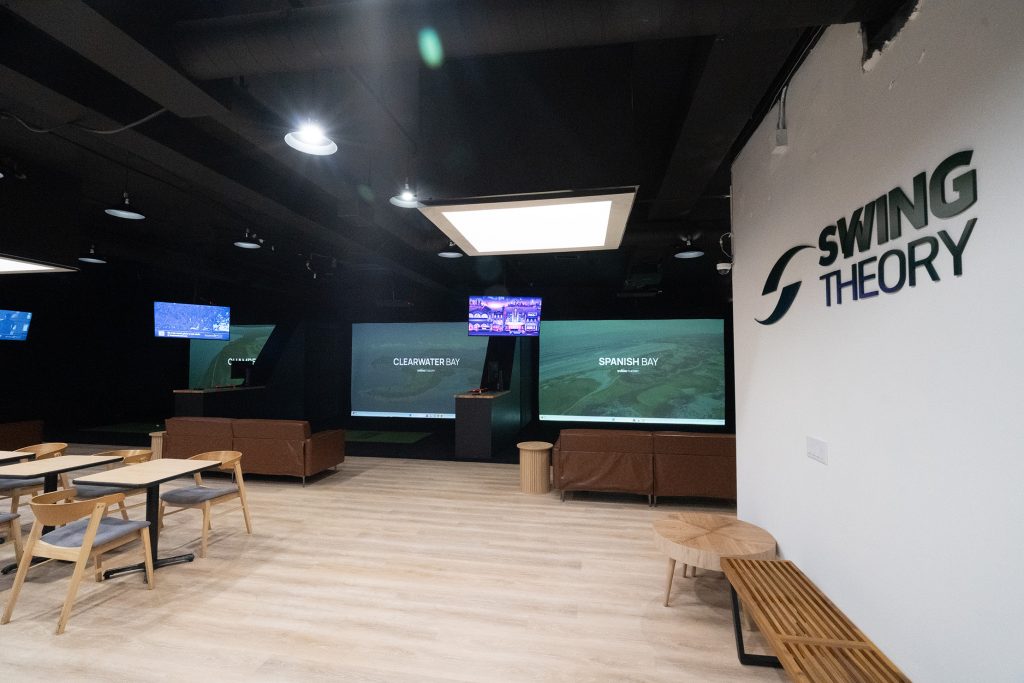
So, the Los Angeles-based business pair did what golfers do when the local tee sheet is essentially impossible to crack, and the driving ranges are jammed: they started imagining a space of their own. The result is Swing Theory, a brand-new indoor golf and social lounge in Pasadena that has quickly become one of the area’s newest entrepreneurial endeavors that is attracting a growing number golfers and the golf-curious.

The Spark: From Scarce Tee Times to a Red-Hot Startup Venture
In Southern California, like many areas, golf is booming — but so are some accompanying frustrations. Prime tee times are scarce, summer heat can be punishing, and ranges are often packed. Mortel and his co-founder noticed that while indoor golf had exploded on the East Coast, their corner of LA County had only a couple of options within a 20-mile radius.
“We went to a few indoor golf places and thought, we can do this,” Mortel says. “There was a gap in the market, and we wanted to fill it.”
The idea was equal parts personal and practical: create a place that doubled as an investment and as a community hub, where serious golfers and complete beginners alike could feel at home.
A Lounge First, a Golf Facility Second
Unlike the hyper-serious, data-driven vibe of some simulator facilities, Swing Theory was deliberately designed with a softer edge.
“We wanted this to feel more like a lounge than a training facility,” Mortel explains. “Golf can be intimidating, like walking into a gym for the first time. Here, you can hang out, play games, or get a private lesson without feeling judged.”
That balance — between the hard-core golfer and the casual group outing — has been key. Early mornings and weekdays bring in PGA pros and serious players dialing in their numbers. Evenings and weekends, the place fills with groups of friends playing mini games on the simulators, BYOB and takeout in tow.
Swing Theory doesn’t serve food or alcohol, but its Old Town Pasadena location means customers can grab dinner or cocktails at one of the dozens of nearby spots and bring it in. The vibe is “basement hangout meets golf tech,” and it’s working.

Betting Smart on Technology
After weighing their priorities, Swing Theory decided to go with Uneekor launch monitors. Finding the right value was important to them and the team found that Uneekor provided the best “value-to-performance” ratio.
“Most golfers aren’t looking for 30 layers of ball flight data,” he says. “They just want accuracy, good visuals, and fun game modes. Uneekor checked all the boxes.”
Through integration with GSPro software, Swing Theory’s simulators also offer access to thousands of courses and arcade-style games like golf darts and beer pong. That flexibility has been a hit for kids’ parties, corporate events, and non-golfers who might otherwise be bored stiff watching their buddy grind out swing drills.
The Partnership That Made It Work
A key player behind the scenes has been The Indoor Golf Shop (ShopIndoorGolf.com), the Texas-based supplier that helped Swing Theory navigate the confusing and often overwhelming simulator market.
“We must have called Trey, our sales rep, two times a week for three months,” Mortel laughs. “He was patient, transparent, and really honest about what we needed and what we didn’t. That kind of support is rare.”
The partnership went beyond just shipping equipment. The Indoor Golf Shop advised on materials, buildout, and even timing purchases to coincide with promotions like Black Friday, which helped Swing Theory keep startup costs manageable.
“That transparency and collaboration was huge,” Mortel says. “We weren’t just buying a product — we had a partner who wanted to see us succeed.”
Calculated Risk, Quick Rewards
Of course, launching an indoor golf lounge in Southern California wasn’t without its nerves. “There’s always anxiety. What if nobody shows up?” Mortel admits.
The team crunched conservative numbers, modeling scenarios where even 10 – 20 percent daily capacity would cover expenses. Within the first month, Swing Theory blew past those projections—even while running a 50 percent off promotion.
Memberships have also outpaced expectations. “We had people here 10 times a month — it made no sense for them not to get a membership,” Mortel says. A few short months since opening, Swing Theory’s member sign-up campaign has performed well above forecast.
Building Community, Not Just Revenue
What has struck Mortel most in the opening months isn’t just the revenue, it’s the feedback. A well-known local restaurateur stopped in, looked around, and told him flatly: “Old Town Pasadena needed this.”
That validation, Mortel says, means more than the early profits. “We didn’t realize how much the community was waiting for something like this until people started telling us.”
The Instagram page @OldPasadena featured Swing Theory shortly after opening, generating more than 30,000 views and 700 shares. “That was one of the things that told us we had hit a nerve,” Mortel says.
The Entrepreneurial Playbook
Asked what advice he’d give someone else thinking of opening a simulator lounge, Mortel doesn’t hesitate:
“Build the right team, do the prep work, and don’t get caught in the weeds. Everyone has ideas. What matters is modeling the numbers, studying the market, and being decisive about the big picture.”
He warns against over-investing early—like splurging on top-tier tech or launching a full-service bar and kitchen. “Know your customer, know your location. We’re surrounded by amazing restaurants. Competing with them would’ve been a waste of energy. We focused on golf and atmosphere, and that’s what works here.”
With so much information out there, The Indoor Golf Shop wanted to provide clear information for why this model could work which is why they partnered with The National Golf Foundation (NGF) to provide a comprehensive, data-driven analysis of the golf simulator market.
Looking Ahead
For now, Swing Theory is focused on dialing in its flagship location, ensuring the experience remains consistent and welcoming. Expansion is on the horizon, but only when the timing is right.
“The ultimate goal is to open more locations — but not at the expense of quality,” Mortel says. “We want customers to know that if one location is full, there’s another with the same vibe, the same service. But first, we have to make this place bulletproof.”
A Business That’s Personal
For Mortel, Swing Theory is more than a business — it’s a manifestation of what golfers everywhere crave: access, fun, and community.
“When I walk in and see every bay full, people laughing, a pro giving a lesson in the corner, and a group of friends playing golf beer pong — that’s when I know we’re doing something right,” he says.
And that’s why Swing Theory has quickly become more than just Pasadena’s newest entertainment spot. It’s a case study in how entrepreneurs can seize on cultural shifts — in this case, golf’s off-course boom — and build businesses that thrive by solving problems and creating experiences.
As Mortel puts it: “We wanted a place where we’d want to hang out. Turns out, a lot of other people wanted that too.”
About The Indoor Golf Shop
The Indoor Golf Shop (TIGS) began in 2017 with a simple realization: golfers deserved a better way to purchase and enjoy golf simulators. After experiencing firsthand the frustrations of buying a simulator, the team saw an opportunity to create indoor golf solutions tailored to players just like them. From that experience, The Indoor Golf Shop was founded with a clear commitment—one that continues to guide the business today: to provide extraordinary customer service and deliver only the highest-quality products. TIGS is here to help with the ever evolving industry of indoor golf and continues to excel to the top with data-analysis driven research calculated by the National Golf Foundation (NGF) which results can be found here. Contact The Indoor Golf Shop here today.
Press release by: Kevin Frisch PR