The Indoor Golf Shop and Practical Golf’s Jon Sherman Keep You Up to Date on Simulator and Launch Monitor Technology.
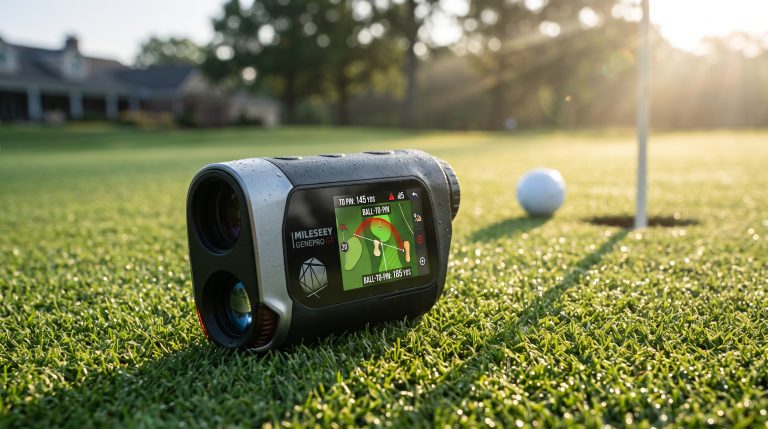
The landscape of golf is changing. No longer is it just played on golf courses around the world, it can also be played in your garage, basement, or a sports bar with the right setup. Thanks to companies like The Indoor Golf Shop, it’s never been easier to set up a home golf simulator or even to add one or two or more to a clubhouse or any other entertainment establishment.
The Indoor Golf Shop’s one-stop shopping multiverse offers an industry-leading selection of residential and commercial indoor golf equipment, which includes a full selection of launch monitors and simulators from companies like Trackman, Uneekor, Garmin, Bushnell, Flightscope, ProTee, Full Swing, and Tru Golf. The company also offers projectors, wall padding, golf mats, and many other products to help you set up your own sim at home.

But where is this industry going? Has it reached its peak? How real can these experiences get? And perhaps, just as important, how good are these simulator and launch monitor setups for serious game improvement?
To answer some of these questions, we talked to an expert, Jon Sherman, the founder of Practical Golf. Sherman’s newsletters, website, and podcasts are all about helping golfers get better. And having an indoor simulator or even just a launch monitor can play a large role in a golfer’s progress. He says it’s never been more affordable, and easier to set up. And now we are starting to see more and more stand-alone businesses that are focusing on simulators, whether it’s for league play, lessons, or just pure enjoyment. And that trend’s not ending anytime soon.
Let’s talk about the realism and effective game improvement that a good launch monitor/simulator setup can bring to serious golfers. What are your thoughts on what has made launch monitor technology so much more relatable to the outdoor game?
First off, my personal opinion is that Trackman has one of the best softwares, especially when you take into consideration different range environments, the testing you can do, the games, the tournaments and so on. I just think if someone wanted the absolute best software with graphics, user interface, challenge, Trackman is definitely the leader.
Of course, that comes at a premium price, correct?
Yes, in order to get into that world, you have to buy the Trackman iO or the Trackman 4, which is $15-25K, plus you’re going to commit to $1,100 a year on software costs. It is definitely an investment, but it’s worth it.
But in my opinion, I think GS Pro (an add-on subscription to compatible launch monitors), which is the software I use, is way more cost-manageable. And I think that their practice environments have a lot of good skill development games. You can customize the range really well. I actually prefer that over some of the leading OEM software. Now, it doesn’t work with every launch monitor but they do have integration with Foresight Sports systems now, for example.
What about really affordable systems like SkyTrak? You can’t use GS Pro with it, correct?
Right. SkyTrak has decided not to do that because they want a proprietary system now. Obviously, with Trackman, you’re going to use their software, which is incredible. Foresight is solid, but it does have some features like dispersion tracking and some other stuff that would be better for clubfitters. But as a consumer product, I would say GS Pro is amazing, as far as a dynamic software that’s going to help bring your simulator experience to life.

When it comes to using the indoor environment for game-improvement, can launch monitors and simulators be an effective tool?
They do a better job of customization of the environment now. You can go on Trackman, for example, and there’s a mode where you can do a variety of testing, like running different tests of clubs. There’s a mode where you can customize the range in terms of the green, like do you want to go to a back right pin, or do you want to do a short-game challenge. You can do situational practice on the golf course. You can really put yourself in an environment that you would face on the golf course.
To take it further, let’s say you’re really uncomfortable hitting a 50-yard wedge shot over a bunker. You can create that environment. Or you can say, I want to have a front-left pin on an elevated green, and work on my strategy here and make sure I don’t chase that pin.
So you can genuinely create any scenario you like on the golf course or range. And in addition to that, they have really good diagnostics like strokes gained data, and you can see how good your shots are with launch angle and distance. And you can get competitive with it.
Trackman Combine is also incredible. I’ve always loved that, and they have something similar in GS Pro now. So yeah, it’s just so much more robust. I think there’s like four or five different main practice environments you can do on Trackman.
Price accessibility and unprecedented competition within the indoor golf space have led to affordability with a high return on investment for those with modest to medium-range budgets. What are companies like SkyTrak doing to give consumers high value without paying top-of-the-market prices?
I was originally a SkyTrak user, so I’ve been a big fan of what they’ve done. I always thought the software had good practice tools. Like they had the bag mapping (how far you hit each club in the bag), the wedge matrix, and a performance test. Now since they’ve kind of rolled together with Golftec (which bought SkyTrak in 2022), they actually had very good skill-based practice, where you can create physical boundaries. They have fun games that are similar to Trackman where you can do bullseye stuff and arcade game type scenarios.
SkyTrak also just added swing speed training with the new ST Max, which is the newest version of the launch monitor. You can have a speed training environment where you can measure your swing speed without hitting a ball, which has become a really popular training method.
So in terms of overall value, SkyTrak seems like a great option.
I’ve always thought SkyTrak was one of the best indoor golf solutions. If you ask me who’s the best below Foresight and Trackman in terms of a launch monitor manufacturer, in terms of game improvement software, SkyTrak is probably it.
But you can make the argument that Foresight has gotten more aggressive. I would honestly rather pay more for better software and save a little bit of money on the launch monitor. Less expensive launch monitors are still pretty accurate. I think that’s a pretty good tradeoff in that space.
And I do think SkyTrak kind of has an ace up its sleeve with that Golftec integration. They’re just going to keep adding more and more game-improvement features. They’re very focused on that.
So what are we looking at pricewise to set up a SkyTrak system?
Right now, with the new ST Max, you’re going to pay between $2,500 and $3,000 for a launch monitor. You have to take the SkyTrak subscription which I believe is anywhere between $300 to $600 a year. They’ve got the Foresight/Trackman courses on there now, which is nice. So yeah, you’re going to pay a little more for their software. But you’re saving on the launch monitor; you’re not going to spend eight to 10 grand on that… That’s the tradeoff. They’re investing more in the software, but it’s also gotten more expensive. And you can only use theirs.
As we see simulator bars and clubs popping up all over the place, could you share your insights on this both as a value for consumers and as a potential small business idea?
I think their biggest challenge, talking to some of the owners, is just how to fill up ambient time, and by that I mean, weekday time and even weekday nights, especially in the warmer months.
I think some of the bigger companies have figured that out with food and beverage. But then you have smaller ones. I’ve seen a self-serve model. There’s basically no one working there. You just purchase a membership, and you book it online, and you have a key fob and you can get in there whenever you want. I think that’s the solution in terms of doing one that has a much lower overhead. You don’t have to pay as many – or maybe not any – employees, but there are far fewer perks available. It’s just people who want to hit golf balls and nothing else. But the bigger companies have figured it out.
Can you give some examples of the bigger companies that are finding success?
We have one here in the Northeast, Golf Lounge 18. They have about 12 locations in Connecticut, Massachusetts, and Long Island. And they’ve been expanding. They build really nice high-end places with bars and big screen TVs. They go for the crowd that wants to watch a football game and hang out. A friend of mine who’s at my club goes to a high-end place like this on Long Island.
Then there’s Five Iron Golf (which offers memberships, leagues, lessons, and can host parties up to 200 people). They’re the national success story. Callaway invested in that. They are in just about every major city.
Is there still room for growth in the golf entertainment/indoor country club and game improvement facilities space?
It’s definitely happening. But it’s not always an easy business. I think there are challenges with that ambient time. Although many have found a model that fills the time with older clients on weekdays, kids and junior programs and league play in the afternoon, and league play or some form of golf entertainment in the evenings.
I don’t think it’s going to stop. Golfers will get more and more used to playing indoors and the technology is going to continue to make the indoor game more realistic-feeling. I don’t think it’s going away. I don’t think it’s a fad. I think it will become more commonplace, especially for people who don’t have the room or the budget to do it at home.
Like here where I live, we’re not playing golf for four or five months. So it’s a way to hang out with your golf buddies who you might not see over the winter. Your golf buddies are different from your normal friends sometimes. Like you hang out at the simulator together. I’ve done that with my friends. I enjoy it.
Press release by: Kevin Frisch PR