October 11, 2026

Matt Fitzpatrick

A closing birdie at the 18th turns last week’s “what if” into today’s “what is.”

PALM HARBOR, Fla. — Seven days can be an eternity in professional golf. Just one week ago, Matt Fitzpatrick stood on the 72nd hole at TPC Sawgrass, a share of the lead in his grasp, only to see his tee shot find the pine needles and his championship hopes vanish with a closing bogey. That agonizing finish handed the Players Championship title to Cameron Young and left Fitzpatrick searching for answers in the dark of a Florida evening.

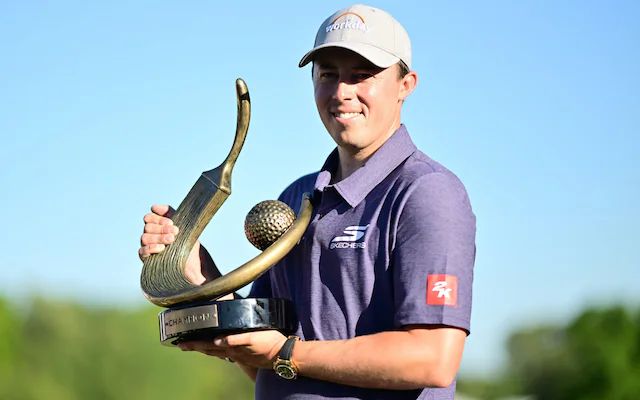
But the beauty of the PGA Tour’s Florida Swing is that the next opportunity is always just a short drive down the I-4. On Sunday at Innisbrook Resort, the universe offered a rewrite. Standing on the 18th green of the fearsome Copperhead Course, Fitzpatrick faced a 14-foot birdie putt to win. This time, there was no hesitation. The ball tracked true, disappearing into the heart of the cup. With an emphatic fist pump and a roar that echoed through the surrounding pines, Fitzpatrick secured a one-shot victory, capturing his third PGA Tour title and—more importantly—his peace of mind.

Fitzpatrick secured a one-shot victory, capturing his third PGA Tour title.

Navigating the Snake Pit

The Copperhead Course at Innisbrook is a different beast than the stadium-style flash of Sawgrass. It is a grinding, claustrophobic test of nerves defined by the “Snake Pit”—the treacherous three-hole closing stretch that has ended many a Sunday charge. Fitzpatrick arrived at the 16th tee on Sunday afternoon locked in a dead heat with David Lipsky, with a hungry pack of pursuers including Xander Schauffele and a surging Jordan Smith breathing down his neck.

While his rivals wrestled with the firm, “sunbaked” greens and swirling winds, Fitzpatrick played a brand of golf that was surgically precise. He didn’t just survive the final round; he dismantled it. In a display of extreme discipline, the 2022 U.S. Open champion didn’t card a single bogey all day. While 54-hole leader Sungjae Im struggled to find his rhythm, shooting a disappointing 40 on the front nine, Fitzpatrick remained the calm center of a chaotic storm.

The Duel in the Pines

The afternoon evolved into a high-stakes chess match between Fitzpatrick and Lipsky. For hours, neither man would blink. When Fitzpatrick finally broke a string of pars by draining a miraculous 30-foot birdie putt on the par-3 15th, it felt like the knockout blow. But Lipsky, playing in the group behind, showed veteran steel, answering with a clinical birdie on the 14th to keep the score knotted.

As the shadows lengthened over the 18th fairway, the tension was palpable. Fitzpatrick had been here before—just seven days prior—with the weight of a tournament on his shoulders. This time, the execution was flawless. He threaded a drive down the middle of the narrow 18th, then stuck a wedge from 118 yards to within “gimme” range for a man of his putting caliber.

“The big thing was I felt I was playing well,” Fitzpatrick said, reflecting on the turnaround from the previous Sunday. “I wanted to continue that and felt like I had the confidence in myself to do so. To do that for four rounds on a course this difficult was special.”

Fitzpatrick is projected to climb back into the top 10 of the world rankings.

A Winner’s Return

When that final putt dropped, the relief was visible. The victory doesn’t just add a trophy to his mantle or a $1.6 million check to his bank account; it re-establishes Fitzpatrick as one of the most dangerous closers in the game. By navigating the “Snake Pit” without a scratch, he proved that his collapse at The Players was a fluke, not a trend.
The golf world now looks toward Augusta National, and Fitzpatrick heads there as one of the hottest players on the planet. He is projected to climb back into the top 10 of the world rankings and currently sits third in the FedEx Cup standings. But for Fitzpatrick, the metrics matter less than the moment.

One week ago, he was the runner-up with a thousand questions. Today, he is the Valspar champion with all the answers. The “Copperhead” may have fangs, but Matt Fitzpatrick proved he’s the one who knows how to strike when it counts.

The air at TPC Sawgrass has a way of thickening when the sun begins to dip behind the moss-draped oaks on Championship Sunday. It is a heavy, pressurized atmosphere that has broken the resolve of the world’s greatest golfers for decades. But as the 2026 Players Championship reached its fever pitch, Cameron Young didn’t look like a man burdened by the weight of the “best player without a major” tag that had followed him for years. Instead, he looked like a man who had finally found the key to the most difficult lock in golf.
In a duel that will be remembered as a modern classic, Young outlasted England’s Matt Fitzpatrick in a back-nine shootout that transformed the daunting Stadium Course into a private arena for two of the game’s purest ball-strikers. When the dust settled on the 18th green, Young stood alone—a Players Champion, a multi-time PGA Tour winner, and officially the new face of American golf.
Players Champion: Cameron Young’s masterclass at the Stadium Course

The Shadow of the Past

To understand the significance of Young’s triumph, one must look at the scars he carried into the week. Since bursting onto the scene, Young had become synonymous with “close but not quite.” With a string of runner-up finishes at major championships and elite elevated events, the narrative had become exhausting: great swing, elite power, but could he close?

Fitzpatrick, conversely, arrived at the first tee on Sunday with the steely resume of a U.S. Open champion. He is a tactician, a player who treats a golf course like a math equation to be solved. As they traded birdies on the opening narrow stretches of the front nine, it felt like a collision of philosophies—Young’s raw, explosive power against Fitzpatrick’s meticulous, grinding precision.

The Turning Point

The leaderboard at Sawgrass is notoriously volatile, and for the first two hours of the afternoon, it looked like a four-way car crash. Ludvig Åberg, the overnight leader, seemed to have the tournament in his grasp until the par-4 11th. In a shocking lapse of judgment, the Swede found the water, and then found it again on the 12th. In the span of twenty minutes, the door didn’t just crack open; it was kicked off its hinges.

Young and Fitzpatrick, playing in the penultimate group, sensed the shift instantly. While the rest of the field struggled with the swirling winds that make the back nine at Sawgrass a psychological minefield, these two found a different gear.

Young’s surge began on the par-5 11th, where he reached the green in two with a towering iron shot that seemed to hang in the air forever. The resulting birdie pulled him level with Fitzpatrick. From there, the two became a two-man breakaway. It wasn’t just about the scores; it was the body language. Every time Fitzpatrick rolled in a clutch ten-footer to save par, Young responded by sticking an approach shot inside the shadow of the flagstick.

The Gauntlet: 16, 17, and 18

The finish at TPC Sawgrass—the par-5 16th, the island-green 17th, and the brutal 18th—is the most terrifying three-hole stretch in the sport. It is where dreams go to drown.

On the 16th, Fitzpatrick played the hole to perfection, laying up and pitching to three feet for a clinical birdie. Young, refusing to play safe, went for the green in two. His ball cleared the water by a mere yard, settling in the fringe. He scrambled for birdie to keep pace, but the momentum seemed to be leaning toward the Englishman. Then came the 17th.

The Island Green is less a golf hole and more a psychological experiment. With the stadium crowd roaring, Fitzpatrick played a safe, conservative shot to the fat part of the green. The pressure shifted entirely to Young. If he missed, the tournament was over. Instead, Young pulled a 57-degree wedge and played a shot so aggressive it silenced the gallery. The ball skipped twice and checked up just six feet from the hole.

When Young poured in the birdie putt, the roar was heard all the way back in Jacksonville. They were tied going to the last.

A Drive for the Ages

The 18th at Sawgrass is a hole that demands a draw over a lake that looks like an ocean. Most players aim for the right-center and hope for the best. Cameron Young, however, produced the single most impressive physical feat of the season.

He unleashed a drive that registered 124 mph of clubhead speed. The ball tracked perfectly over the corner of the water, catching the downslope of the fairway and rolling out to a staggering 375 yards. It was the longest drive on the 18th hole in the history of ShotLink tracking. It turned the hardest par-4 on the course into a pitch-and-putt.

Fitzpatrick, forced to press, pushed his tee shot into the pine straw on the right. From a difficult lie, he could only hack his approach to the front edge of the green. When Fitzpatrick’s par effort slipped past the low side of the cup, the stage was set. Young had two putts from 15 feet to win.

He only needed one.

The Aftermath

As the final putt dropped, Young didn’t offer a wild celebration. There was no hat toss or fist pump to the heavens. Instead, he took a long, deep breath and shared a lingering embrace with his caddie. The look on his face wasn’t just joy; it was relief.

“I’ve been in this position enough times to know that nothing is guaranteed,” Young said afterward, clutching the gold Tiffany-designed trophy. “To do it here, against a player like Matt, on a course that tests every single part of your soul… it’s hard to put into words. I think I just proved to myself that I belong.”

For Fitzpatrick, it was a bitter pill to swallow, but he was gracious in defeat. “I didn’t lose it,” he remarked outside the scoring hut. “Cameron won it. That drive on 18… I don’t know many people on the planet who can hit that shot under that kind of pressure.”

A New Era

The 2026 Players Championship will be remembered for the record-breaking $4.5 million purse and the technical brilliance of the golf played, but more importantly, it signaled a shift in the hierarchy of the PGA Tour. With this victory, Cameron Young moved to No. 4 in the world rankings. He is no longer the “nearly man.”

As he walked off the 18th green toward the clubhouse, the “stadium” atmosphere he had mentioned earlier was still buzzing. Young had faced the most intimidating closing stretch in golf and emerged not just unscathed, but emboldened. The monkey is off his back, and if his performance at Sawgrass is any indication, the rest of the major championship season should be very, very worried.

0
0
Your Cart
Your cart is emptyReturn to Shop