October 13, 2026

Indoor Golf Shop

When Derek Mortel and his longtime friend first started musing about a solid business in which to “park some investment capital,” the business-savvy duo’s conversations led them to a very modern take on golf entrepreneurship. Stocks, crypto, the usual suspects — none of it scratched the itch. “None of those was a physical asset we could actually use,” Mortel recalls. “We wanted something tangible. Something we could enjoy and share.”

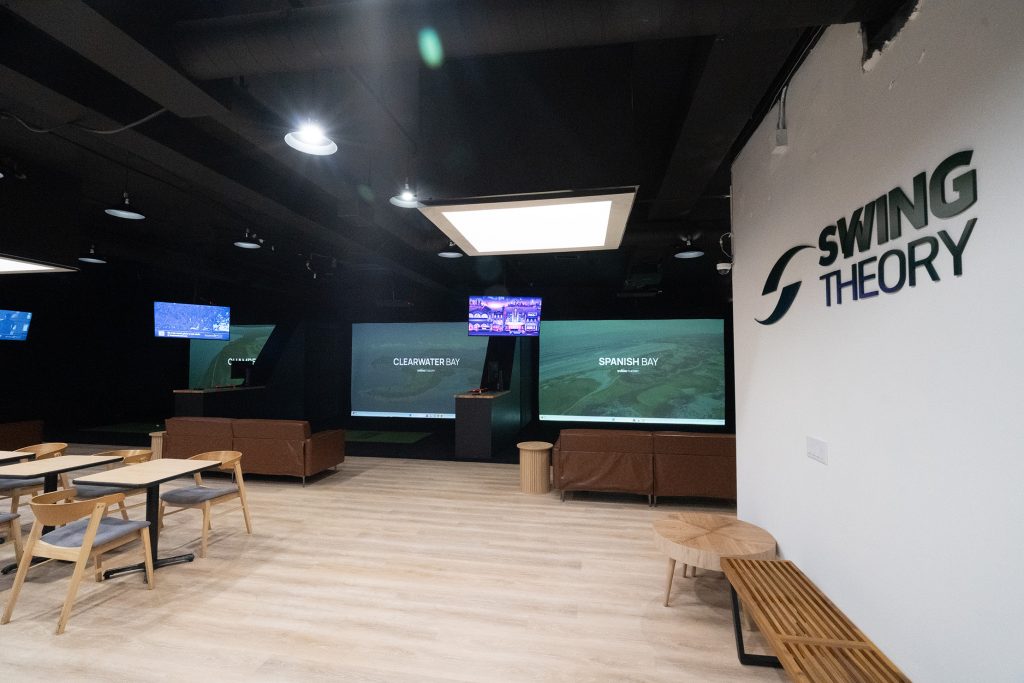
So, the Los Angeles-based business pair did what golfers do when the local tee sheet is essentially impossible to crack, and the driving ranges are jammed: they started imagining a space of their own. The result is Swing Theory, a brand-new indoor golf and social lounge in Pasadena that has quickly become one of the area’s newest entrepreneurial endeavors that is attracting a growing number golfers and the golf-curious.

The Spark: From Scarce Tee Times to a Red-Hot Startup Venture
In Southern California, like many areas, golf is booming — but so are some accompanying frustrations. Prime tee times are scarce, summer heat can be punishing, and ranges are often packed. Mortel and his co-founder noticed that while indoor golf had exploded on the East Coast, their corner of LA County had only a couple of options within a 20-mile radius.

“We went to a few indoor golf places and thought, we can do this,” Mortel says. “There was a gap in the market, and we wanted to fill it.”

The idea was equal parts personal and practical: create a place that doubled as an investment and as a community hub, where serious golfers and complete beginners alike could feel at home.

A Lounge First, a Golf Facility Second
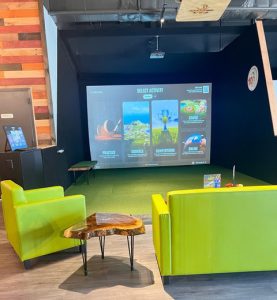
Unlike the hyper-serious, data-driven vibe of some simulator facilities, Swing Theory was deliberately designed with a softer edge.

“We wanted this to feel more like a lounge than a training facility,” Mortel explains. “Golf can be intimidating, like walking into a gym for the first time. Here, you can hang out, play games, or get a private lesson without feeling judged.”

That balance — between the hard-core golfer and the casual group outing — has been key. Early mornings and weekdays bring in PGA pros and serious players dialing in their numbers. Evenings and weekends, the place fills with groups of friends playing mini games on the simulators, BYOB and takeout in tow.

Swing Theory doesn’t serve food or alcohol, but its Old Town Pasadena location means customers can grab dinner or cocktails at one of the dozens of nearby spots and bring it in. The vibe is “basement hangout meets golf tech,” and it’s working.

Betting Smart on Technology
After weighing their priorities, Swing Theory decided to go with Uneekor launch monitors. Finding the right value was important to them and the team found that Uneekor provided the best “value-to-performance” ratio. 

“Most golfers aren’t looking for 30 layers of ball flight data,” he says. “They just want accuracy, good visuals, and fun game modes. Uneekor checked all the boxes.”

Through integration with GSPro software, Swing Theory’s simulators also offer access to thousands of courses and arcade-style games like golf darts and beer pong. That flexibility has been a hit for kids’ parties, corporate events, and non-golfers who might otherwise be bored stiff watching their buddy grind out swing drills.

The Partnership That Made It Work
A key player behind the scenes has been The Indoor Golf Shop (ShopIndoorGolf.com), the Texas-based supplier that helped Swing Theory navigate the confusing and often overwhelming simulator market.

“We must have called Trey, our sales rep, two times a week for three months,” Mortel laughs. “He was patient, transparent, and really honest about what we needed and what we didn’t. That kind of support is rare.”

The partnership went beyond just shipping equipment. The Indoor Golf Shop advised on materials, buildout, and even timing purchases to coincide with promotions like Black Friday, which helped Swing Theory keep startup costs manageable.

“That transparency and collaboration was huge,” Mortel says. “We weren’t just buying a product — we had a partner who wanted to see us succeed.”

Calculated Risk, Quick Rewards
Of course, launching an indoor golf lounge in Southern California wasn’t without its nerves. “There’s always anxiety. What if nobody shows up?” Mortel admits.

The team crunched conservative numbers, modeling scenarios where even 10 – 20 percent daily capacity would cover expenses. Within the first month, Swing Theory blew past those projections—even while running a 50 percent off promotion.

Memberships have also outpaced expectations. “We had people here 10 times a month — it made no sense for them not to get a membership,” Mortel says. A few short months since opening, Swing Theory’s member sign-up campaign has performed well above forecast.

Building Community, Not Just Revenue
What has struck Mortel most in the opening months isn’t just the revenue, it’s the feedback. A well-known local restaurateur stopped in, looked around, and told him flatly: “Old Town Pasadena needed this.”

That validation, Mortel says, means more than the early profits. “We didn’t realize how much the community was waiting for something like this until people started telling us.”

The Instagram page @OldPasadena featured Swing Theory shortly after opening, generating more than 30,000 views and 700 shares. “That was one of the things that told us we had hit a nerve,” Mortel says.

The Entrepreneurial Playbook
Asked what advice he’d give someone else thinking of opening a simulator lounge, Mortel doesn’t hesitate:

“Build the right team, do the prep work, and don’t get caught in the weeds. Everyone has ideas. What matters is modeling the numbers, studying the market, and being decisive about the big picture.”

He warns against over-investing early—like splurging on top-tier tech or launching a full-service bar and kitchen. “Know your customer, know your location. We’re surrounded by amazing restaurants. Competing with them would’ve been a waste of energy. We focused on golf and atmosphere, and that’s what works here.”

With so much information out there, The Indoor Golf Shop wanted to provide clear information for why this model could work which is why they partnered with The National Golf Foundation (NGF) to provide a comprehensive, data-driven analysis of the golf simulator market.

Looking Ahead
For now, Swing Theory is focused on dialing in its flagship location, ensuring the experience remains consistent and welcoming. Expansion is on the horizon, but only when the timing is right.

“The ultimate goal is to open more locations — but not at the expense of quality,” Mortel says. “We want customers to know that if one location is full, there’s another with the same vibe, the same service. But first, we have to make this place bulletproof.”

A Business That’s Personal
For Mortel, Swing Theory is more than a business — it’s a manifestation of what golfers everywhere crave: access, fun, and community.

“When I walk in and see every bay full, people laughing, a pro giving a lesson in the corner, and a group of friends playing golf beer pong — that’s when I know we’re doing something right,” he says.

And that’s why Swing Theory has quickly become more than just Pasadena’s newest entertainment spot. It’s a case study in how entrepreneurs can seize on cultural shifts — in this case, golf’s off-course boom — and build businesses that thrive by solving problems and creating experiences.

As Mortel puts it: “We wanted a place where we’d want to hang out. Turns out, a lot of other people wanted that too.”

About The Indoor Golf Shop
The Indoor Golf Shop (TIGS) began in 2017 with a simple realization: golfers deserved a better way to purchase and enjoy golf simulators. After experiencing firsthand the frustrations of buying a simulator, the team saw an opportunity to create indoor golf solutions tailored to players just like them. From that experience, The Indoor Golf Shop was founded with a clear commitment—one that continues to guide the business today: to provide extraordinary customer service and deliver only the highest-quality products. TIGS is here to help with the ever evolving industry of indoor golf and continues to excel to the top with data-analysis driven research calculated by the National Golf Foundation (NGF) which results can be found here. Contact The Indoor Golf Shop here today.

Press release by: Kevin Frisch PR

When Ajit Padda decided to branch out from his 23-year career in investment banking, he wasn’t exactly setting out to reorient a community’s relationship with the sport of golf. Honestly, he was just looking for a place to hit balls with his friends. His Trackman simulator didn’t quite fit into his new house, so he and a partner leased space near a train station in Fairfield, Connecticut, opened the doors in 2018, and called it Golf Lounge 18.

Seven years later, Padda and growing team oversee 10 thriving locations across the Northeast, with three more under construction and a freshly minted franchise model gaining traction. What began as a side project has become one of the most thriving indoor golf businesses in the northeastern United States — at a moment when indoor golf is exploding.

“Back then, you had to convince people indoor golf was real,” Padda says. “Today, people really embrace the concept. They’ve tried it, they understand it, and many actually prefer it because so few of us have six hours anymore to play a full round of golf. People today love an in-and-out fun experience that still feels like real golf.”

Riding the Indoor Golf Boom
The numbers back him up. According to the National Golf Foundation (NGF), 2024 marked the first year that indoor rounds outpaced outdoor rounds in the U.S. Industry revenue, pegged at $1.3 billion in 2020, is projected to top $3.2 billion by 2030 with 8.14 million participants playing golf indoors.

Timing has been on Golf Lounge 18’s side. The NGF further reports that simulator and screen usership has grown 126 percent since 2019 and the already-thriving golf entertainment space grew by another 78 percent in that same time period.

COVID accelerated the trend, but Padda points out that lifestyle changes are the real driver. Leagues that start at 8 p.m. and run past 11, kids’ clinics after school, retirees in weekday “early bird” slots indoor golf simply fits modern schedules.

“Our core customer is between 35 and 50, younger than your local country club membership’s average age,” Padda says. “That was never the green-grass golf demographic. But here, it works because we have a little something for everyone. Guys finish dinner, put the kids to bed, and then come play league night with their buddies. It’s a new rhythm for the game.”

A Different Kind of Clubhouse
Golf Lounge 18 leans heavily on the “clubhouse” concept — a more elevated, cozy feel and aesthetic than a warehouse simulator joint, more accessible than a country club.

Padda knew early that balance was critical. “You have to fight the temptation to just build this like your dream basement and think it will click with all of your clientele,” he says. “It’s a business. And if you don’t run it with discipline—payroll ratios, rent ratios, ROI targets — you run the risk that you won’t last.”

Plenty haven’t. Indoor golf is capital-intensive, and Padda has watched poorly planned competitors flame out. Golf Lounge 18’s formula is a hybrid: upscale but approachable, tech-driven but social.

Food and beverage offerings (which now consist of a simple elevated pub menu that varies based on local tastes and preferences), for instance, was a bit of a reluctant addition. “Early on, if I had my choice, I wouldn’t touch food,” he admits. “It’s another welcoming touch that makes people stay a little longer and enjoy themselves more. Now they stay two and a half hours, order a fresh grill item, and the experience is complete. It’s not overly fancy, but it makes the experience richer.”

NGF data suggests offering an attractive food and beverage menu can potentially boost the average customer’s spend per visit by about 73 percent.

Golf Lounge 18’s programming evolved organically. Leagues dominate specific nights. Kids’ camps are blocked after school. No lessons during peak weekend hours when beers are flowing and families gather. “It’s about knowing who’s in the building and when,” says Padda. “You just don’t mix kids’ clinics with bachelor parties.”

A Tech Business Disguised as a Fun Business
If the clubhouse vibe drives retention, technology fuels consistency. With a background in tech, Padda’s team built a proprietary in-house operations system that links all ten locations.

“We have 110-plus Trackman bays, and every system is interconnected,” he says. “A member in Boston can play league night with his partner in Connecticut in real time. Our employees can move between locations seamlessly because everything — from TVs to music to booking systems — runs the same way.”

This backbone allowed Golf Lounge 18 to scale without losing its personalized, local touch. Each site feels familiar but incorporates regional quirks: Boston locations serve local craft beer, New York spots add Yankees-themed murals, menus shift by market. If roughly 70 percent of the design is templated and built off of a ‘best practices’ model, the other 30 percent thrives on local flavor.

A Strategic Partner: The Indoor Golf Shop
Critical to that rollout has been Golf Lounge 18’s partnership with The Indoor Golf Shop (ShopIndoorGolf.com), one of the industry’s leading suppliers and manufacturers of indoor golf equipment, providing comprehensive design and installation expertise.

Padda initially worked with multiple vendors but says meeting Indoor Golf Shop founder Rene Delgado changed everything. “It felt different,” he recalls. “His team loves what they do. They’re passionate, they’re on the ground, sleeves rolled up. It wasn’t just a transaction — it was collaborative.”

That alignment mirrored Padda’s own values. “Success has to be mutual,” he says. “With other vendors, it felt one-sided. With The Indoor Golf Shop, it feels like home.”

Together, Golf Lounge 18 has become one of the largest Trackman customers in the world. Each new location benefits from the standardized systems and seamless installation expertisethat The Indoor Golf Shop brings. “They help us scale without compromising the customer experience,” Padda notes.

Disciplined Growth in a Hot Market
The temptation, of course, is to sprint. With demand surging, investors circling, and competitors ever-present, Golf Lounge 18 could easily chase rapid expansion. Padda resists.

“In my view, growing too fast is a recipe for disaster,” he says. “But going too slow is a problem too. Striking that balance is hard.”

Since 2018, Golf Lounge 18 has averaged just over one new location per year. All are 100 percent equity-owned by Padda and his partner — no outside capital. “We’re still walking before we run,” he says. “I believe in that.”

That said, the next 24 months will mark a shift. With franchising legalized six months ago, Golf Lounge 18 expects to double its footprint by supporting franchisees alongside corporate locations.

“We’re built to support it,” Padda says. “Our corporate locations already operate like franchisees, paying into a central system for marketing, ops, and tech. The goal now is to share what we’ve learned with others and help them succeed.”

The Road Ahead
Looking forward, Padda sees opportunity — and inevitable shakeout. He predicts consolidation as the industry matures, with weaker players exiting and stronger brands scaling. But he insists indoor golf, even with room to grow, isn’t ready for faceless corporate management just yet.

“This industry still needs local engagement,” he says. “You can’t run it entirely from a corporate level. Somebody has to be on the floor, knowing the customers, running the leagues. That’s what keeps it sticky.”

And for Padda personally? The inspiration comes less from numbers and more from the clubhouse culture he’s helping foster. “At the end of the day, it’s about building community,” he says. “It’s about giving people who love golf — or who just want to try it — a place to belong. If we can keep doing that, and do it well, the business will take care of itself.”

Press release by: Kevin Frisch PR

For one ShopIndoorGolf.com customer, a longtime Hawaii-based CEO, deciding to build his own home golf simulator was easy. He already had the perfect space: a former high-end home theater room that wasn’t getting much use. After selling off the equipment, he converted the air-conditioned, fully soundproofed room into a golf simulator — it turned out to be the perfect fit.

He reached out to The Indoor Golf Shop for the elements he needed to complete his project, including a 15-foot-wide commercial enclosure, 4K short throw projector, as well as a SIGPRO Super Softy Golf Mat and Money Putt Golf Turf.

Here, this happy customer shares his experiences creating his golf simulator room and making it the perfect space to enjoy and work on his game.

What were the biggest questions you had when you started this project?

The biggest question I had was how to get the best value for a complete golf simulator setup — ideally from a one-stop shop that could answer questions quickly and make the whole process seamless.
I needed to know the size of a  full enclosure that would fit my room, what golf launch monitor would work best, and what accessories were needed to complete the setup.

How was The Indoor Golf Shop able to help you answer some of those questions?

Trey Alvarez at The Indoor Golf Shop helped me every step of the way, answering all my questions and making the entire purchase process as smooth as possible. His follow-through was excellent and gave me complete confidence in my decision.

How much better is the reality of having access to golf in your home even better than you thought it would be?

Having access to golf at home has been even better than I imagined. I can practice anytime without worrying about weather, driving to a course, or booking a tee time. It’s made it easy to work on my game consistently, and the convenience and fun of just walking into the room and swinging a club is something I didn’t fully appreciate until I had it.

I mainly use the simulator to practice and improve my game — working on my swing, dialing in distances, and tracking progress. But it’s also great for fun rounds with friends or just relaxing and hitting a few balls when I have some free time. It’s really a mix of both training and enjoyment.

Do you feel like your golfing time is more efficient now?

Definitely. What I value most is the convenience — being able to practice anytime, rain or shine, in an air-conditioned room, without leaving the house. I also enjoy the privacy and focus it gives me to work on my game without distractions. It’s become a relaxing escape where I can enjoy golf on my own terms.

How “true to golf” is your simulator experience feels and applies to the actual game of golf?

The realism today is on a whole different level. My simulator feels incredibly close to playing on a real course. The feedback from the launch monitor, the accuracy of ball flight, and the visual experience all translate well to actual golf. When I get back out on the course, I can tell the time spent in the sim really carries over.

When people ask you if they should invest in their own sim installation, what do you tell them?

I tell them it’s absolutely worth it if they love the game. Having your own sim setup makes it easy to practice consistently, have fun with friends, and enjoy golf year-round. If they have the space and budget, it’s one of the best investments they can make for both improving their game and adding a fun, personal retreat at home.

I tell them I’d be happy to help walk them through the process. I can share tips, give advice on setup, and even help with instructions for putting the unit together and installing the enclosure. It’s a lot easier when someone’s been through it already.

What would you tell them about what it’s like to work with The Indoor Golf Shop team?

The team at The Indoor Golf Shop is top-notch. They’re responsive, knowledgeable, and make the whole process smooth from start to finish. Working with them gave me a lot of confidence — they really care about getting it right and making sure you’re happy with your setup.

Working with The Indoor Golf Shop has been a great experience from start to finish. The team made the process easy, answered every question, and helped me build a setup that fits perfectly in my space. I use the simulator almost daily, and it’s become one of my favorite parts of the house. I couldn’t be happier with how it all turned out.

What the golf simulator room has done is let me turn the space into more than just a practice area. I’ve added cameras, a TV, audio setup, and even a refrigerator — it’s become a fully equipped, comfortable space that’s perfect for both golf and relaxing, all in the convenience.

Article by: Kevin Frisch PR

Golf is an unusual sport. We hit down to make the ball go higher, swing more slowly when the wind blows hardest, and the lowest score wins. Where else is that normal? Perhaps most unusual of all, sometimes local golf coaches compete on the national stage, shoulder-to-shoulder with the game’s most elite talent. The recent PGA Championship at Quail Hollow is a reminder of just that. We all remember Michael Block’s Cinderella story of contending in the 2023 PGA before finishing in a respectable tie for 15th place.

One of the top 20 finishers at the PGA Professional Championship who earned an exemption in the PGA Championship (one of the game’s prestigious four majors), was a teaching professional from Virginia Beach, VA, 35-year-old Rupe Taylor. Taylor’s “Play Better Now” business (Yes, he clearly subscribes to his own instructional philosophy), part of Virginia Beach National Golf Club, is where he makes his living. On the golf course, though, Taylor excels despite dedicating most of his time to helping others improve.

His two-under-par 285 finish was good for ninth place at the PGA Professional Championship and a tee time in the first two rounds at Quail Hollow alongside veteran touring professionals Eugenio Chacarra and Justin Lower and 154 of the best players in the world.

“It was pretty surreal, playing with pros who I’ve watched for as long as they’ve been playing on the PGA Tour. To have my name on the same list of PGA Tour winners that I’ve just looked up to is very humbling. I know how hard I’ve worked to get to where I am, so there’s a lot of gratitude in there with all the fulfillment that comes with realizing a dream. Most people play their whole lives never getting to see how their games stack up against the game’s best, so the honor is definitely not lost on me,” Taylor said.

“I was able to get down to the same golf PGA Golf Club courses in Port St. Lucie (Florida) where we play the PGA Professional Championship to play in one of the PGA Winter Series events back in February and played well, so I definitely took confidence from that one event and got to stay in the process of playing one shot at a time. That was a huge help in helping me qualify for the PGA,” he adds.

In another fateful irony, the busy Taylor who conducts lessons with his golf students both on the range and in simulators, has spent most of the spare time he had to improve his own game in an indoor golf setting. In fact, prior to the PGA Championship, Taylor’s only experience playing Quail Hollow was on his Trackman software in his home simulator space.

“To have some idea of the types of shots that I would be facing, I played Quail Hollow in my simulator plenty of times in the lead up to the PGA. Honestly, I would say 99 percent of my preparation for the PGA Professional Championship was in my simulator. Without it, I would have a hard time making the time to get through the rain, to put in the type of reps that I have in my home. So it’s been a huge asset to have, and pretty much the only way I’ve been able to feel prepared for most of the tournaments that I played in in the last couple of years,” Taylor said.

Every cynic who ever said it isn’t possible to level up your golf game working primarily in an indoor environment, take note of what Taylor has accomplished.

“I definitely attribute a lot of my success recently to just the work that I put in over the last couple years, which was primarily in my simulator,” he said. “I get students asking questions all the time like, ‘How do you know that these numbers are legitimate? ‘How do you trust it?’ And, ‘Do you think to factor it?’ I tell them, ‘look like the best players on the world use the same technology, right?’ There is no reason to doubt it. These people who create these simulators are in it all day, every day, compiling as much data and research as they can to know that they’re putting the best product forward that they possibly can. I certainly trust my game with my Trackman. I take it wherever I go with me and try to at least get some confirmation of what I’m working on and how I am performing. The conditions, really, are at least fairly comparable to what I face indoors.”

Taylor says indoor golf technology and its instant feedback has also made his lessons more productive and impactful.

“I use Trackman data most of the time in my teaching, as well. I can take it on the range, even the presentation of the data is a little bit more difficult than it is when you see it indoors, it’s still very effective. When I’m standing on a range just with an iPad or my iPhone. I’m constantly having to explain, ‘Hey, your path is this, your face is this, your attack angle is this, right?’ So, indoors, when they hit a shot, and the numbers immediately come up on the projector, I’m trying to help them understand cause and effect. Technology helps them tell the difference between what they’re feeling or what they think they’re doing versus what’s actually happening. It helps them translate for themselves, so that once they’re playing on their own, they don’t need someone to tell them, ‘This is what caused this result, right? Indoor golf technology is a huge asset for everything that I do, both teaching and playing.”

Taylor thinks indoor golf could help unlock the key to golfers playing and scoring better year-round and fending off the ageless “Winter Rust” excuse.

“One of the biggest issues for most offers is that they basically go into hibernation over the winter because they’re not willing to go out into the elements, which is understandable, right? Anything and everything we can do to hit the ground running, hopefully close to full speed by the time that spring rolls around, I think you’d be crazy not to try to find an indoor facility that can help you stay sharp all year long,” he said. “A lot of indoor golf places are establishing flexible hours, so you can come in whenever it suits you. Without some sort of feedback and a way to just continue improvement, if you’re not trying to get better, you’re going to get worse, right?”

While Taylor’s time at the PGA at Quail Hollow could have had a more cinematic trajectory, his goal all along was to approach each thought with a healthy mindset – he even consulted famed mental coach Dr. Bob  Rotella – and to find out how his game stacks up against the best players in the world. He posted rounds of 80 and 84 but came away with a rewarding experience and incentive to continue working on his game while inspiring his students to rich their most ambitious scoring goals.

“What I tell my students is the day that I no longer have the desire to work on my own game, I probably won’t have the same level of passion for teaching. I would feel like a hypocrite if I wasn’t doing the things that I told my students that they need to do to get better. I get a lot of satisfaction from improving my own game. And in the same way, I hope that sets an example and gives people an understanding of what working on my game one-to-three hours a day, basically seven days a week can yield for them in their games. And, at times it is difficult. Sometimes you just need a mental and physical reset. It’s hard to get better at this game, because the game is so hard and there are so many variables, but that’s kind of the advantage of working indoors. It eliminates some of those variables, right? There’s no wind, so you don’t have to worry about how that affects the ball flight. I know people like hitting off of grass, but, to be honest, if you can’t feel the difference between hitting the ball solidly and hitting it fat or thin, you’re in trouble. Hitting indoors off of turf keeps your ball stroking honest. With feedback and launch monitor data, you can get a sense of awareness of how well you’re hitting it and what direction and distance it’s going, what distance it’s going. There are plenty of ways to find improvement indoors.”

Taylor knew going into the PGA that competing with the likes of Scottie Scheffler and Bryson DeChambeau would be a longshot but takes away amazing memories and an admirable perspective that suggests he just might have the game and mindset to make it back into the field at a future PGA Championship.

“Dr. Bob Rotella encouraged me to be able to look at myself in the mirror at the end of the day, on every single day, and realize I just had the most fun time of my life. The whole experience was all about going and having fun seeing what I’m capable of on the golf course. I’ve learned to embrace whatever comes my way and not put too much stress or pressure on myself in some of those big moments,” he said.

Indoor golf equipment can be attained at a reasonable cost, for more information check out shopindoorgolf.com to learn more.

Press release by: Kevin Frisch PR