September 16, 2026

Breaking 90

Stop trying to overhaul your swing and start weaponizing the one you brought to the course.

Getting ready for a weekend round isn’t about fixing your swing—it’s about weaponizing the one you already have. Success on the course comes from shifting your focus from the practice range to the reality of the 18-hole challenge, where managing the environment and your own expectations is the true secret to a lower score. To help you navigate everything from tricky winds to tucked pins, here is your tactical blueprint for a smarter, more disciplined weekend of golf.

This Weekend Warrior Cheat Sheet is designed for quick scrolling on your phone between holes. Save this or screenshot it before you head to the first tee.

The Weekend Golfer’s Tactical Blueprint:

1. Pre-Round: Play with what you brought

Instead of rebuilding your swing, embrace a “play with what you brought” mentality. If your shots curve right on the range, don’t fight it—simply aim left and let that natural shape work for you. While you’re at it, scrub your wedge grooves for maximum spin and spend five minutes rolling 30-foot putts from fringe to fringe to calibrate your feel for the day’s green speeds.

2. The Elements: “Breezy? Swing Easy.”

When the wind kicks up, remember: “When it’s breezy, swing easy.” Hard swings add distance-killing backspin, so take one extra club and commit to a smooth 75% power stroke. To keep the flight piercing, move the ball an inch back in your stance. On uphill lies, club up to account for the high, short flight; on downhill lies, club down and tilt your shoulders to match the slope for a low, rolling finish.

3. Course Strategy: Smart Targets

Success is about playing the percentages. Use the “Middle of the Green” rule—ignore tucked pins and aim for the “fat” part of the surface. To eliminate the “Big Miss,” tee up on the side of the trouble (if water is left, tee up on the left) to create a wider angle toward safety. If you find the trees, ditch the hero shot; punch out to your favorite wedge yardage (like 80 yards) to set up a stress-free par save.

4. The Finish: Stamina & Simplicity

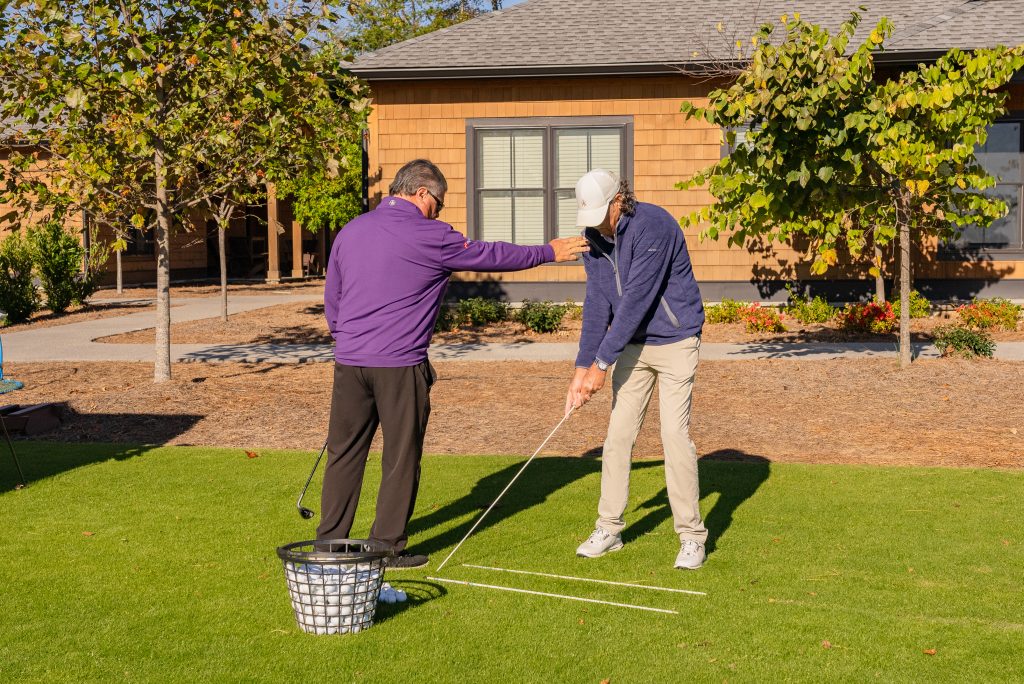
To survive the back-nine fade, follow the short-game mantra: Putt when you can, chip when you can’t putt, and pitch only as a last resort. Keeping the ball on the ground is your safest bet. Before the round, use a club on the ground to recalibrate your alignment—most amateurs aim further right than they think. Fuel up with a snack every six holes to keep your focus sharp through the 18th.

The 15-Minute “Tee-Ready” Routine

0-3 min: Dynamic torso twists and leg swings.
3-8 min: 15 balls (5 wedges, 5 “one-sided” mid-irons, 5 drivers).
8-13 min: 30-foot lag putts and 5 basic chips.
13-15 min: Check alignment on the range and grab your water.

Finally: Go get ’em this weekend! This guide is all about owning your game exactly as it is right now. Forget the stress of “perfect” form—you’ve already got the tools you need to crush it. By playing smart, staying smooth in the wind, and aiming for the heart of the green, you’re setting yourself up for a confident, low-scoring round. Trust your swing, stay fueled, and most importantly, enjoy the walk. You’ve got this!


Why Managing Your Mind is Faster Than Fixing Your Slice.

In today’s game, where every stat is tracked and every yardage is exact, the greatest threat to your score isn’t a bad swing—it’s emotional volatility. Modern sports psychology has moved away from “staying positive” toward “neutral thinking.” When you hit a ball into the water, a “positive” person tries to force a miracle on the next shot, while a “negative” person collapses. A “neutral” golfer acknowledges the situation as a factual data point and asks: “What is the smartest next move from here?”

To stay sharp over 18 holes, you must manage your “Cognitive Load.” You cannot be “on” for four hours straight. Elite players use a “Mental Dimmer Switch”: they turn their focus up to 100% when they step behind the ball for their pre-shot routine, but dial it down to 20% between shots by talking about anything other than golf. This prevents the mental fatigue that leads to “lazy” club selections or sloppy alignment on the back nine. By detaching your self-worth from the scoreboard, you allow your body to execute the swings you’ve practiced without the interference of “flight or fight” adrenaline.

“A neutral golfer views every lie as a factual data point, asking: ‘What is the smartest next move from here?'”

The Drill: The “Acceptance” Nine

The “Acceptance Nine” drill trains the brain to maintain physical composure by converting emotional reactions to poor shots into logical, pre-planned responses. By decoupling self-worth from performance, this method prevents immediate mistakes from snowballing and fosters a consistent, neutral mindset throughout the round.

The Play: Go out for 9 holes of practice. Before every shot, verbalize your “Target” and your “Miss Room” (e.g., “Target is the flag, Miss Room is anywhere left”).

The Constraint: Regardless of where the ball goes—even if you shank it into the woods—you are forbidden from reacting with anything other than a physical “reset” (like re-velcroing your glove or taking a deep breath).

The Penalty: If you slump your shoulders, swear, or toss a club, you must “penalize” yourself by playing the next hole with only three clubs of your choice.

The Goal: The objective isn’t to score well; it’s to finish 9 holes with your heart rate and body language exactly the same on the 9th green as they were on the 1st tee.

Why it works: It builds a “psychological firewall.” By forcing yourself to remain neutral, you break the neurological link between a “bad shot” and “bad emotions.” Over time, this makes you “bulletproof” under the pressure of a Sunday afternoon or a closing-hole bet.

Summary: To lower your scores, stop fighting your swing and start managing your mind. This article highlights that emotional volatility is the real scorecard killer, advocating for “neutral thinking”—treating mistakes as data rather than disasters. By utilizing a “Mental Dimmer Switch” to conserve energy between shots and practicing the “Acceptance Nine” drill, you can build a psychological firewall that prevents back-nine mental fatigue and keeps your body relaxed enough to execute the shots you’ve practiced.

Master Your Mental Game

Tired of “blow-up” holes ruining a great round? Become a Golf Tips Premium Member today to unlock elite sports psychology strategies and drills. Our exclusive content teaches you how to stay mentally sharp, maintain your composure under pressure, and play “bulletproof” golf from the first tee to the final green. Register to today at: GolfTipsMag.com.

Breaking 90

Difference Between Dumb and Stupid

I’ve been telling my son since he was 3 years old there’s a difference between dumb and stupid; stupid knows better.  Think about the mistakes you make that prohibit you from breaking through the 90-scoring barrier.  Are those mistakes because you did not know what to do? Or you knew what to do but decided to do something else? Let’s make sure you make great decisions going forward so you can’t pin the label of making a stupid mistake on yourself any longer.

  • When on a par 5 and there’s no way to hit the green in 2, LAY UP! Laying up may feel dumb but prevents you from labeling yourself stupid when you have no chance to make par from where your second shot ends up.
  • When the pin on any hole is tucked in a corner of the green that your average shot will curve away from and off the green, AIM FOR THE MIDDLE of the GREEN! Aiming at the middle is dumb but effective. Aiming at the pin is stupid if you can’t keep the ball on the green.
  • When faced with an in between yardage, TAKE MORE CLUB! You may feel like you look dumb to others doing so. But you prevent yourself from calling yourself stupid when the shot you hit with the lesser club comes up short.

Tip provided by: John Hughes, PGA Master Professional & Golf Tips Top 25 Instructor

Contact: john@johnhughesgolf.com


Breaking 90

Channel Your Passion

You can’t get better at anything without true passion. But sometimes passion can get the best of you. As you make plans to break 90 more often in 2025, let’s find ways to channel your passion in productive ways.

  • When practicing, practice with a purpose. Aimlessly hitting balls for the sake of hitting balls is not productive. Always set up a practice station. And always have a plan you’ll follow before you leave for the practice facility.
  • No round of golf is more important than another. If you’re playing in a tournament, use the extra energy and excitement to prepare the same for the tournament, as you would a casual round with your golfing buddies.
  • Sometimes your passion can put you into a “mono-focused” state. Meaning, just being passionate about one aspect of your game. Remember it takes an average amount of competence with all skills to break 90 more often

Tip provided by: John Hughes, PGA Master Professional, Golf Tips Top 25 Instructor.

Contact: john@johnhughesgolf.com


Breaking 90

Understand How Impact Feels

2025 should be the year you fall in love with your impact position. With every club. But doing so with your short and mid-irons will almost insure your break 90 more often this year.

  • Learning to create “forward shaft lean” is an essential part of creating a good impact position with your short and mid-irons. Dragging and releasing an alignment stick provides you with the feeling of your hands being in front of the ball and club at impact.
  • Placing a tee in front of the ball with the objective of hitting the tee out of the ground provides a forward shaft lean while you are placing the ball on the center of the club face.
  • Hitting shots from a downhill lie will always set you up in a great impact position. If you can learn to swing down the hill with a forward shaft lean, the ball will fly in the air and enhance your chances of repeating this position anywhere on the golf course.

Tip provided by: John Hughes, PGA Master Professional & Golf Tips Top 25 Instructor

Contact: john@johnhughesgolf.com


0
0
Your Cart
Your cart is emptyReturn to Shop