September 15, 2026

Shotmaking

Greenside Monster

Photo 1

Even to mention this shot brings many a heart faint! Of all the shots around the green, this shot seems to bring more anxiety to the average weekend golfer than almost every other shot. Why is that?

My theory from 40 years of teaching experience is that the handicap golfer fears this shot from failing to follow four fundamentals. I’m not saying this is an easy shot, but if you apply the following six steps you will improve, even become comfortable — not fearful of tackling this green side bunker shot with a high lip looming in front of you.

STEP 1

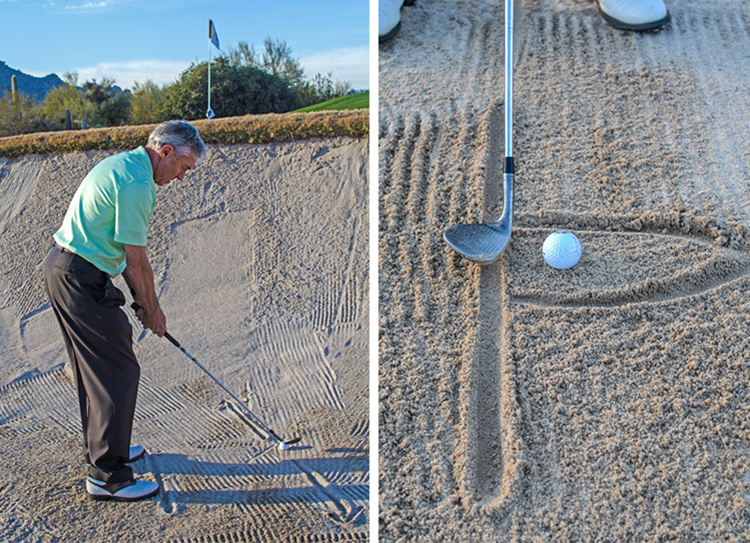
Open the face of your sand wedge. Yes, you’ve heard that before, but do you know why? To create more loft and bounce. When the face opens (Photo 1) the loft of the club increases. A standard sand wedge is 56 degrees loft. For every degree you open the face you increase the degree of loft. With this shot I am opening the face 20 degrees, so my “effective loft” is now 76 degrees. Special note here: Opening the face is not leaning the shaft backwards. For a right-handed golfer, opening the face is pointing the bottom edge 20 degrees to the right of the target line.

When you open the face you increase the bounce. Bounce is the word given to the rear, trailing edge underneath on the sole of the sand wedge. Some get confused with the flange, which is the width of the sole. Bounce is the degree of the slope of the back edge of the sole/ flange.

Greenside Monster
Photo 2

STEP 2

The ball is placed two inches forward of the middle of your stance. Although it is against the rules to draw a line in the sand before you swing, and a two-stroke penalty, visualize that line two inches behind the ball (Photos 2-3). That is where the bounce edge enters the sand and the sand divot starts there, moving forward. So, you are splashing the sand starting the divot in the middle of your stance. A shallow divot is ideal. You may have heard the cliché of a “dollar bill divot,” but it remains a good mental image of a shallow divot.

Left: Photo 4; Right: Photo 3

With the club face open to the target line or flag, open your body alignment and (Photo 4) stance the same amount — in this case 20 degrees to the target. At this point most golfers open their body too much. Only open (aiming left of target) the body the same amount that you’ve opened the face. For some students I don’t even let them open the body. It’s the club face that strikes the ball, so opening the face is the most important thing here.

Greenside Monster
Photo 5

STEP 3

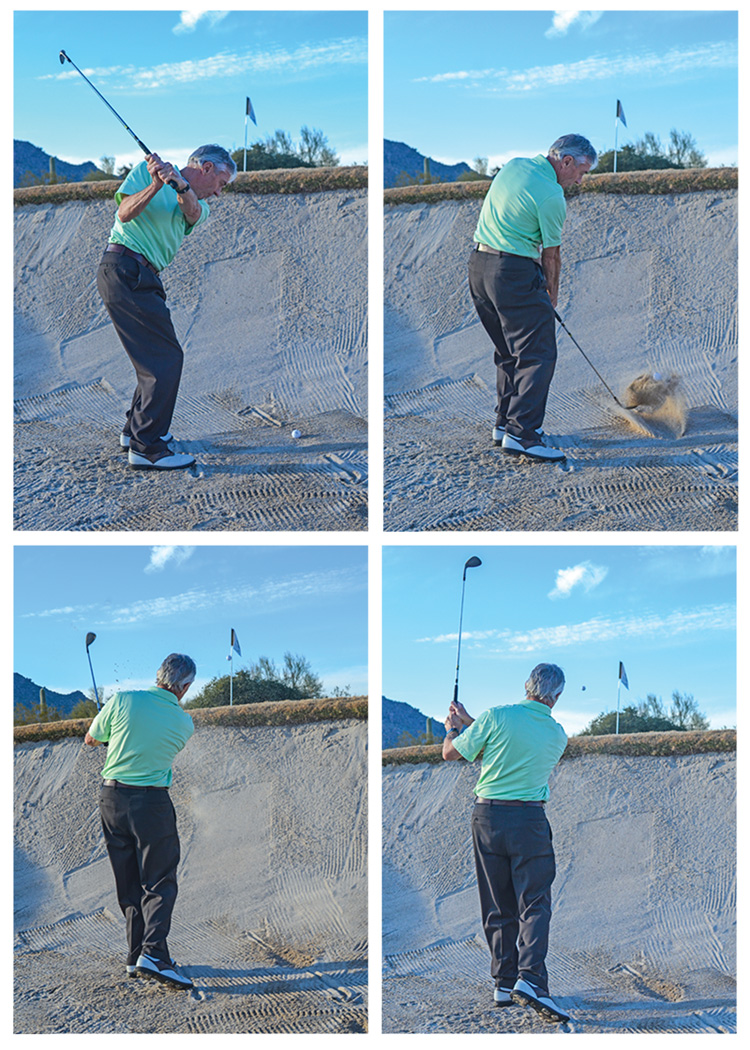
Now the next statement is a big key to success: Swing along your body line. Not at the flag, not inside, not across the ball. Swing along your body line as if you were pitching the ball from grass for a 35-yard pitch. I use this analogy to get people to make a normal swing, the length and speed you may need to pitch the ball 35 yards through the air. Notice how the club has swung up and along the body line and yes, my chest is turning (Photo 5). This shot is not “all arms, keep your body still.” No shot should be all arms!

STEP 4

Look at the club face at the top of the backswing — the face is open and the shaft is over my rear shoulder (Photo 6). We may call this a three-quarter swing as opposed to a full swing. Simple keys could be: turn your chest 69 degrees, swing hands up and opposite my rear shoulder. Again, think of a 35-yard pitch shot with a sand wedge.

Greenside Monster
Top Left: Photo 6; Top Right Photo 7; Bottom Left: Photo 8; Bottom Right: Photo 9

STEP 5

The downswing is where most poor bunker players fail. Swing back down (where you went up) along your target line, which is NOT the flag. To swing along your body line, you are swinging 20 degrees left of the target.

STEP 6

The lower body, legs and hips are so important here. Unwind and clear the hips, weight on left side. The sand divot is following along the stance/body line (Photo 7). This divot is 29 degrees left of the flag. Maintain posture and spine angle. The ball comes up and out on a cushion of sand (Photo 8).

This greenside bunker shot is the only shot in golf where your club face doesn’t make contact with the ball. The ball is forced out, like a breaking wave in the ocean, on a wave of sand. Feel to thump or splash the sand with the bounce edge of the sand wedge. Splash the sand out of the bunker and the ball will follow.

The follow through is left of target. The hips and chest are fully unwound. Weight is on the left forward foot. The club has swung through to finish over the left shoulder. (Photo 9). End result? A high soft shot up and over the lip, landing softly on the green.

One final comment here. You must keep your swing speed up. The club does not decelerate and dig the sand. The club is accelerating through the sand. Again, feel to pitch a SW shot from 35 yards and you will get the feel of the swing speed needed.

Troon North Golf Club Scottsdale, Arizona

In today’s golf climate, it seems everyone is fixated on distance. Whether it’s off a tee with a driver or from the fairway with a wood or an iron, we’ve become obsessed with hitting the ball farther and not so much on hitting more fairways and greens. That’s not always a good thing, especially if you play target golf on layouts like the one you see here at my home club, Troon North Golf Club in Scottsdale, Arizona. Here, distance helps, but as you can see, there isn’t much room for shots that veer too far offline. The course is designed more as a series of targets to land the ball on, not so much a course where the fairway unrolls all to the green.

Let’s take a look at a handful of shots that not only will help you better navigate target-style golf courses, but will make you a more accurate player no matter where you choose to play.

HIT YOUR DRIVES HIGHER

Ball Forward

Playing target-style golf doesn’t always mean you have to scale back on distance. In fact, sometimes hitting the ball higher not only makes you more accurate, it can help you hit the ball farther, as well. To launch the ball higher so it lands more softly and with less roll, set up with the ball a little more forward in your stance. This will help you hit up on the ball for a higher launch. Also, widen your stance. This will keep you from hitting the ball too much over your left side and, again, get the ball launched higher in the air.

Add More Tilt

Don’t get me wrong, there are some instances where lessening your shoulder tilt can help you. But come time to launch some big bombs high into the air, it’s best to hit the ball with some added shoulder tilt. By that, I mean lowering the right shoulder. Now, before you go do this on your own, notice how I’m adding tilt not by artificially raising my left shoulder, but by tilting more from the base of my spine and adding tilt without adjusting my shoulders. The last thing you want to do is fake some extra shoulder tilt by raising the left shoulder and keeping your core relatively vertical. To do it right, add tilt to your shoulders by bending to the right with the lower spine, not the shoulders or neck.


Lay a club across your shoulders and add tilt from tilting at the hip, not by raising your left shoulder.


Another great way to hit the ball higher is to hit the ball more toward the top of the clubface. The top region, once dubbed “the hot spot,” is where the clubface deflects, loft is added and spin is reduced, all at the same time. You may lose some ball speed here, but the net effect of less spin and a higher launch sometimes can lead to more distance than you would have had hitting it dead-center in the driver’s sweet spot.

So consider adding some height to your tee, and it’s okay to hit the ball more toward the top of the face. If you hit lower on the clubface, generally this means you’ll create more backspin, which despite what you may think, actually can cause your drives to fly more errantly. The simple reason is, all shots have backspin, and when you hit a slice or hook, that slice-spin and hook-spin is actually backspin on a tilt. So unless you hit the ball dead-straight all the time, adding backspin actually can make your slices and hooks bigger. When in doubt, opt for less spin for more accuracy off the tee with a driver and make contact higher on the clubface.


CONFIDENCE!

Let ’Er Rip

Are you the type of player who hits straight drives on wide-open courses, but struggles with accuracy on tighter, narrow courses? Odds are, you make faster, more confident swings when there’s less danger to contend with, and you punish more fairways when the course is free and wide. If this sounds like you, play every hole as though it’s wide open! Don’t tense up and worry because there’s trouble left or right. A constricted swing is usually an out-of-sync swing that rarely hits the ball straight. Instead, swing aggressively and imagine a huge fairway. You’ll find that a confident swing is more accurate than a swing where you’re trying to steer the golf ball.

rake it up photo montage

If there’s one shot in golf that golfers unnecessarily struggle with, it has to be the simple bunker shot. Hitting a bunker shot is the only shot in golf where it’s okay to miss the ball, meaning it actually requires less precision than a standard shot. So, as you would guess, it’s all in the technique, which makes this drill I call “Rake It Up” so valuable.

REMEMBER THE BOUNCE

To improve your sand play, first understand how the club is designed to interact with the sand. Most sand wedges have an element called “bounce,” which is the angle of the leading edge and trailing edge of the sole. In simple terms, “bounce” actually does as the name implies. It helps the wedge bounce off the sand and prevents it from getting stuck. To develop how to take advantage of your wedge’s bounce and how to feel the proper sensation for the bunker shot, consider making a few practice swings on top of the rake in the sand that’s pointing directly at your target. (Obviously, this is a practice drill; you can’t do this in competition.) Take a few light swings and get the sole of your wedge to start bouncing off the rake. As you do this, you may actually see the rake lift off the sand. This is the feeling you want to have as the club passes through the sand and helps lift the ball into the air. (By the way, don’t break the rake!) As you practice this drill, keep swinging along the rake at the target.

IT’S A V-SHAPED MOVE

Secondly, think of the bunker swing as a V shape, not a U shape. This means you want to steepen both your backswing and your downswing by adding some extra hinge in the wrists. As you add some extra hinge, keep your lower body quiet and favor your left side. The key is to limit your lower body movement, which will both help speed up the upper body and add some steepness to your swing arc.

BE OPEN ABOUT IT

Third, open the face of the wedge before you grip it (don’t twist your hands) and experiment with how much works best for you. Some players like square clubfaces; other prefer hitting shots with the face wide open. The key to remember is that even with an open face, you want to swing the club directly at the target. Don’t worry so much about where the clubface is aiming. Even if it’s open to the right, I want you to swing the club directly “along the rake,” that is, I like to imagine there’s a rake below the ball and I need to swing the club directly along that rake. Allow the hands
to release, too. Don’t feel as though you need to hold that clubface open through the entire shot.

Lastly, as you make a bunker swing, remember the sensation you developed while practicing with the rake. You want to clip the sand before the ball and actually use the bounce of the wedge to bounce the wedge off the sand. Now, practicing with the rake helps you really feel the sensation of bouncing the sole off the handle, but in
the sand there will be a lot more friction to deal with, so swing with extra speed and momentum, and hit no deeper than an inch or so into the sand. The finish position that indicates a good bunker shot always has a full rotation of the upper body, with the hands low in front of the chest. Hone in on these quick pointers, and you’ll find that bunker shots are a lot easier than you first thought. Bounce your wedge off the rake!

Charlotta Sorenstam is a former LPGA Tour player and now a teacher based in Orlando, Florida.


Let’s face it.
The driver used to be placed off the deck a lot more often than it is now. Older drivers not only tended to be smaller, but they also had more loft, which helped golfers get the ball up in the air off the ground a little easier. Also, with the advent of today’s fairwood technology, it’s safe to assume that some of today’s fairway woods are longer than the drivers of as little as 10-15 years ago. That said, hitting a driver off the deck can still be a useful shot, if you know when and how to play it.

Before you decide to hit the driver from the fairway, make sure you have a good even lie (and please, don’t try it from the rough). Second, don’t position the ball quite as far as you normally would with a tee in the ground. Back up the ball to about where you play your fairway woods. Now’s when trusting it comes into play. Too many amateurs try to add loft to the driver by hanging and trying to hit up on the ball. This not only will rarely work, but also can lead to really fat or thin shots. Instead, trust that the design of your driver will do its job. Most driver heads are designed to impart more spin on the ball when struck on the lower half of the clubface. So don’t try to lift up on it. Make a smooth, level swing with the driver and let the club do the work!

Try this a few times out on the range before you put this shot in play. The typical ballflight with this shot is a low fade, so plan accordingly on the golf course. You’ll soon see that the driver off the deck is a great shot for keeping the ball low and out of the wind, all while flying a long way. Stay level and finish on your forward side.

Jeff Johnson teaches at Ojai Valley Inn & Spa in Ojai, California. For more information, visit ojairesort.com.

THE SWEET SPOT

Today’s drivers have the biggest clubfaces ever. No really, they’ve never been this big, making it easier for more types of players to hit longer and straighter drives. But what’s really going on with big faces? Does the sweet spot actually get bigger?

The answer is no. A driver (or any other club for the matter) has a sweet spot located at the precise intersection of the vertical center of gravity and the horizontal center of gravity. What’s referred to as a sweet spot should more appropriately be called a sweet point, since it’s actually a mere intersection point of two axes of gravity.

When equipment manufacturers refer to a driver as having a bigger or enlarged sweet spot, what they’re really saying is the area around the sweet spot has become more forgiving, which in some cases, produces little to no loss of distance or accuracy when contact with the ball is slightly off the sweet spot.

That’s not to say missing the sweet spot is always a bad thing. Some better players intentionally make contact above the sweet spot, which not only increases the launch angle and lessens ball speed a bit, but also reduces spin for a more bor-ing ballflight. On the other hand, hitting below the sweet spot will produce drives with added backspin, which helps when hitting drives off the ground.
–Staff Report


Hybrid clubs are incredibly useful, so long as you know how to swing one. You’d be surprised at how many golfers come to me with hopes of making use of these versatile clubs, often with no clue of how–or of what the hybrid was designed to do in the first place.

To clear up misconceptions about hybrids, as well as how to swing one, let’s look at what hybrids are designed to do. In most cases, hybrids are designed not as fairway-wood replacements but as long-iron replacements. This isn’t the case across the board, but to know for certain, check out the design of your hybrid. If it looks more like a wood, then it’s better suited for a wood-like swing. There aren’t many hybrids like that; most hybrids on the market have iron-like features, meaning these babies are better suited to swing like an iron. That’s what this quick primer is about.

BALL Position: Use your 3- or 4-iron as a guide

SETUP

For starters, let’s get your address position corrected. The right ball position for your hybrid is just a smidge forward of your 3- or 4-iron. The goal is to position the ball just in front of the lowest point of your swing arc. And by in front of the lowest point, I mean you want to hit down on the ball with your hybrid. It’s not made to scoop! Second, the distance from you and the golf ball should change. This means moving away from the ball, about an inch or so. To get more specific, check your hybrid’s length with your long iron. If it’s an inch longer, then stand an inch farther from the ball.

 
Hybrid Iron Or Wood?

What is a hybrid, exactly? Most hybrids are designed to be replacement clubs for those hard-to-hit long irons, but that’s not true with all models. The easiest way to determine if your hybrids require more of a wood-like swing or an iron-like swing is to check the design of the face. If the face looks like an iron, then it’s meant to be swung more like an iron. If it has a more rounded profile and looks more like a wood, the club might perform better for you if you have a slightly shallower angle of attack. Now be careful, no matter what, a hybrid is not a fairway wood, and in most cases, your steeper iron swing will prevail. But if you have hybrids that look more like woods, don’t be afraid to make a lower and longer golf swing.
–Staff Report


PLANE

Hybrids are longer than irons, but, generally, they’re shorter than your fairway woods. That means the plane of your hybrid swing also should be somewhere in between your irons and woods. By how much you ask? Again, not much. In fact, if you follow my advice in the setup, being farther away from the ball will make your swing a little flatter naturally. So don’t force a swing plane to happen. If you swing the club like an iron and move the ball forward and away from your body, the slightly flatter plane will take care of itself.

DON’T LIFT AT IMPACT

Just as you would with a long iron, hitting a hybrid effectively means hitting down onto the golf ball, and making a full extension through the hit. In case you were also wondering, it’s perfectly acceptable (in fact, it’s encouraged) to make a divot with your hybrid shots. Follow these steps–hit your hybrids like a long iron, and you’ll be on your way to making the most out of them.

Frank O’Connell, PGA, teaches at We-Ko-Pa Golf Club near Scottsdale, Ariz. For more information, visit wekopa.com.

8 Tricks To Become A Better Player

Editor’s Note: This story was updated May 10, 2017 — Serious golfers love to work on the fundamentals of the swing and stroke, which leads to “automatic” improvement that you really don’t need to think about — until your move gets out of sorts (and it will, even for the best players). But beyond the basics are valuable tips that deal with aim, club selection, course management … all those nuances that add up to a more complete golf package. I call them 8 tricks to become a better player, and I’m happy to share them with you here.

8 Tricks To Become A Better Player

TRICK 1: Align The Clubface

One of the most common mistakes amateurs make is improper alignment. Some think they should align their feet at the target, others try to get their shoulders parallel to it. Hey, some golfers try to align everything at the target! They’re all wrong.

The correct way to align your shots is to always begin by first assessing your target from behind the ball. This will give you a perspective of the entire hole and help you aim right where you want the ball to go. Secondly, before you make your actual stance, set the clubface behind the golf ball and align it directly at the target. Do this before, not after, you get into your stance. PGA Tour players have a knack for aligning the clubhead in this fashion. Pay attention to how they do it the next time you tune in.

8 Tricks To Become A Better Player

After you have the right clubface alignment, then comes time to situate the rest of your body. Most players benefit from aligning their lower body left of the target line and their upper body parallel to the target line. There’s actually no right answer as to what works best for you, but one thing is for sure. Aligning your body directly at the target rarely works. It usually leads to crossovers and over-the-top swings. Keep your body aiming left of the target line, and experiment with what works best for you. But be sure to align that clubface first!

CASE #1: Your ball comes to rest on the wrong side of a tree/bush.

I can’t go at this shot right-handed because the cactus impedes my stance. But I can get the ball back in play by playing a left-handed shot. Here’s how to do it:

First, take one of your lofted clubs and flip it over so you expose the toe of the club as your contact area. Take a left-handed grip and lean the shaft forward. This gets the clubface aimed squarely.

Next, make a few practice swings to get a feel for the swing and your club control. (When you do this, it’s vital to make sure you consistently hit the ground.)

Then, simply try to stay in balance, make a controlled swing and commit to swinging down into the impact zone. In this situation, I advanced the ball about 40 yards back into the fairway.

CASE #2: You stripe your ball down the middle, but your ball ends up in a divot.

To play this shot, make sure you catch the ball first, then the dirt.

To do this, set up with your weight leaning toward the target, much as you would for a punch or chip shot. As you take the club back, try to keep it going back on plane or even slightly outside. (If your club shaft is slightly steep, you may hit down too much, and the club will bottom out in front of the ball.)

As you swing into and through impact, it’s imperative that you keep your body and club moving forward. You should hit the ball first, then the ground in front of the ball. Because of the adjustments you’ve made, it’ll come out with a little lower-than-normal ballflight.


CASE #3: Your ball plugs in a bunker’s lip and it compromises your stance.

The trick here is to get into a setup position that allows you to successfully escape a tough lie from the kitty litter.

If both of my feet were in the bunker, it’d be hard to stay balanced when I swing, so I place my left foot outside, on the grass. Now, my left foot is higher than my right, so I need to make sure my shoulders are in a similar position (left shoulder high, right shoulder low). This puts me in a severe uphill lie stance that’ll help me get the ball over the bunker’s lip.

As you can see, I’ve chosen to set up with my clubface square because the ball is slightly buried, and this will allow the club to dig the ball out. I need to make an aggressive swing through impact and not worry about hitting the lip on my followthrough. If executed well, the ball will come out high, hit the green and roll slightly.

CASE #4: Your ball is on the fringe, but a sprinkler head is on the target line.

I would love to just putt this ball to the hole, but unfortunately the sprinkler head has gotten in the way.

If you find yourself in this situation, you need to get the ball airborne, but instead of hitting a chip or pitch that might spin, try the so-called off-green putt instead. What’s an off-green putt you ask? It’s a shot where you use a lofted club with a putting technique. The ball will have just enough airtime to get over the sprinkler but will then roll like a putt.

I’ve chosen a pitching wedge in this case, and set up with my putting grip and stance (notice how I shorten the club to putter length so my eyes are right over the ball at setup). Then it’s just a matter of making a normal putting stroke. Do that and the ball will pop up over the trouble and roll to the target.

BUMP & RUN

CASE #5: Your ball rolls off the edge of the green and goes 10 yards down a hill.

you think you’ve hit a perfect shot, only to find out that it doesn’t stay on the green. In this photo, you can see the ball careened down a hill. I can play it two ways: I can go low and play a bump-and-run, or I can go high with a flop shot.

To play a bump-and-run, set up with your weight leaning toward the target. Lean the shaft forward and make a chipping motion. Notice how I finish with the clubhead low? That’s a good thing. The ball should come out low, bounce along the ground and run up the hill.

FLOP SHOT

To play a high flop shot, set up with your weight more balanced and the ball forward in your stance. Make a bigger swing and let the clubhead pass your hands through impact. You still need to clip the grass underneath the ball, but keep in mind that this swing uses the wrists much more than any shot.

Notice how the clubface looks at the sky in my finish and I’ve exposed all the loft of the club through impact to elevate the ball.
|
Steve Dahlby, PGA, is the director of instruction at The Golf Club Scottsdale and Forest Highlands Golf Club. He has taught numerous Tour players.

One of the great things about the game of golf is that, on occasion, all of us, even the highest handicapper, will hit a shot like a pro. It might be a well-struck drive, hitting a par-5 in two or holing out a bunker shot. Whatever the case, once in a while, the stars align, and for a brief moment, we pull off a Tour-quality shot.

Having been around Tour pros for many years, I can tell you that one thing is certain, however: There are things they consistently do on the golf course that you and I can’t. That’s why they’re the game’s greatest.

And yet, of course, you’re an expert in your respective field. Whether you’re a doctor, a chef or a real estate agent, in your work, you’re a Tour pro. There are things you know that most of us don’t.

Like you, Tour pros are good at their jobs, and there are shots they hit that we can’t always pull off when we play. That’s reality. But let’s look at what they do well and try to learn from them so we can improve our games.

…hit it 300 yards on a rope consistently

To crush it, you must use all your power sources (correct wrist action, a controlled arm swing and a full body pivot) effectively.

Start your downswing by uncoiling your lower body first so your club swings around your body on plane. This will help you hit it in the center of the clubface and help you square the club at impact.

…control your distance with all clubs

Tour pros know not only how far they hit each of their clubs, but also the distance gaps between them. The key, though, is how they fill the gaps between each club: by adjusting the length and speed of their swings. This ability to dial in shots helps Tour players make tons of birdies.

To shrink your distance gaps, work on making half and three-quarter swings. You’ll find that the distances the ball travels and the trajectory you have with different-length swings will help you control your distances much better.


…spin the ball on command

When you see the pros hit the ball past the flag and then zip it back to the pin, it doesn’t happen because they got lucky.

Tour pros are great at making perfect contact with a descending blow into the ball, plus they use the right equipment. To spin your shots like a pro, use a soft-covered ball, keep your grooves sharp and make solid contact. Hitting into perfect turf on great greens doesn’t hurt either.

…curve the ball on command

If you want to move the ball from right to left, I suggest you strengthen your grip slightly at setup (see photograph at right). Turn both hands to the right a few degrees. The Vs created by your thumbs and forefingers should now be pointing toward your right shoulder. This stronger grip will encourage you to rotate your hands and wrists over through impact (see photograph at left), which will place a draw or hook spin on the ball and make it curve from right to left (for a right-handed player). If you’re a lefty, do the opposite.

To hit the ball from left to right, weaken your grip slightly. Turn both hands a few degrees to the left so that the Vs are pointing more toward your chin (see photo at left). This helps your hands and wrists hold off the club and keep the face open at impact (see photo at right). As a result, the ball will move from left to right. Make sure both hands match! For a slice, they both should rotate to your left; for a draw, they both should rotate to the right. This will help your hands and wrists work together.

…get out of trouble like Houdini

In the photo at left, you can see I’m stymied. Should I start the ball way left and slice it? Should I hit it over the tree? Can I fit it through the gap between the branches?

SLICE

Here’s how to hit all three:
To slice it, take a less lofted club (this will help you curve it), weaken your grip slightly and aim safely to the left to get the ball started away from the trouble. Try to actually swing down from outside to inside the target line and make sure to hold the clubface open at impact. Here, the ball started left of the tree, and I curved it 30 yards.

To hit the high shot, play the ball a bit forward in your stance and keep your head well back of the ball at impact. Make sure you hit the turf and don’t flip your wrists at impact. In both photos, notice how low my right shoulder is. I’m definitely behind the ball, and that produces a high ballflight.

HIGH LAUNCH
PUNCH THROUGH

To punch the ball (here, through the gap between the rocks and the large branch), lean your weight slightly forward and commit to making a swing down into the turf to promote a low ballflight. Here I hit an 8-iron, played the ball slightly back in my stance and made sure the hands stayed in front of the clubhead as I struck the turf.


…lag it close from anywhere

Learning to lag putts close is a great way to save shots during your round. There’s a stat on Tour called 3 Putt Avoidance, and trust me, nobody wants to be near the bottom of it.

If you’re going to be a good distance putter, I believe you need to do two things very well. First, you need to be a good green reader. As you approach the green and survey your putt, look for high and low points in the green complex. Imagine where water would flow if it were dumped on the green. Remember, all greens are built for drainage, so look for those spots, and they’ll tell you where your ball is going.

The second (and most crucial element), however, is distance control. It doesn’t matter how well you read your putt if you leave it 15 feet short. In the photo at left, I’m faced with an uphill putt over a small tier. It also appears as if the ball is going to move a little from left to right. To make sure I get the ball to the hole on this uphill putt, I visualize a pin 10 feet past the hole so I can make sure I hit my putt with enough pace.

…make it all day from 3 to 6 feet

The key to making tons of short putts is to develop a consistent putting stroke. In my opinion, the simplest type of stroke should give you the best chance to make those so-called 3-6 foot knee knockers.

Here you can see I’m working with a training aid made by Momentus called the Inside Down the Line Putting Track to help me groove a stroke. You can use either this type of aid or any other tracks that help you get the feeling of what a good putting stroke should feel like.

One thing to remember while practicing either with or without a training aid: Tour pros work incredibly hard on these putts, and while it’s not as much fun as hitting drivers on the practice range, the time you put in on the green will pay big dividends on the course.

…chip it off the tightest lies

For many players, tight lies are the kiss of death. When the grass is really closely mown, you need to trust that your technique will give you perfect contact (remember you always want to hit the ball first, then the turf), or all sorts of things can happen: fat contact, skulled shots across the green or, worse yet, the chip yips. When we watch Tour pros play these shots, they don’t seem like that big a deal, but they are.

Don’t tell your greenskeeper (or mine), but a great way to gain confidence when playing off tight grass is to hit a couple chips off the practice green. To begin, first lay a club down a couple feet in front of your ball. The goal is to hit the ball over the club. If you aren’t confident with this shot, you’ll probably try to lift the ball, your wrists will flip, and the ball will skid into the club (see below right).

YES
NO

If your technique is good (see below left), however, you can make a confident stroke, pick the ball right off the green and control its trajectory, distance and spin. To do this, make a small swing with your weight leaned slightly forward before and throughout the swing. Wrist action is the enemy in this shot, so keep the left wrist flat at impact, and good contact will occur.


…Perform at the highest level in front of spectators

Part of a Tour pro’s job is to play in front of large crowds while television cameras and thousands (at times millions) are trained on his or her every move.

Although professionals do get nervous during tournaments, the consistency they have in their games (and the confidence that breeds) allows them to focus on the shot at hand and continue to pull off great shots. They’re no different than elite athletes in any other sport.

Great athletes are so mentally tough and focused that they can (most of the time) put all the outside elements aside and focus on their jobs.

Keep in mind, if you feel nervous while playing, that’s a good thing. It means you’re playing well, and the more often you play well, the easier it’ll get to play under pressure. Embrace your nervousness and let it help you play your best.

…average under 70 for a year on the world’s most difficult courses

Tour pros’ games are rarely satisfied with the state of their games. That’s one of the reasons why they work so hard at improving. The time they put into their games pays off too: They hit long, straight drives and controlled approach shots and have accurate short games. It’s easy to see why the world’s best players average under 70.

While you may not play as well as Tour players, take a close look at your game to identify areas that need the most work. Then set some goals as to how best to improve your game. With quality practice, you’re sure to get better.

Steve Dahlby, PGA, is the director of instruction at The Golf Club Scottsdale and Forest Highlands Golf Club. He has taught numerous Tour players.


Editor’s Note: Back in 2009, PGA Tour veteran Kevin Streelman was just making his mark on the big circuit, and a decade later he’s still going strong, posting Top 20 finishes and keeping himself in the hunt week to week. He put together this Practice Like a Pro feature exclusively for Golf Tips readers. Enjoy.

1. FOCUS ON THE TARGET…ALWAYS

If you want to play like a pro, you have to practice like one. In the following pages, I’ll show you how I practice and the things that help me fine-tune my game, so come time to compete, I don’t have to worry about my swing. Instead, I can play shot-by-shot and concentrate on lowering my score.

To get started, when you practice, always do so with a target in mind for every shot. After all, why hit balls if you don’t aim? Think of a target and don’t forget it.

2. GET BEHIND AND SET UP

When I see amateurs hit shots, I notice many don’t have the right pre-shot sequence. So try this. First, take your grip behind the ball while facing the target. I like to do this so I can focus more on alignment, and not worry about my hands. I pick my target, make my grip and I don’t readjust it. Once it’s on there, it’s on for good.

While still fixated on the target, I approach the ball from the side. This helps me see the target and align my body considerably to the left of the target (as evident by my orange stick to the side of the ball). I don’t step directly into position just yet. I’m still zoned in on the target, and the club is held out in front of me. I’m ready to go.

My eyes have moved off the target, and I’m looking at the ball. I also track my eyes across the orange stick representing my target line. Then, I step into my stance from the side, not from behind or at an angle. This helps me align my body more squarely, with the clubface aiming at the target and my body situated parallel to the left.

Now I’m ready to strike. My stance is squared, I have a mental picture of the target in my mind, and my eyes stay glued to the ball throughout my swing. I may peek at the target, and if it doesn’t feel right, I start all over again. Your preshot routine and alignment is critical if you want to compete out here on the PGA Tour.


OLD SCHOOL

NEW SCHOOL

The Tour pros I teach have altered their swings over the past few years to better match the latest equipment, advances in physical conditioning and varying course conditions.

As a result, not only have their swings become more efficient, but they’ve added a lot of new shots to their game, as well. These trends aren’t just for Tour pros, however. They’re for you, too.

1. SQUARE UP IN THE BUNKER
Players used to hit this shot by opening their stance and swinging with an open clubface, on an outside-in swing path . But it often caused them to come down steeply, take a deep divot and lose control.

Now, players set up more square, squat down a bit and stand farther away from the ball so their swing is more rounded.

As a result, the divot is thinner and the club slides through the sand.

This helps control trajectory, distance and spin much better than the old-school bunker swing.


Old School

New School

2. DON’T FLIP, JUST TURN AND RIP
Here I’m using a bucket of balls to help illustrate how to (and how not to) release the club. On the left, I’m releasing the club with my hands. Note how the balls spilled? This is an old-school arms-and-hand swing that relied on timing, hitting lots of balls and grooving your release.

These days, players use their body to release and control the clubface. Instead of rotating their hands, they turn their body aggressively through the ball and keep their hands quiet through impact (note how the balls don’t spill in the photo at left).

Why are they doing this? Good technology and better physical conditioning (in particular, core strength) mean that players can utilize their larger muscles more efficiently.


TOUR TIP
Check out Zach Johnson’s followthrough at Justin Timberlake’s tournament last year. He hasn’t released his hands at all, but he turned his body completely through the shot. That ball nearly landed in the hole.

EQUIP TIP
I use a Titleist Vokey 56_¡ sand wedge to help me get up and down from 100 yards and in. Here’s a photo of Bob Vokey’s latest design, the Spin MilledTour Chrome. Its lofts range from 48_¡ to 64_¡. Depending on the type of course you play (and what other clubs you need), I suggest carrying anywhere from two to four wedges.


3. DRAW YOUR PITCH SHOTS
Used to be that when you hit a pitch shot, you cut across the ball with an open face. While that still works, if the pin is in the middle or back of the green, or if you’re hitting into the wind, you have to hit your shot on a lower trajectory.

To do this, make a more rounded swing. This promotes more release so your shot draws and doesn’t spin as much, and it releases when it hits the green. An easy way to practice this is to tee up your pitch shots to get the feel of letting the club work more around your body.

4. DON’T GET STUCK
If Tour players have one fault, it’s that they get stuck with their hands and club behind their body on the downswing. To prevent this, they make sure their upper and lower bodies are in sequence.

Practice this by placing a shaft in the ground behind you at a 45-degree angle. Swing down with the club on top of the shaft in a position where you can just turn through and swing left. Don’t let your club swing to the inside of the shaft!

5. SWING EFFICIENTLY
Tour players used to move off the ball, but today most players are working on staying more centered during their swings. By staying centered over the ball, players don’t have to time their swings to compensate when they sway or slide.

Although I don’t suggest you swing with a reverse pivot, I do like to see less movement than swings of the past had.

To stay centered on your backswing, place your golf bag against your right side and make a swing. If you run into it on the backswing, you slid too much. If not, you stayed centered and are in a position to turn back and load your body for efficient power!


Equipment Trends On Tour
By Charlie Schroeder

You might be surprised to learn that some Tour pros don’t know how their equipment works. But Mike Helfrich, COO of Hot Stix Golf, says that may be changing. The next generation of Tour players are more in tune with technology. They’ll try things to minimize bad shots.

One way Tour pros improve their ballflight is to use premium shafts. The clubhead gives them the look and feel they want, but it’s the shaft that gives them the desired ballflight. Helfrich says players use lower-torque shafts to keep the clubhead from snapping closed, and higher-torque shafts to keep the clubhead from opening.

Another piece of equipment Tour players constantly fine-tune is their wedges. Tour pros change wedges more often to keep their grooves sharp, Helfrich says, noting that Vijay Singh has been known to switch out his wedge every week.

Helfrich notes that recent improvements in ball composition don’t benefit just Tiger, et al. Balls like the Bridgestone B330-RX are geared for swing speeds under 105 mph, and using the right one can really help slower swingers.

Of course, it helps everyone to be properly fitted, and as Helfrich says, once you find your perfect setup, there’s probably not a lot of need for adjustment.

0
0
Your Cart
Your cart is emptyReturn to Shop