The long putter should be about 43 to 50 inches. The putter length may vary to one’s height, but if the putter is too long one can easily adjust by lowering the top hand to a desired position determined by practice and experimentation. The top hand can be placed near the right shoulder to give a perpendicular shaft, or more to the center of the body. Wherever it is placed, it must not move during the stroke, as it is the center of the swing. If the center moves, then the swing arc will also change, and that’s not good.
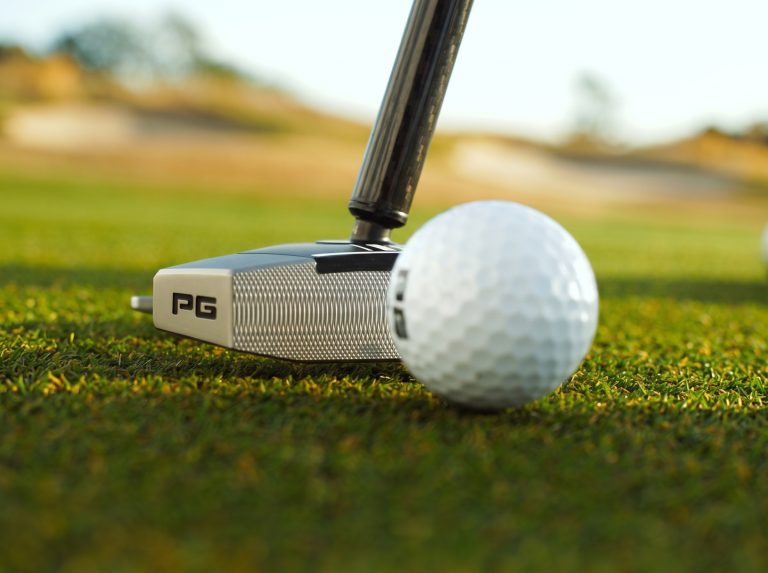
The Rules of Golf state that the shaft of the putter must have a 10-degree lie. If the head of the putter is longer than three and a half inches, the toe of the putter may dig into the green if the shaft is perpendicular to the ground with the top hand at the right shoulder. If the top hand is near the center of the body then the putter blade will usually be flat on the green.
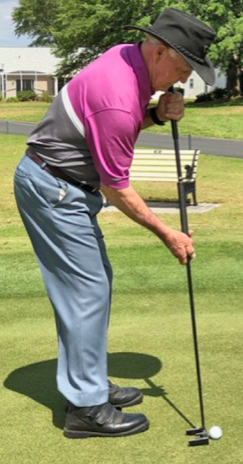
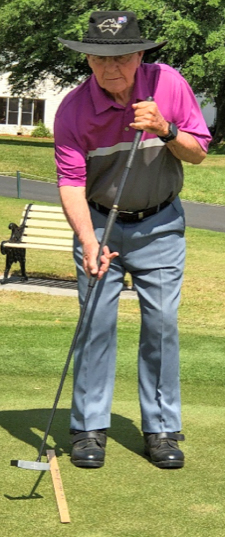
You will notice that I held the top of the putter to about my left shoulder, ball to the side of my right foot, faced the hole and then pulled my right elbow/arm back and then forward through the ball in a swinging motion like tossing a penny.
Only my right arm moves while the rest of my body remains motionless. This is important for accuracy. The right arm swing is smooth and not jerky. It is a pull back and push through. Keep it simple.
As I experimented, I moved the end of the putter to my right side so that the putter was vertical. Fortunately, the putter blade was not long (3 ½ inches) so the toe did not dig into the ground. I balanced more on my right leg for balance and to put my eyes over the ball.
In the standard putting stroke, facing the ball, we swing the arms back and then forward to stroke the ball. This is a natural swinging motion of the swing path moving in an arc around the body. The ball must be positioned in the correct placement of the circular swing pattern or the ball will go left or right of the hole or target.
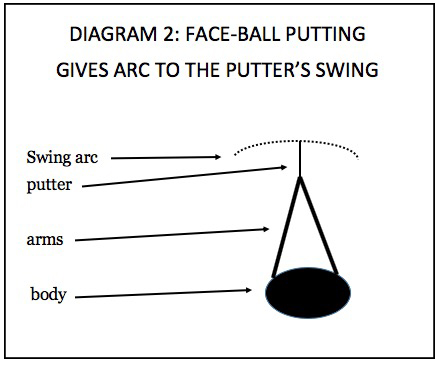 In face-the-ball, the putter moves in an arc, though his is sometimes not accurate. Notice in Photo 4 how the putter head moves away from a straight line to the target during the backswing.
To counter this circular swing arc, we practice moving the putter head back and forward in a straight line. Sometimes this works but is often inconsistent as the swing is not natural. We have a thousand putting aids to help us learn to swing in a straight line but often this does it hold up under pressure.
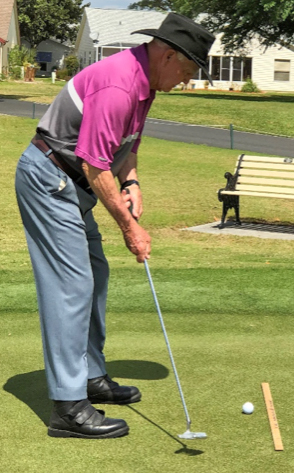
Face-the-target putting makes it easy to pull the putter straight back and then straight forward to the target, much like tossing pennies or horseshoes. Pulled and pushed putts are now easily eliminated. This would be like facing the target and then rolling the ball to the target.
Try this experiment. Pick a target and with a ball in your hand, roll the ball to the target. Do this several times and notice how much arm swing back and forth you used. Now repeat the drill to a target at a different distance. In a short time, you will notice how far back and forward the arm moved to achieve the various distances. When putting with the putter, use the same arm length swing for various distances. One of my golf pro students did this arm swing without a ball to get the feel of distance control every time he was to putt. He qualified for the U.S. Open.
Here is another concept for distance control. Now that you have some feel, practice putting with a three-inch backswing, three-inch backswing, nine-inch backswing, etc. Some have found that a putt will roll two feet for every inch of backswing. Some have found three feet for every inch of backswing. The author has found one inch of backswing equal to one walking pace. This is easy as one can quickly pace their distance to the hole. In longer putts just go half way or one-third of the way and then just double or triple the distance.
This may help: Measure the length of your putter head and use this as a ruler to measure your backswing length. If your putter head is four inches then you can easily mark off visual increments of four, eight, 12 inches of backswing length.